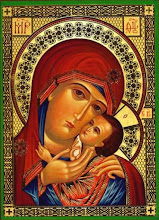
Q: Excuse me, did I just hear the priest say "most holy Theotokos save us"? Please explain how that is not blatantly contrary to Scripture, since "no one comes to the Father, except through" Jesus, (Jn 14.6), who came to "save that which was lost" (Matt 18.11), and since "there is no other name under heaven given among men, whereby we must be saved (Acts 4.12). Calling upon Mary to "save us" is in direct opposition to the teachings of the Bible!
A: Yeah, that freaked me out the first time I heard it, too. It was at the very first Vespers service that I attended at a local Greek parish, and I thought, "This could be the deal-breaker." It bothered me so much that I confronted the priest afterwards.
He admitted that it is a difficult thing for a Protestant to hear, and that it troubled him the first time he heard it, too (he was a convert from Pentecostalism). He explained to my satisfaction why this phrase is not improper or contrary to biblical teaching, but it is still a little uncomfortable for me to heard it, even now, especially having come from a faith tradition in which Mary is little more than an afterthought. I suppose it just takes some getting used to.
So, is the statement "Theotokos, save us" really attributing to Mary something that should only be attributed to God? Is this usurping the work of Christ? It seems to, but rest assured that Orthodox Christians
do not believe for one second that Mary died on the cross for our sins, or that she rose from the dead, or that she is seated at the right hand of the Father, etc. Any Orthodox Christian will tell you that it was
Christ and Him alone "
who for us men and for our salvation came down from the heavens." The prayers and hymns and writings of the Orthodox Church testify again and again to this foundational, non-negotiable truth.
Well, then if the Bible says, and the Orthodox believe, that there is
no other name whereby we must be saved, isn't the statement in question plainly contrary to both? It would appear so, but if this sort of language were truly contrary to biblical teaching then we would, of course, expect no similar use of the word "save" in Scripture, except in reference to the direct work of God. Right?
However, we read in the Bible that St Paul hopes to
save the Jews through his example (
Rom 11.14), and that he believes that by being "all things to all men" he may
save some (
1Co 9.22). He also tells husbands and wives that they are able to
save each other (
1Co 7.16), and says that he himself was
saved through the prayer of the Philippians (
Php 1.19).
Paul later tells his protégé Timothy that he can
save himself and others by his adherence to doctrine (
1Ti 4.16), and that a woman can be
saved by bearing and raising a faithful Christian (
2.15).
St Peter is said to be able to
save entire households merely by his words (
Acts 11.14), and St Jude instructs us to
save people with fear (
Jude 1.23). St James tells us that prayer can
save the sick (
Jam 5.15), and that when we convert a sinner, we
save a soul and "cover a multitude of sins" (
v.20).
Clearly it's not contrary to biblical teaching to believe that we have a role in the salvation of others. We don't save them by dying on the cross, of course, but by preaching the Gospel, by prayer, by being a good example. It's worth mentioning at this point that the Orthodox do not believe, as their Protestant brethren do, that salvation is the result of a one-time, momentary conversion of faith. Rather, it requires
daily, hourly, minute-by-minute conversion. That is,
constant repentance and self-denial. That's why serious Orthodox Christians go to church every day, and surround themselves with religious imagery, and give alms, and fast regularly, and pray constantly, and make the sign of the cross about eleven-thousand times a day: not because they believe these good works will earn them a place in heaven, but because they want to stay constantly focused on Christ, and away from self, and tuned-in to what is
true and honest and just and pure and lovely. It is also why Orthodox Christians rely on the prayers and good council of other Orthodox Christians: to keep them on the straight and narrow. It is in this manner that Orthodox Christians
save each other, just like Sts Paul, Peter and Timothy did.
Is it really unreasonable, then, to think that Mary can likewise
save us?
Should we not look to her for her prayer and for her example of obedience, so that we will not
deliberately keep on sinning, but will
continue grounded and settled in the faith; so we will continue to
do the will of God, and
work out our salvation with fear and trembling; so that we will not be
cut off, or
disqualified, or
denied; so we won't come out
worse in the end than we were at the beginning and be assigned
a place with the unbelievers?
Like so many other things in the Orthodox Church, the phrase "Most holy Theotokos, save us," is indeed arresting and horrifying to a lifelong Protestant like me. But, like so many other initially arresting, horrifying aspects of Orthodoxy, this phrase does prove, on close examination, to be perfectly consistent with biblical teaching. And as I become more and more familiar with the context surrounding certain Orthodox statements and actions and disciplines, the more clearly I can see how much sense they make within the broader scope of Orthodox worship and devotion.
Read these for more information:
Orrologion (blog):
On Prayer to the Saints; or, "Everything which is God's became man's"Pillar and Ground of Truth (blog):
"Most holy Theotokos, save us!" Part 1,
Part 2,
Part 3
 Q: Why do Orthodox crosses often portray a skull and crossbones? Isn't that a sign of evil or a symbol of the Illuminati or other secret organizations?