ATTENTION: Visitors looking for the Royal Eagle restaurant website, click here
Showing posts with label Martyrs. Show all posts

20101113

St Quentin (d. 278)

Quintin was of noble lineage of the city of Rome, and came into the city of Amiens, showing many miracles. And was taken there of the provost of the city by commandment of Maximian, and was beaten until they that beat him were weary, and after was put in prison, but he was unbound of an angel, and he went into the city and there preached to the people. Then he was taken again, and was strained on the eculee, an instrument to torment saints on, unto the breaking of his veins, and beaten with raw sinews right long, and afterwards he was boiled in burning pitch and oil, and yet for all that he mocked the judge. Then the judge did do put into his mouth quicklime, vinegar, and mustard, and yet always he abode constant and unmovable. And then he was brought into Vermandos, and fixed in him two nails from his head unto his knees, and ten nails between his nails and the flesh of his nails and the flesh on his hands. And at the last the provost made him to be beheaded, and threw the body into the water.


Which body was hid there fifty-five years, and then founden there by a noble woman of Rome. For as she was continually in prayer, she was in a night warned by an angel that she should go hastily unto the castle of Vermandos, and it was commanded to her that she should fetch the body of Saint Quintin in such a place and bury it honourably. And when she came to the said place with a great company, and as she made her prayers, the body of Saint Quintin appeared above the water, sweetly smelling and without corruption, which body she took and buried it worshipfully. And for the sepulture that she made honourably, she that tofore was blind, received her sight again for a reward. And then there she edified a fair church, and returned home to her own place again. In which church now is a fair monastery of monks and a good town called Saint Quintins in Vermandos, where daily be showed many great miracles, especially for the dropsy, etc., and swelling of great bellies for over great superfluity of water. For this sickness in especial he is sought, and many men have been cured and made whole by the merits of this blessed saint and martyr Saint Quintin. To whom pray we that we may be delivered from all infirmities, as far as it shall please God, and necessary for us. Amen
 
source

20100818

St Oswald of Northumbria, King and Martyr

Oswald’s great devotion and faith in God was made evident by the miracles that took place after his death. For at the place where he was killed fighting for his country against the heathen [Aug. 5, 642], sick men and beasts are healed to this day. Many people took away the very dust from the place where his body fell, and put it in water, from which sick folk who drank it received great benefit. This practice became so popular that, as the earth was gradually removed, a pit was left in which a man could stand. But it is not to be wondered at that the sick received healing at the place of his death; for during his lifetime he never failed to provide for the sick and needy and to give them alms and aid. Many miracles are reported as having occurred at this spot, or by means of the earth taken from it; but I will content myself with two, which I have heard from my elders.


Not long after Oswald’s death, a man happened to be riding near the place when his horse suddenly showed signs of distress. It stopped and hung its head, foaming at the mouth, and as its pains increased it collapsed on the ground. The rider dismounted, removed the saddle, and waited to see whether the beast was going to recover or die. At length, having tossed this way and that in great pain for a considerable time, it rolled on to the spot where the great king had died. Immediately the pain ceased, and the horse stopped its wild struggles, then having rolled on its other side, as tired beasts do, it got up fully recovered and began to graze. The traveller, an observant man, concluded that the place where his horse was cured must possess special sancitity, and when he had marked it, he mounted and rode on to the inn where he intended to lodge. On his arrival he found a girl, the niece of the landlord, who had long suffered from paralysis; and when members of the household in his presence were deploring the girl’s diease, he began to tell them about the place where his horse had been cured. So they put the girl in to a cart, took her to the place, and laid her down. Once there she fell asleep for a short while; and, on awaking, she found herself restored to health. She asked for water and washed her face; then she tidied her hair, adjusted her linen headgear, and returned home on foot in perfect health with those who had brought her.”

(source)

20100318

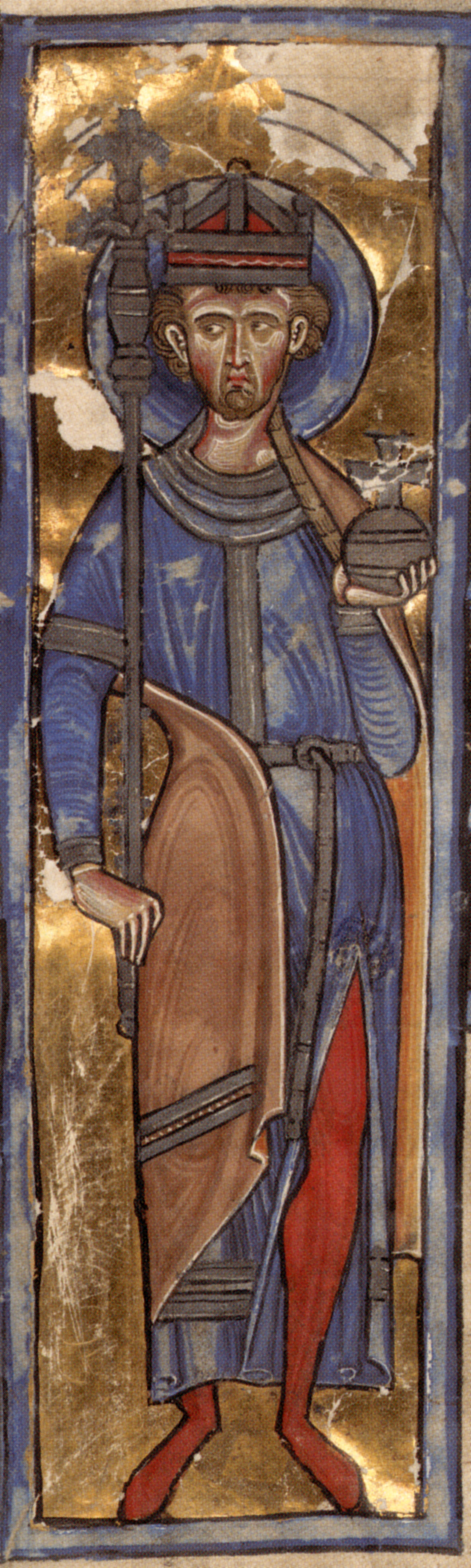
St. Edward the Martyr, King of the English

Edward was the eldest son of King Edgar the Peacemaker by his first wife, the beautiful Ethelflaeda Eneda (White-Duck). The lady died shortly after the birth of her son and, after her death, Edgar remarried Aelfthrith, daughter of Ealdorman Ordgar of Devonshire. She bore him two sons, Edmund, who died young, and Aethelred. Edward was thirteen years old when his father died in AD 975. An admirable youth, upright in all his dealings and fearing God, he was elected to the throne by the Witan, largely under the influence of St. Dunstan and Ealdorman Aethelwin of East Anglia.
On 18th March AD 978, when Edward was only sixteen, he was assassinated under controversial circumstances. In reality, this surrounded a magnetic power struggle, led by the Mercian anti-monastic party who favoured Edward's half-brother. However, legend tells a very different story. The Anglo-Saxon Chronicle does not record the King's assassin, only that he was killed at eventide at Corfe Castle in Dorset. Henry of Huntingdon says that King Edward was killed by his own people. Florence of Worcester, that he was killed by his own people by order of his step-mother, Queen Aelfthrith. William of Malmesbury says he was killed by Ealdorman Aelfhere of Mercia; but in recording his death, Malmesbury also attributes the crime to Aelfthrith and tells the now traditionally accepted story:
Queen Aelfthrith hated Edward because he had been elected King when she had hoped her own son, Aethelred, would take the throne; and she plotted to have him murdered. One day, the young King was hunting near the Royal Palace of Corfe, in Dorset, where Queen Aelfthrith and Prince Aethelred were staying. Being weary and thirsty, King Edward turned away from his hunting party and rode off to drop in on them and take a rest. When he rode up to the palace gate, Aelfthrith herself came out to greet him with a kiss. The two were on friendly terms as far as the King knew and, without dismounting, he asked his step-mother for a drink. Queen Aelfthrith sent for a cup of wine and the exhausted Edward drank eagerly. But as he drank, Aelfthrith gave a sign to one of her servants, who stepped forward, drew his dagger and stabbed the King in the back! The King cried out in pain, but managed to set his spurs to his horse in an attempt to escape to the safety of his comrades. He slipped from his horse though and, with his leg caught in the stirrup, he was dragged along until the combination of the knife-wound and inflicted head injuries killed him.
Queen Aelfthrith sent out her men to follow the King's bloody trail and retrieve the body. She ordered it buried in Wareham Priory, but not in holy ground or with any Royal pomp. A light from heaven is later said to have shone over King Edward's humble grave and many miracles were reported there. As a good youth, unjustly and cruelly killed, people looked on him as a saint and called him Edward the Martyr. On 20th June AD 980, St. Dunstan translated the body to Shaftesbury Abbey. Relics excavated amongst the ruins, and believed to be his, were for many years the subject of a legal dispute. However, they now reside in the Eastern Orthodox Church in Brookwood (Surrey).

From EBK

See also:

Service to the Holy Martyr Edward, King of England

20100213

Sanctus Valentinus

Before Valentine's Day became a celebration of the insipid and the raunchy, it was an occasion to remember the martyrdom of a bishop of the Orthodox Church. The following is from a website called the Struggler:

Yes, Virginia, there was and is a real Saint Valentine who as an early Christian martyr has taken his place in the heavenly mansions prepared by the Savior for those who love Him. He lived in Rome and so long ago when persecutions racked the Church of Christ, that virtually nothing is known of his earthly life.


Given that his name has unfortunately also been conferred upon tokens and practices that are being abused by people today, it seems important that we attempt to discover some overriding element of spiritual truth in the legend about him that has come down to us.

Read the rest here

20100205

Martyr Agatha of Palermo in Sicily

The Holy Virgin Martyr Agatha was the fifteen-year-old daughter of rich and respected Christian parents from the city of Palermo (formerly Panormos) in Sicily. During the persecution under the emperor Decius (249-251), the city prefect of Catania, Quintianus, having heard about Agatha's wealth and beauty, sent his soldiers after her to bring her to trial as a Christian.

At Catania they housed the saint with a certain rich woman, who had five daughters. They all attempted to tempt St Agatha with fine clothes, amusements and entertainment, urging her to offer sacrifice to the pagan gods, but the saint disdained all these things. The more they tried to move her, the more resolute she became. She prayed that she might soon face martyrdom.

During her interrogation under Quintianus, the holy martyr was swayed neither by the flattery, nor by the threats, and she was subjected to cruel torments. They also tried to remove her breasts with metal tongs, and when this failed, they used knives.

The holy Apostle Peter appeared to her in prison and healed her wounds. St Agatha was led to torture again, and Quintianus was astonished to see her completely healed, with no trace of cutting. Then the torture began once more.

At this moment an earthquake took place in the city, and many buildings were destroyed. Among those killed were two of Quintianus's advisors. The terrified inhabitants rushed to Quintianus, demanding an end to Agatha's tortures. Fearing a revolt by the people, Quintianus sent St Agatha back to prison. There the martyr, offering thanks to God, peacefully surrendered her soul to the Lord.

(oca.org)

20100109

The Holy Protomartyr Stephen the Archdeacon

Stephen was a kinsman of the Apostle Paul and one of those Jews who lived in the Hellenic provinces. Stephen was the first of the seven deacons whom the holy apostles ordained and appointed to the service of assisting the poor in Jerusalem. For this, he is called the archdeacon. By the power of his faith, Stephen worked great miracles among the people. The wicked Jews disputed with him, but they were always defeated by his wisdom and the power of the Spirit, Who acted through him. Then the shameful Jews, accustomed to calumnies and slander, incited the people and the elders of the people against the innocent Stephen, slandering him as though he had blasphemed against God and against Moses. False witnesses were quickly found who confirmed this. Stephen then stood before the people, and all saw his face as it had been the face of an angel (Acts 6:15), that is, his face was illumined with the light of grace as was once the face of Moses when he spoke with God. Stephen opened his mouth and enumerated the many good works and miracles that God had performed in the past for the people of Israel, as well as the many crimes and opposition to God on the part of this people. He especially rebuked them for the killing of Christ the Lord, calling them betrayers and murderers (Acts 7:52). And while they gnashed their teeth, Stephen beheld and saw the heavens open and the glory of God. That which he saw, he declared to the Jews: Behold, I see the heavens opened and the Son of Man standing on the right hand of God! (Acts 7:56). Then the malicious men took him outside the city and stoned him to death. Among his persecutors was his kinsman Saul, later the Apostle Paul. At that time, the Most-holy Theotokos, standing on a rock at a distance with St. John the Theologian, witnessed the martyrdom of this first martyr for the truth of her Son and God, and she prayed to God for Stephen. This occurred one year after the descent of the Holy Spirit upon the apostles. Gamaliel, a prince of the Jews and a secret Christian, clandestinely took St. Stephen's body and buried it on his own estate. Thus, this first among the Christian martyrs gloriously reposed and took up his habitation in the Kingdom of Christ God.

20091014

King Harold II


On this date in 1066, the last Orthodox king of England, Harold Godwinson, mere days after battling Viking raiders in the north, died in defense of his homeland against the invading Norman forces in the Battle of Hastings on the southern coast of England. The leader of the invasion, William, duke of Normandy, often known today as "William the Conquerer," had long believed himself entitled to the English crown, but had found his nobles less than enthusiastic about risking an invasion. Only when William had secured a papal blessing for the invasion--in return for promising to suppress the English Church and install Norman bishops loyal to Rome--was he able to raise an army suitable for the undertaking.

Christians of Anglo-Saxon England had always recognized the Pope as their patriarch and most of them were probably not aware that, twelve years prior, the church of Rome had severed ties with the churches of the East. Thus, it must have come as a terrible shock to see their attackers, thundering toward them on their massive war horses, flying the papal banner.

On the day he died,
the God-loving King Harold, together with his loyal troops, commended themselves to God, for those whom they had honored as brethren and leaders in the Faith had foresaken them. Shouting the Orthodox English battle cry, which invoked the aid of the Holy Cross, King Harold and his faithful soldiers faced down their foes and would have had the victory in a closely matched battle...
The blessed King Harold was shot in the eye with an arrow. He plucked it out and continued to fight bravely. In the end, however, he was cut down by Norman knights and hacked to pieces. His body was desecrated, and many Norman Crusaders abused the remains of the fallen king, a thing to which not even pagans and Turks had been wont to do with the remains of their foes (Orthodox Tidings).
After the Norman invasion, English bishops were imprisoned, exiled or put to death, and were replaced by French-speaking Norman bishops. Thus England became Roman Catholic and remained so until 1534, when King Henry VIII declared himself the head of the Church of England. It is a well-known story, but one with a little-known epilogue:
To the Orthodox mind, there is an even more direct link with Hastings. Harold's daughter (born 1056) was to flee England after the Invasion for friendly Denmark and thence Russia. Here she married the future Grand-Prince of Kiev, Vladimir Monomach, in the Cathedral of Our Saviour in Chernigov in April 1074. Vladimir, himself half-Greek, was the grandson of St Anne of Novgorod, who had been baptised by the Glastonbury monk and missionary, St Sigfrid of Sweden. Among the children of Vladimir and Gytha was St Mstislav-Harold (in holy baptism, Theodore, feasted on 15 April), who bore a Slav name as well as that of his maternal grandfather. According to chroniclers, 'no woman in all the world was ever happier than her', Gytha had twelve children, another of whom, George (Yuri), founded Moscow. (Orthodox England)
Read more here:
The Fall of Orthodox England
Entry from OrthodoxWiki
Entry from Wikipedia
King Harold's Battle Force
About Bosham and the Battle
BBC article about grave of King Harold II
Royal Mystery on Brink of Solution

20091011

Good King Wenceslas


Today, Christians who observe the Old Calendar celebrate the life of King Wenceslas of Bohemia, who was martyred in 935. The Following is from Holy Trinity Church in Baltimore:

The Holy Nobleborn Prince Vyacheslav (Wenceslaus) of the Czechs was a grandson of the holy Martyress and Princess Liudmila (Comm. 16 September), and he was raised by her in deep piety. He began to rule at age 18 after the death of his father prince Bratislav (+ 920). In spite of his youthful age, he ruled wisely and justly and concerned himself much about the Christian enlightenment of the people. The holy prince was a widely educated man, and he studied in the Latin and Greek languages. Saint Vyacheslav was peace-loving. He built and embellished churches, and in the Czech capital Prague he raised up a magnificent church in the name of Saint Vitus, and he had respect for the clergy. Envious nobles decided to murder the saint and at first to incite his mother against him, and later to urge his younger brother, Boleslav, to occupy the princely throne. Boleslav invited his brother to the dedication of a church, and then asked him to tarry and stay for still another day. In spite of the warnings of his servants, the holy prince refused to believe in a conspiracy and exposed his life to the will of God. On the following day, 28 September 935, when the nobleborn Vyacheslav went to matins, he was wickedly murdered at the doors of the church by his own brother by birth and that one's servants. His body was stabbed and thrown down without burial. The mother, hearing about the murder of her son, found and placed him in a recently consecrated church at the princely court. They were not able to wash off the blood splashed on the church doors, but after 3 days it disappeared by itself. Repenting himself, the perpetrator of the fratricide transferred the relics of Saint Vyacheslav to Prague, where they were placed in the church of Saint Vitus, which the martyr himself had constructed.

St Wenceslas is also the subject of a well-known Christmas carol. The song, which recounts a legendary event in the saint's life, is really not about Christmas at all; rather it tells a story that supposedly took place on St Stephen's Day, which in the Western Church is the day after Christmas (in the Eastern Church it is two days after):

Good King Wenceslas looked out, on the Feast of Stephen,
When the snow lay round about, deep and crisp and even;
Brightly shone the moon that night, tho' the frost was cruel,
When a poor man came in sight, gath'ring winter fuel.
"Hither, page, and stand by me, if thou know'st it, telling,
Yonder peasant, who is he? Where and what his dwelling?"
"Sire, he lives a good league hence, underneath the mountain;
Right against the forest fence, by Saint Agnes' fountain."
"Bring me flesh, and bring me wine, bring me pine logs hither:
Thou and I will see him dine, when we bear them thither."
Page and monarch, forth they went, forth they went together;
Through the rude wind's wild lament and the bitter weather.
"Sire, the night is darker now, and the wind blows stronger;
Fails my heart, I know not how; I can go no longer."
"Mark my footsteps, good my page. Tread thou in them boldly
Thou shalt find the winter's rage freeze thy blood less coldly."
In his master's steps he trod, where the snow lay dinted;
Heat was in the very sod which the saint had printed.
Therefore, Christian men, be sure, wealth or rank possessing,
Ye who now will bless the poor, shall yourselves find blessing.


Read more here.

20090823

Martyr and Archdeacon Laurence of Rome

The Martyrs Archdeacon Laurence, Pope Sixtus, Deacons Felicissimus and Agapitus, the Soldier Romanus were citizens of Rome, and suffered in the year 258 under the emperor Valerian (253-259). Holy Pope Sixtus, born at Athens, received a fine education, preached in Spain and was made bishop in Rome following the martyr's death of Holy Pope Stephen (253-257, commemorated on August 2). These were times when a pope occupying the Roman throne, was known to choose death for the faith. In a short while St Sixtus also was arrested and put in prison together with his deacons Felicissimus and Agapitus.

When the holy archdeacon Laurence visited Pope Sixtus, whom they held in prison, he cried out with tears: "Whither art thou gone, father? Why hast thou forsaken thine archdeacon, with whom always thou hast offered the Bloodless Sacrifice? Take thy son with thee, that I may be thy companion in having blood shed for Christ!" St Sixtus answered him: "I have not forsaken thee, my son. I am old and go to an easy death, but yet greater sufferings await thee. Know, that after three days upon our death thou shalt follow after me. And now go, take the church treasury and distribute it to the poor and needy Christians." St Laurence zealously did the bidding of the holy hierarch.

Having heard, that Pope Sixtus had been taken to trial with the deacons, St Laurence went there so as to witness their deed, and he said to the holy bishop: "Father, I have already fulfilled thy command, and distributed by hand thine treasury; forsake me not!" Hearing something about treasure, soldiers put him under guard, and the other martyrs were beheaded (+6 August 258). The emperor locked up St Laurence in prison and ordered the chief jailer Hyppolitus to keep watch over him. In prison St Laurence with prayer healed the sick gathered together with him and he baptized many.

Astonished by this, Hyppolitus himself believed and accepted Baptism from St Laurence together with all his household. Soon the archdeacon Laurence was again brought to the emperor and commanded to produce the hidden treasure. St Laurence answered: "Give me a period of three days, and I shalt show thee this treasure". During this time the saint gathered up a crowd of the poor and the sick, who ate only because of the charity of the Church, and bringing them he explained: "Here are the vessels in which is contained the treasure. And everyone, who puts their treasure in these vessels, will receive them in abundance in the Heavenly Kingdom".

After this they gave St Laurence over to fierce tortures, urging him to worship idols. The martyr was scourged (with a fine iron flail with sharp needles), they burned his wounds with fire, and struck at him with metal switches. At the time of the martyr's suffering, the soldier Romanus suddenly cried out: "St Laurence, I behold a bright youth, who standeth about thee healing thy wounds. Beseech thy Lord Christ not to forsake me!" After this they stretched St Laurence on a rack and returned him to prison to Hyppolitus. Romanus brought there a waterpot with water and besought the martyr to baptize him. And immediately after the Baptism of the soldier, he was beheaded (+9 August). When they took St Laurence to his final torture, St Hyppolitus wanted to declare himself a Christian and die together with him, but the confessor said: "Conceal for now thy confession in thy heart.

After some length of time I shall summon thee, and thou shalt hear and come unto me. Weep not for me, but rather rejoice, for I go to receive a glorious crown of martyrdom." They placed him in an iron cage, under which they set an intense fire, and the flames of the fire flicked towards the body of the martyr. St Laurence, glancing at the governor, said: "Here now, you burn only but one side of my body, turn over the other and do my whole body". Dying, he uttered: "I thank Thee, Lord Jesus Christ, that Thou hast accounted me worthy to enter into Thy gates" -- and with these words he gave up the spirit.

St Hyppolitus took the body of the martyr by night, he wrapped it in a shroud with ointments and gave it over to the priest Justin. Over the relics of the martyr in the home of the widow Kyriake they made an all-night vigil and Divine Liturgy. All the Christians present partook of the Holy Mysteries and with honor they buried the body of the holy martyr Archdeacon Laurence in a cave on 10 August 258. St Hyppolitus and other Christians suffered three days after the death of St Laurence (13 August), as he had foretold them of this.

Troparion - Tone 4 Victorious martyr of Christ our God,by the sign of the Cross you gave sight to the blind;you distributed the riches of the Church to the poor;you were tried by fire and no evil was found in you.As you endured the burning,may your prayers extinguish the flames of our many sins,blessed Archdeacon Lawrence!

Kontakion - Tone 2 Your heart burned with divine fireas the flames of the passions died within you.God-bearing martyr Lawrence, the pillar of those who struggle,you cried out in the midst of your contest:"Nothing can separate me from the love of Christ."


From oca.org

20090718

Holy Royal Martyr Grand Duchess Elizabeth

Saint Elizabeth was the older sister of Tsarina Alexandra [and grand-daughter of Queen Victoria of the U. K.], and was married to the Grand Duke Sergius, the governor of Moscow. She converted to Orthodoxy from Protestantism of her own free will, and organized women from all levels of society to help the soldiers at the front and in the hospitals.

Grand Duke Sergius was killed by an assassin's bomb on February 4, 1905, just as St Elizabeth was leaving for her workshops. Remarkably, she visited her husband's killer in prison and urged him to repent.

After this, she began to withdraw from her former social life. She devoted herself to the Convent of Sts Martha and Mary, a community of nuns which focused on worshiping God and also helping the poor. She moved out of the palace into a building she purchased on Ordinka. Women from the nobility, and also from the common people, were attracted to the convent.

St Elizabeth nursed sick and wounded soldiers in the hospitals and on the battle front. On Pascha of 1918, the Communists ordered her to leave Moscow, and join the royal family near Ekaterinburg. She left with a novice, Sister Barbara, and an escort of Latvian guards.

After arriving in Ekaterinburg, St Elizabeth was denied access to the Tsar's family. She was placed in a convent, where she was warmly received by the sisters.

At the end of May St Elizabeth was moved to nearby Alopaevsk with the Grand Dukes Sergius, John, and Constantine, and the young Count Vladimir Paley. They were all housed in a schoolhouse on the edge of town. St Elizabeth was under guard, but was permitted to go to church and work in the garden.

On the night of July 5, they were all taken to a place twelve miles from Alopaevsk, and executed. The Grand Duke Sergius was shot, but the others were thrown down a mineshaft, then grenades were tossed after them. St Elizabeth lived for several hours, and could be heard singing hymns.

The bodies of St Elizabeth and St Barbara were taken to Jerusalem in 1920, and buried in the church of St Mary Magdalene.

Troparion (Tone 4)

Emulating the Lord's self-abasement on the earth,
You gave up royal mansions to serve the poor and disdained,
Overflowing with compassion for the suffering.
And taking up a martyr's cross,
In your meekness
You perfected the Saviour's image within yourself,
Therefore, with Barbara, entreat Him to save us all, O wise Elizabeth.


From oca.org

20090705

St Alban, Protomartyr of Britain

Saint Alban was a pagan soldier in the Roman Army stationed in Britain. His exact background is unknown, but popular tradition declares him a native Briton. Bede says he lived during the religious persecutions of the Emperor Diocletian (c.AD 304), though modern historians have argued for similar circumstances which arose some years earlier, during the reigns of Decius (c.254) or Septimus Severus (c.209).

During these dangerous times, Alban received into his house and sheltered a Christian priest, supposedly named Amphibalus, and was so struck by the devotion to God and blameless life of this man whom he protected, that he placed himself under his instruction and became a Christian. A rumour having reached the governor of Verulamium (now St. Albans), that the priest was hiding in the house of Alban, he sent soldiers to search it. Alban, seeing them arrive, hastily threw the long cloak of the priest over his own head and shoulders and presented himself to the soldiers as the man whom they sought. He was immediately bound and brought before the governor who, at that moment, was standing at one of the civic altars, offering up a sacrifice.

When the cloak, which had concealed Alban's face, was removed, it was immediately revealed that he was not the priest whose arrest the governor had ordered. The latter's anger flamed hot and he ordered Alban, immediately, to sacrifice to the gods or to suffer death.

St. Alban steadfastly refused to offer to idols. Then the magistrate asked, "Of what family and race are you?""How can it concern thee to know of what stock I am?" answered Alban. "If thou desirest to know what is my religion, I will tell thee - I am a Christian and am bound by Christian obligations.""I ask thy name, tell it me immediately.""I am called Albanus by my parents," he replied, "and I worship and adore the true and living God who created all things." Then the governor said,"If thou wilt enjoy eternal life, delay not to sacrifice to the great gods." Alban rejoined,"These sacrifices which are offered to devils are to no avail. Hell is the reward of those who offer them." The governor ordered St. Alban to be scourged, hoping to shake his constancy by pain. But the martyr bore the stripes patiently and even joyously, for our Lord's sake.

When the judge saw that he could not prevail, he ordered Alban to be put to death. On his way to execution, on 20th June, the martyr had to cross a river. "There," says Bede, "he saw a multitude of both sexes, and of every age and rank, assembled to attend the blessed confessor and martyr; and these so crowded the bridge, that he could not pass over that evening. Then St. Alban, urged by an ardent desire to accomplish his martyrdom, drew near to the stream, and the channel was dried up, making a way for him to pass over."'

Then the martyr and his escort, followed by an innumerable company of spectators, ascended the hill above Verulamium, now occupied by the abbey church bearing his name. It was then a green hill covered with flowers, sloping gently down into the pleasant plain. However, the executioner refused to perform his office and, throwing down his sword, confessed himself a Christian also. Another man was detailed to deal the blow and both Alban and the executioner, who had refused to strike, were decapitated together.

St. Alban's body was buried in the adjoining cemetery and, when Christianity was legalized by the Emperor Constantine the Great, not long afterwards, he was well remembered by the local community who erected a martyrium above his grave. This almost certainly became a place of pilgrimage, even in Roman times. It was famously visited by St. Germanus of Auxere, in AD 429, and, as a small church, survived the pagan Saxon expansion, until the present abbey church was founded on the site, by King Offa of Mercia, in AD 793. Alban's relics were reverred by the devout for centuries, before they eventually disappeared during the Dissolution of the Monasteries.

From EBK

20090508

The Holy Disciple and Evangelist Mark


The Holy Disciple and Evangelist Mark, named also John-Mark (Acts 12: 12), was a Disciple from among the Seventy, and was also a nephew of the Disciple Barnabas (Comm. 11 June). He was born at Jerusalem. The house of his mother Mary adjoined the Garden of Gethsemane. As Church Tradition relates, on the night of the Sufferings of Christ on the Cross he followed after Him, wrapped in a linen winding-cloth, and he fled from the soldiers catching hold of him (Mk. 14: 51-52). After the Ascension of the Lord, the house of his mother Saint Mary became a place of prayerful gatherings of Christians and a lodging for certain of the Apostles (Acts 12:12).

Saint Mark was a very close companion of the Apostles Peter and Paul (Comm. 29 June) and of the Disciple Barnabas. Saint Mark was at Seleucia together with Paul and Barnabas, and from there he set off to the island of Cyprus, and he crossed over the whole of it from East to West. In the city of Paphos Saint Mark was an eye-witness, of how the Apostle Paul had struck blind the sorcerer Elymas (Acts 13: 6-12).

After working with the Apostle Paul, Saint Mark returned to Jerusalem, and then with the Apostle Peter he arrived in Rome, from whence at the latter's bidding he set out for Egypt, where he became founder of the Church.

During the time of the second evangelic journey of the Apostle Paul, Saint Mark met up with him at Antioch. From there he set out preaching with the Disciple Barnabas to Cyprus, and then he went off again to Egypt, where together with the Apostle Peter he founded many churches, and then also at Babylon. From this city the Apostle Peter directed an Epistle to the Christians of Asia Minor, in which he points to Saint Mark as his spiritual son (1 Pet. 5: 13).

When the Apostle Paul came in chains to Rome, the Disciple Mark was at Ephesus, where the cathedra-seat was occupied by Saint Timothy (Comm. 4 January). The Disciple Mark arrived together with him in Rome. There also he wrote his holy Gospel (c. 62-63).

From Rome Saint Mark again set off to Egypt. At Alexandria he made the beginnings of a Christian school, from which later on emerged such famous fathers and teachers of the Church, as Clement of Alexandria, Sainted Dionysios (5 October), Sainted Gregory Thaumatourgos ("Wonderworker", Comm. 5 November), and others. Zealous with the arranging of Church Divine-services, the holy Disciple Mark compiled the order of Liturgy for the Alexandrian Christians.

Later on in preaching the Gospel, Saint Mark also visited the inner regions of Africa, and he was in Libya at Nektopolis.

During the time of these journeys, Saint Mark received inspiration of the Holy Spirit to go again to Alexandria and confront the pagans. There he visited at the home of the dignitary Ananias, for whom he healed a crippled hand. The dignitary happily took him in, hearkened with faith to his narratives, and received Baptism. And following the example of Ananias, many of the inhabitants of that part of the city where he lived were baptised after him. This roused the enmity of the pagans, and they gathered to kill Saint Mark. Having learned of this, the holy Disciple Mark made Ananias bishop, and the three Christians: Malchos, Sabinos and Kerdinos – presbyters.

The pagans pounced upon Saint Mark when he was making Divine-services. They beat him, dragged him through the streets and threw him in prison. There Saint Mark was granted a vision of the Lord Jesus Christ, Who strengthened him before his sufferings. On the following day the angry crowd again dragged the holy disciple through the streets towards the court-room, but along the way Saint Mark died with the words: "Into Thy hands, O Lord, I commend my spirit".

The pagans wanted to burn the body of the holy disciple. But when they lit up the bon-fire, everything grew dim, thunder crashed and an earthquake occurred. The pagans fled in terror, and Christians took up the body of the holy disciple and buried it in a stone crypt. This was on 4 April in the year 63. The Church celebrates his memory on 25 April.

In the year 310, a church was built over the relics of the holy Disciple Mark. In the year 820, when the Mahometan Arabs had established their rule in Egypt and those of this different faith oppressed the Christian Church, the relics of Saint Mark were transferred to Venice and placed in the church of his name.

In the ancient iconographic tradition, which adopted symbols for the holy Evangelists borrowed from the vision of Saint John the Theologian (Rev. 4: 7), the holy Evangelist Mark is depicted by a lion – symbolising the might and royal dignity of Christ (Rev. 5: 5). Saint Mark wrote his Gospel for Christians from among the gentile-pagans, since he emphasises predominantly the words and deeds of the Saviour, in which particularly is manifest His Divine Almightiness. The many particularities of his account can be explained by his proximity to the holy Apostle Peter. All the ancient writers testify, that the Gospel of Mark represents a concise writing-down of the preaching and narratives of the first-ranked Apostle Peter. One of the central theological themes in the Gospel of Saint Mark is the theme of the power of God, doing the humanly impossible, wherein the Lord makes possible that which of man is impossible. By the efficacy of Christ (Mk. 16: 20) and the Holy Spirit (Mk. 13: 11), His disciples are to go forth into the world and preach the Gospel to all creatures (Mk. 13: 10, 16: 15).


From Holy Trinity Church

20090506

Greatmartyr, Victory-bearer and Wonderworker George

St George, who is the patron saint of Moscow, Georgia, and England, is commemorated today according to the Church [Old] Calendar. The following is from OrthodoxWiki:

According to Tradition, George was born to a Christian family during the late 3rd century. His father was from Cappadocia and served as an officer of the army. His mother was from Lydda, Palestine. She returned to her native city as a widow along with her young son after the martyrdom of George's father, where she provided him with a respectable education and raised him in piety.

The youth, it would seem, followed his father's example in joining the army soon after his coming of age. He proved to be a charismatic soldier and consequently rose quickly through the military ranks of the time. By his late twenties he had gained the titles of tribunus (tribune) and later comes (count). By that time George had been stationed in Nicomedia as a member of the personal guard attached to Roman Emperor Diocletian (reign 284–305).

In 303, Diocletian issued an edict authorising the systematic persecution of Christians across the Empire. His caesar, Galerius, was supposedly responsible for this decision and would continue the persecution during his own reign (305–311). It is believed that George was ordered to take part in the persecution but instead confessed to being a Christian himself and criticised the imperial decision. An enraged Diocletian proceeded in ordering the torture of this apparent traitor and his execution.

Then, after innumerable forms of torture, George was executed by decapitation in front of Nicomedia's defensive wall on April 23, 303. The witness of his suffering convinced Empress Alexandra and Athanasius, a pagan priest, to also become Christians, and so they also joined George in martyrdom as consequence. George's body was then returned to Lydda for burial, where Christians soon came to honour George as a martyr

20090502

Hieromartyr Alphege, Archbishop of Canterbury

St. Alphege, or more properly Ælfheah, was, traditionally, born of a noble family in Weston near Bath (Somerset), about the year AD 953. While he was still very young, he renounced the World and, notwithstanding the tears and entreaties of his widowed mother, retired into the monastery of Deerhurst, in Gloucestershire, where he served God with great devotion for many years. After a time, he moved on to Glastonbury, where he became Prior. Afterwards, wishing to lead a life of greater seclusion and austerity, he lived as an anchorite near the hot springs in Bath. Here, he was followed by many of his former disciples until St. Dunstan, who was then primate of all England, persuaded him to become Abbot of the community of secular canons living nearby. On the death of Aethelwold, Bishop of Winchester, in AD 984, the latter, further, called on St. Alphege to take up the vacant dignity.

England was, at this time, a continual prey to the marauding Vikings. King Aethelred the Unready had recourse to repeated bribes, with which he hoped to purchase relief from their attacks; but Alphege sought to win them by the power of the Gospel. In AD 994, Olaf Tryggyeson, King of Norway, and his men attacked London. The citizens bravely beat him off and he moved on to ravage the south coast, wintering at Southampton. King Aethelred the sent Alphege and the Ealdorman, Ethelward, to visit Olaf there and request him to confer with the English King; and they brought the Norwegian to Andover, where Aethelred was then residing. Olaf was a Christian, but he was unconfirmed. So Alphege persuaded him to enter into a peace whereby he would confirm Olaf and King Aethelred adopt him as his son. In return, Olaf promised that he would never invade England again; and he kept his promise faithfully.


After governing the See of Winchester for twenty-two years, Alphege was translated to that of Canterbury, on the death of Archbishop Aelfric in 1005. He was present at the Council of Enham, at which he inspired measures to be taken for the national defence. Not a moment too soon; for, only two years into his Archiepiscopate, Viking invasions began once more. A Danish fleet came to England, in two divisions. The first was commanded by Earl Thorkell, the second by his brothers Heming and Eglaf. From this time till the end of Aethelred's reign, the Danish ravages were unceasing. In 1011, the Danes took Canterbury, which was betrayed to them by Alfmar, the Abbot of St. Augustine's, whose life had once been saved by Archbishop Alphege. The Danes are said to have committed every sort of cruelty, the city was plundered and the cathedral burnt. They took many prisoners mostly to sell as slaves. Amongst them was Archbishop Alphege, who had remained at his post to reassure his people. He was kept in captivity, in the Danish base at Greenwich, for seven months in hope of a ransom.


When, in April the following year, the Witan met in London and agreed to pay the Danes £84,000 in Danegeld in order persuade them to leave. However, the Archbishop refused to burden the country further by allowing them to pay his extra £3,000 ransom. His captors got drunk one night and, angry at his defiance, they pelted the poor man with ox-bones. Their leader, Earl Thorkell, tried to save him, but his men were uncontrollable The dying Archbishop was finally put out of his misery through a blow from an axe wielded by a sympathetic Dane, named Thrum, whom he had converted whilst a prisoner.


The murder took place where the current parish church of St. Alphege now stands in Greenwich. He lay there for several days, the Viking warriors refusing him a descent burial. However, when a dead stick, which had become anointed with his blood, grew green again and began to blossom - a power attributed to the pagan goddess, Dia Feronia - they relented and carried St. Alphege's body to London. Here, Bishops Ednoth of Dorchester and Elfhun of London buried him in St. Paul's Cathedral. By his countrymen, Alphege was justly esteemed a martyr and pilgrims flocked to his side. In 1023 however, London lost its most holy of relics. King Canute the Dane was prevailed upon by his pious queen, Emma, to make amends for the cruelty and sacrilege which the followers of his father had committed in England. He removed the body of St. Alphege to Canterbury Cathedral, where it was laid in a noble tomb, near the high altar, and the cathedral was enriched by many costly gifts from the King and Queen.


His principal feast is the date of his death, 19th of April [May 2 Old Calendar]; but his translation is also celebrated on 8th June. He is represented in art as an Archbishop, sometimes with an axe cleaving his skull.
From EBK

20090402

The Holy Martyrs of St Sabbas Monastery

The Monks John, Sergios, Patrikios and Others Murdered in the Monastery of Saint Sava: During the VIII Century the surroundings of Jerusalem were subjected to frequent incursions of the Saracens [Muslims]. The monastery of Saint Chariton was devastated and fell into ruin. Twice the Saracens tried to plunder the Lavra monastery of Saint Sava the Sanctified, but Divine Providence protected the monastery. The Lavra monks would have been able to escape the barbarian incursions by going to Jerusalem, but they decided not to forsake the spot where they had sought salvation for so many a year.

At the end of Great Lent in the week before Palm Sunday, on 13 March, the Saracens broke into the monastery and demanded all the valuables be given them. Upon receiving the reply of the monks, that in the monastery was nothing besides a scant supply of food and old clothing, the Saracens began to shoot arrows at the monastery inhabitants. Thirteen men were killed and many wounded, and monastery cells were set afire. The Saracens intended also to torch the monastery church, but seeing in the distance a throng of people, they mistook this for an army force sent out from Jerusalem. The Saracens managed to get away, carrying off the little they had succeeded to plunder. After the enemy fled, Father Thomas, an experienced physician, began to render help to those remaining alive.

On Great Thursday, 20 March [2 April on the New Calendar], the Saracens with a yet larger force again descended upon the Lavra and began to beat up the monks. Those remaining alive were driven into the church, so as to learn from them under torture where any treasure might be hidden. The monastery was surrounded, so that no one could save themself by fleeing. The barbarians seized hold of Saint John, a quite still young monk, who before had cared for the vagrant. They beat him fiercely, then they cut through the sinews of his hands and feet and dragged him by the feet over stones with the woeful effect of tearing the skin of the back of the martyr.

The keeper of the church vessels, the Monk Sergios, hid the church-ware and attempted to flee, but he was captured and beheaded. Several of the monks nevertheless managed to hide themselves away outside the monastery in a cave, but this was spotted by a sentry on an hill and they ordered everyone to come out. Inside the cave the Monk Patrikios in a whisper said to the brethren huddled with him: "Fear not, I alone on your behalf will emerge and meet my death, meanwhile sit ye and pray". The Saracens questioned whether there was anyone else in the cave, and the monk answered that he was alone. They led him off to the Lavra church, where those yet alive awaited their fate. The Saracens demanded of them a ransom of 4,000 gold pieces and the sacred vessels. The monks were not able to give such a ransom. Then they led them around into the cave of the Monk Sava, located at the monastery enclosure, and in front of the entrance to the cave they set a bon-fire, on which they piled up dung, so as to suffocate the imprisoned with the poisonous fumes. In the cave perished eighteen men, among which were the Monks John and Patrikios. Those remaining alive the Saracens continued to torture, but getting nothing out of them, they finally left the monastery.

Later in the night on Great Friday the monks hidden in the hills returned to the Lavra, they took up the bodies of the murdered monastic fathers to the church and in grief buried them there.

The barbarians that plundered the monastery were punished by God. They fell victim to a sudden illness, in which they perished all every one, and their bodies became the spoil of wild beasts.

Courtesy of Holy Trinity Church

20090322

Forty Martyrs of Sebaste

Today the Church commemorates forty Roman soldiers who, in the early fourth century, were stationed near the Armenian town of Sebasteia when their commander, discovering that they were Christians, ordered them to renounce their Faith or suffer torture and death.

They refused this order and were stripped naked and marched out onto a frozen lake where they were forced to spend the night. A warm bath and bonfires were set up at the edge of the lake to entice the soldiers. One soldier did eventually relent and made for the edge of the ice, but fell down dead before he could reach the shore. The remaining thirty-nine soldiers sang hymns and prayed, until one of the pagan soldiers assigned to guard them was so moved by the strength of their Faith that he flung off his uniform and ran out onto the ice, praying "Lord God, I believe in Thee, in Whom these soldiers do believe. To them add me also, and esteem me worthy to suffer with Thy servants."

In the morning, the Forty were found still to be alive. They were rounded up, their legs were broken, and all forty men were burned. Three days later, local Christians, led by bishop Peter of Sebasteia, gathered the charred remains of the Martyrs and committed them to a Christian burial.

20090214

Happy St Valentine's Day!


Actually, Orthodox Christians remember the martyrdom of St Valentinus on June 6th. The following is from OCA.org:

Martyr Valentinus the Presbyter and those with him at Rome

The Holy Martyrs Valentinus the Presbyter, Martha, Marinus, Audifax, Habakkuk, Cyrenus, Asterius and many others with them at Rome.

During the reign of the emperor Claudius II (268-270), St Marinus together with his wife Martha and their sons Audifax and Habakkuk journeyed from Persia to Rome, to pray at the graves of the holy Apostles Peter and Paul. During this time fierce persecutions and executions befell the Roman Church. St Marinus and his wife and sons helped Christians locked up in the prisons, and also to request the bodies of executed martyrs. At one of these jails they met a prisoner named Cyrenus and they helped him, since he had endured many torments for faith in Christ.

The persecution spread, and even more Christians were arrested. During this time 260 Christians, among whom was the tribune Vlastus, had been sent under the court sentence to dig ground along the Salerian Way, and were executed by archers. When they learned about this vicious murder, Marinus, his family, and the presbyter John went by night and took the bodies of the martyrs to be buried in the catacombs. They returned later to the prison where St Cyrenus was incarcerated, but did not find him. He had been executed the day before and his body was thrown into the Tiber River. Doing their holy duty, Sts Marinus and Martha and their sons took the body of the holy martyr from the river and committed it to the earth. The holy workers were among Christians, who continued secretly to perform the divine services under the leadership of the holy Bishop Callistus, and hid them from their pursuers.

In consummation of their great charitable deeds the holy family was deemed worthy to glorify the Lord by martyrdom. The pagans beheaded the courageous confessor Valentinus the Presbyter, and the imperial gardener Asterius who had been converted by him, and the holy ascetics from Persia were arrested and given over to torture. By order of the emperor, Sts Marinus, Audifax and Habakkuk were beheaded in the year 269, and St Martha was drowned in a river. The relics of the holy saints are in Rome at the Church of St John the Hut-Dweller, and the relics of St Valentinus are in the Church of the holy Martyr Paraskeva.

20090129

The Veneration of the Venerable Shackles of the Holy and All-Praiseworthy Apostle Peter

On the orders of Herod Agrippa, in about the year 42 the Apostle Peter was thrown into prison for preaching about Christ the Saviour. In prison he was held secure by two iron chains. By night, on the eve of his trial, an Angel of the Lord removed these chains from the Apostle Peter and miraculously led him out from the prison (Acts 12: 1-11). Christians who learned of the miracle took the chains and kept them as precious keepsakes. Those afflicted with illness and approaching them with faith received healing. The Chains of the holy Apostle Peter were kept at Jerusalem until the time of Patriarch Juvenalios, who presented them to Eudocia, spouse of the emperor Theodosius the Younger, and she in turn transferred them from Jerusalem to Constantinople in either the year 437 or 439. Eudocia sent one Chain to Rome to her daughter Eudoxia, who built a church in the name of the Apostle Peter and put within it the Chain. At Rome were also other Chains, in which the Apostle Peter found himself before his death under the emperor Nero.

On 16 January [O.S. Jan 29] the Chains of the Apostle Peter are brought out for veneration by the people.

From Holy Trinity Orthodox Church

20090102

St Ignatius of Antioch

From oca.org:

The Hieromartyr Ignatius the God-Bearer, was a disciple of the holy Apostle and Evangelist John the Theologian, as was also St Polycarp, Bishop of Smyrna (February 23). St Ignatius was the second bishop of Antioch, and successor to Bishop Euodius, Apostle of the Seventy (September 7).

Tradition suggests that when St Ignatius was a little boy, the Savior hugged him and said: "Unless you turn and become as little children, you shall not enter into the Kingdom of Heaven" (Mt. 18:3).

As Bishop of Antioch, St Ignatius was zealous and spared no effort to build up the church of Christ. To him is attributed the practice of antiphonal singing (by two choirs) during church services. He had seen a vision of the angels in heaven alternately singing praises to God, and divided his church choir to follow this example. In the time of persecution he was a source of strength to the souls of his flock, and was eager to suffer for Christ.

In the year 106 the emperor Trajan (98-117), after his victory over the Scythians, ordered everyone to give thanks to the pagan gods, and to put to death any Christians who refused to worship the idols. In the year 107, Trajan happened to pass through Antioch. Here they told him that Bishop Ignatius openly confessed Christ, and taught people to scorn riches, to lead a virtuous life, and preserve their virginity. St Ignatius came voluntarily before the emperor, so as to avert persecution of the Christians in Antioch. St Ignatius rejected the persistent requests of the emperor Trajan to sacrifice to the idols. The emperor then decided to send him to Rome to be thrown to the wild beasts. St Ignatius joyfully accepted the sentence imposed upon him.

On the way to Rome St Ignatius visited several churches, teaching and guiding the Christians there. He also wrote seven epistles: to the churches of Ephesus, Magnesia, Tralles, Rome, Philadelphia, and Smyrna. He also addressed a letter to St Polycarp, who mentions a collection of the letters of St Ignatius in his letter to the Philippians (Ch. 13). St Irenaeus of Lyons quotes from St Ignatius's letter to the Romans (AGAINST HERESIES 5:28:4). All these letters have survived to the present day.

The Roman Christians met St Ignatius with great joy and profound sorrow. Some of them hoped to prevent his execution, but St Ignatius implored them not to do this. Kneeling down, he prayed together with the believers for the Church, for love between the brethren, and for an end to the persecution against Christians.

On December 20, the day of a pagan festival, they led St Ignatius into the arena, and he turned to the people: "Men of Rome, you know that I am sentenced to death, not because of any crime, but because of my love for God, by Whose love I am embraced. I long to be with Him, and offer myself to him as a pure loaf, made of fine wheat ground fine by the teeth of wild beasts."

After this the lions were released and tore him to pieces...

After his execution St Ignatius appeared to many of the faithful in their sleep to comfort them, and some saw him at prayer for the city of Rome. Hearing of the saint's great courage, Trajan thought well of him and stopped the persecution against the Christians. The relics of St Ignatius were transferred to Antioch (January 29), and on February 1, 637 were returned to Rome and placed in the church of San Clemente.