ATTENTION: Visitors looking for the Royal Eagle restaurant website, click here
Showing posts with label Prayer. Show all posts

20100428

"Pascha...is the equivalent of prayer with fireworks."

Fr. Meletios Webber

listen here

20090323

How We Worship

From St Innocent Orthodox Church (bold and italics have been added)

The Eastern Orthodox understanding of worship begins with the scriptural understanding that there are other heavenly or spiritual beings: angels and archangels, cherubim and seraphim. The Scriptures teach that in worship, believers are surrounded by and worship within this communion of heavenly hosts. As the Prayer of Entrance says, "O Sovereign Lord, our God, Who appointed in heaven the orders and armies of angels and archangels for the service of Your glory, grant that the holy angels may enter with us to serve and glorify Your goodness with us." Or, as the prayer during the Thanksgiving acknowledges of God, "for this liturgy which You are pleased to accept from our hands, though there stand before You thousands of archangels, and myriads of angels, cherubim and seraphim, six-winged, many-eyed, soaring high on their wings; singing, proclaiming, shouting the Hymn of Victory."

In other words, we should worship God on earth as he is shown to be worshiped in heaven. As the letter to the Hebrews tells us, there is "a heavenly pattern" behind the liturgical life of the Church of then (Israel) and now. If we consider the Old Testament pattern and the visions of heavenly worship found in Isaiah, Ezechiel and Revelation, several elements are consistent:
      • use of light, candles, candelabras

      • use of vestments, crowns

      • thrones

      • incence, smoke

      • liturgical (fixed) prayers, patterns and expressions

      • physical movements (bowing down, prostrations, etc)
These are the elements found in Orthodox worship. However strange they may seem to one raised in the Western/Protestant Christian tradition, they are soundly Scriptural and hark back to the earliest apostolic times.

Worship in the Kingdom
Consistent with the earliest Christian beliefs, worship involves this heavenly host because Christian worship takes place in the Kingdom of God before the heavenly throne (see, for example, Isaiah 6: 1-8). Also gathered around the throne are all the Saints who Christians remember and who join in the worship. Christians pray for those who partake of the gifts of the Eucharist, and say "Furthermore, we offer to You this spiritual worship for those who in faith have gone on before us to their rest: forefathers, fathers, patriarchs, prophets, apostles, preachers, evangelists, martyrs, confessors, ascetics and every righteous spirit made perfect in faith, especially for our most holy, most pure, most blessed and glorious Lady, the Mother of God and Ever-virgin Mary". Christians throughout the ages have affirmed the "great cloud of witnesses" (Heb. 12: 1), those Saints who have gone before. Christians pray for them even as they believe and expect the Saints pray for them.

The Physical Dimension of Worship
The Scriptures teach that God created human beings as physical as well as spiritual beings. To deny this physical aspect of being human is to deny the nature of the creation. The challenge is to affirm this physical aspect of being human in a manner which is edifying and which builds up and conforms the believer to the image of Christ.

Furthermore, the Incarnation of Jesus, the taking on of human flesh and possession of both human and divine natures, is the ultimate affirmation of the inherent goodness of creation. To deny the physical side of being human, or to affirm the spiritual at the expense of the physical, is simply not Christian. In Orthodox worship all senses are involved, through the smell of incense, the sight of candles and icons, the hearing of prayers and music, and the taste of the Eucharist.

Read the rest here

20090315

The Sunday of Saint Gregory Palamas

St Gregory Palamas was a fourteenth century Athonite monk and defender of hesychasm. On the Second Sunday of Great Lent, the Church remembers him and his defense of the Faith.

The following is from the
GOA:

On the Second Sunday of Lent the Orthodox Church commemorates our Holy Father Gregory Palamas, Archbishop of Thessalonica, the Wonderworker. The feast day of Saint Gregory Palamas is November 14, however, he is commemorated on this Sunday as the condemnation of his enemies and the vindication of his teachings by the Church in the 14th century was acclaimed as a second triumph of Orthodoxy.

Our holy Father Gregory was born in Constantinople in 1296 of aristocratic parents who had emigrated from Asia Minor in the face of the Turkish invasion, and were attached to the court of the pious Emperor Andronicus II Palaeologus (1282-1328). Despite his official duties, Gregory's father led a life of fervent prayer. Sometimes as he sat in the Senate, he would be so deep in prayer as to be unaware of the Emperor addressing him.

[Gregory] was instructed by the most highly reputed masters of secular learning [but] the young man's real interest lay only with the things of God. He associated with monks of renown in the city and found a spiritual father in Theoleptus of Philadelphia, who instructed him in the way of holy sobriety and of prayer of the heart.

About the year 1316, Gregory decided to abandon the vanities of the world. His mother, two sisters, two brothers and a great many of his servants entered upon the monastic life with him. He and his two brothers went on foot to the holy Mountain of Athos, where they settled near the Monastery of Vatopedi under the direction of the Elder Nicodemus, who came from Mount Auxentius.

[Gregory's] conduct in the cenobitic life was beyond reproach, and the brethren admired his zeal for putting into practice all the holy evangelic virtues. He lived with such abstinence as to appear unburdened by the flesh to the extent of being able to go three months without sleep.

In 1326, Gregory was ordained a priest, having understood in a vision that this was indeed the will of God. He then departed to found a hermitage in the area of Beroea, where he practiced an even stricter ascesis than before. For five days of the week he remained alone, fasting, keeping vigil and praying with abundant tears. He only appeared on Saturdays and Sundays to serve the Divine Liturgy, share a fraternal meal, and converse on some spiritual subject with his companions in the ascetic life. He continued thus to rise up in contemplation and to enter into closer union with God in his heart.

At that time, Barlaam, a monk from Calabria, won a great name for himself as a speculative thinker in Constantinople. He was particularly fond of expounding the mystical writings of Saint Dionysius the Areopagite, which he interpreted in an entirely philosophical way, making knowledge of God the object of cold reason and not of experience. When this refined humanist learned of the methods of prayer of some simple monks of his acquaintance, who allowed a place to the sensory element in spiritual life, he was scandalized. He took occasion to calumniate then and to accuse them of heresy. The hesychast monks appealed to Gregory who then wrote several polemical treatises in which he answered the accusations of Barlaam by locating monastic spirituality in a dogmatic synthesis.

Saint Gregory's brilliant answer to Barlaam was first accepted by the authorities of Mount Athos in the Hagiorite Tome and then adopted by the Church, which condemned Barlaam (and with him the philosophical humanism that would soon inspire the European Renaissance), during the course of two Councils at the Church of Saint Sophia in 1341.

Orthodox Commemoration of the Sunday of Saint Gregory Palamas
The feast day of Saint Gregory Palamas is November 14, the day of his repose, however the Orthodox Church commemorates the Saint on the Second Sunday of Lent. As a Sunday of Great Lent, the commemoration is celebrated with the Divine Liturgy of Saint Basil the Great, which is preceded by a Matins (Orthros) service. A Great Vespers is conducted on Saturday evening.

Hymns of the Feast
Apolytikion (Plagal of Fourth Tone)
Light of Orthodoxy, pillar and teacher of the Church, adornment of monastics, invincible champion of theologian, O Gregory, wonderworker, boast of Thessalonica, herald of grace: ever pray that our souls be saved.

Kontakion (Plagal of Fourth Tone)
With one accord, we praise you as the sacred and divine vessel of wisdom and clear trumpet of theology, O our righteous Father Gregory of divine speech. As a mind that stands now before the Primal Mind, do you ever guide aright and lead our mind to Him, that we all may cry: Hail, O herald of grace divine.

For More:
Mt Athos

20081123

Q&A

Q: Excuse me, did I just hear the priest say "most holy Theotokos save us"? Please explain how that is not blatantly contrary to Scripture, since "no one comes to the Father, except through" Jesus, (Jn 14.6), who came to "save that which was lost" (Matt 18.11), and since "there is no other name under heaven given among men, whereby we must be saved (Acts 4.12). Calling upon Mary to "save us" is in direct opposition to the teachings of the Bible!

A: Yeah, that freaked me out the first time I heard it, too. It was at the very first Vespers service that I attended at a local Greek parish, and I thought, "This could be the deal-breaker." It bothered me so much that I confronted the priest afterwards.

He admitted that it is a difficult thing for a Protestant to hear, and that it troubled him the first time he heard it, too (he was a convert from Pentecostalism). He explained to my satisfaction why this phrase is not improper or contrary to biblical teaching, but it is still a little uncomfortable for me to heard it, even now, especially having come from a faith tradition in which Mary is little more than an afterthought. I suppose it just takes some getting used to.

So, is the statement "Theotokos, save us" really attributing to Mary something that should only be attributed to God? Is this usurping the work of Christ? It seems to, but rest assured that Orthodox Christians do not believe for one second that Mary died on the cross for our sins, or that she rose from the dead, or that she is seated at the right hand of the Father, etc. Any Orthodox Christian will tell you that it was Christ and Him alone "who for us men and for our salvation came down from the heavens." The prayers and hymns and writings of the Orthodox Church testify again and again to this foundational, non-negotiable truth.

Well, then if the Bible says, and the Orthodox believe, that there is no other name whereby we must be saved, isn't the statement in question plainly contrary to both? It would appear so, but if this sort of language were truly contrary to biblical teaching then we would, of course, expect no similar use of the word "save" in Scripture, except in reference to the direct work of God. Right?

However, we read in the Bible that St Paul hopes to save the Jews through his example (Rom 11.14), and that he believes that by being "all things to all men" he may save some (1Co 9.22). He also tells husbands and wives that they are able to save each other (1Co 7.16), and says that he himself was saved through the prayer of the Philippians (Php 1.19).

Paul later tells his protégé Timothy that he can save himself and others by his adherence to doctrine (1Ti 4.16), and that a woman can be saved by bearing and raising a faithful Christian (2.15).

St Peter is said to be able to save entire households merely by his words (Acts 11.14), and St Jude instructs us to save people with fear (Jude 1.23). St James tells us that prayer can save the sick (Jam 5.15), and that when we convert a sinner, we save a soul and "cover a multitude of sins" (v.20).

Clearly it's not contrary to biblical teaching to believe that we have a role in the salvation of others. We don't save them by dying on the cross, of course, but by preaching the Gospel, by prayer, by being a good example. It's worth mentioning at this point that the Orthodox do not believe, as their Protestant brethren do, that salvation is the result of a one-time, momentary conversion of faith. Rather, it requires daily, hourly, minute-by-minute conversion. That is, constant repentance and self-denial. That's why serious Orthodox Christians go to church every day, and surround themselves with religious imagery, and give alms, and fast regularly, and pray constantly, and make the sign of the cross about eleven-thousand times a day: not because they believe these good works will earn them a place in heaven, but because they want to stay constantly focused on Christ, and away from self, and tuned-in to what is true and honest and just and pure and lovely. It is also why Orthodox Christians rely on the prayers and good council of other Orthodox Christians: to keep them on the straight and narrow. It is in this manner that Orthodox Christians save each other, just like Sts Paul, Peter and Timothy did.

Is it really unreasonable, then, to think that Mary can likewise save us?

Should we not look to her for her prayer and for her example of obedience, so that we will not deliberately keep on sinning, but will continue grounded and settled in the faith; so we will continue to do the will of God, and work out our salvation with fear and trembling; so that we will not be cut off, or disqualified, or denied; so we won't come out worse in the end than we were at the beginning and be assigned a place with the unbelievers?

Like so many other things in the Orthodox Church, the phrase "Most holy Theotokos, save us," is indeed arresting and horrifying to a lifelong Protestant like me. But, like so many other initially arresting, horrifying aspects of Orthodoxy, this phrase does prove, on close examination, to be perfectly consistent with biblical teaching. And as I become more and more familiar with the context surrounding certain Orthodox statements and actions and disciplines, the more clearly I can see how much sense they make within the broader scope of Orthodox worship and devotion.

Read these for more information:
Orrologion (blog): On Prayer to the Saints; or, "Everything which is God's became man's"
Pillar and Ground of Truth (blog): "Most holy Theotokos, save us!" Part 1, Part 2, Part 3

20081028

Prayer

Prayer is another subject about which rivers of ink have been spilled by many men who know far more than I ever will. Nor could I ever hope to add anything of value to what has already been said or written about prayer.

The following are just a few of my thoughts and observation regarding prayer, particularly the practice of formal, liturgical prayer.

One of my many early objections to liturgical worship was the use of what I considered to be "canned" prayers. Why, I thought, would I want to recite prayers that were written hundreds of years ago by some stranger who doesn't know me or my needs and wants? Doesn't God want prayer to be from the heart? Pre-written prayers seemed dry, dead, uninspired.

I have since realized that, for my entire Christian life, I have used pre-written prayers. The Psalms, hymns, even "praise songs" are all forms of pre-written prayer, and never have I had any reason to object to them. Prayer doesn't need to be off-the-cuff in order to be powerful and effective and sincere and worshipful. In fact, I can see now that there are times when formal, liturgical, pre-written prayers are actually preferred:

Pre-written prayers allow the worship community to pray together with one voice.
Imagine if, one Sunday morning at church, instead of singing the hymns together, everyone in the congregation stood up and started singing whatever was on their hearts at that moment.
That's not worship, it's chaos. And that's not a worship community, it's a crowd of individuals clamoring for their personal wants and needs to be heard. The truth is, short of miraculous intervention, there simply is no way to have corporate prayer that isn't pre-written.

I've mentioned before how important the sense of community is to Orthodox Christians. Combine that with their strong connection to the past, and you start to realize that, when you're standing in a Vespers service praying the ancient prayers, you're singing with one accord, not only with the others in the room and with the millions of Orthodox Christians elsewhere in the world, but also with twenty centuries worth of saints and martyrs who prayed—and still pray—those very same prayers. It's an awesome thing to consider.

Formal prayer removes the "me" from worship.
When I offer to God the prayers of the Church, I set my own worries and cares and preferences aside. Only then can I really worship, because "it is no longer I who live, but Christ [who] lives in me" (Gal 2.20). True worship cannot be about me; it cannot be personally fulfilling, pleasing or satisfying to me in any way and still be worship. Real worship must be a purely objective act. The prayers in my Prayer Book belong to the whole Church, not to me personally; they are the offerings of an entire community of believers, spanning thousands of years of Church history, rather than my own personal desires and impulses.

Now, that certainly doesn't mean that there is anything wrong with presenting to God our needs and concerns. On the contrary, we are instructed to do precisely that (Php 4.6). However, when we worship, it should be selfless and devoid of "me." Does that mean that my worship will never include an element of subjectivity? Of course not, I'm still human. But formal prayer gets me closer than I would get otherwise.

The Jews prayed liturgically and so did the first Christians.
According to the notes in the Orthodox Study Bible, "the Jews had practiced liturgical prayer for centuries," and the early Christians, being Jews, continued this practice, which has been maintained without interruption since that time. When Acts 2.42 says that the apostles continued in "fellowship, and in breaking of bread, and in prayers," the word prayers is "literally 'the prayers' in Greek, referring to specific liturgical prayers" (OSB, p.1473).

Furthermore, the prayer in Acts 4:23-30 "follows a traditional liturgical formula of praise, remembrance of God's works, and petition" (OSB, p.1476). And, according to the Book of Acts, the Apostles observed the "hours" of prayer which were observed by pious Jews and are followed in monastic communities to this day (Acts 3.1, 10.9).

For thousands of years—since long before King David—God has inspired men to compose beautiful, stirring hymns and prayers to His honor. I will, from time to time, be posting some of these "canned" prayers that are used by Orthodox Christians. This first one was composed by God Himself and is probably the one offered most frequently in the Orthodox Church:

Our Father which art in Heaven, Hallowed be thy name. Thy kingdom come. Thy will be done in earth, as it is in Heaven. Give us this day our daily bread. And forgive us our debts, as we forgive our debtors. And lead us not into temptation, but deliver us from the evil one. Amen. (The Lord's Prayer, Mt 6.9-13)


20080917

"Cold Macaroni"?

Someone asked me last week whether the Gospel comes through in the liturgy of the Orthodox Church, or if it kind of drifts into the background like it seems to do in so many other churches.

My father has a special name for churches like that; churches whose teachings either communicate a timid, lukewarm, non-committal version of the Gospel, or avoid it altogether: "cold macaroni." These are the churches that don't want to discomfort or offend their audience with all that Death-and-Resurrection talk; or risk upsetting them by asking them to, y'know, be holy and stuff. These are the churches that look nice and allow people to sit comfortably in their pews and feel good about checking the "go to church" box on their To-do list every week; the ones that Frederica Mathewes-Green described as being a "social worker club with excellent aesthetics."

I can't say whether any particular Christian denomination tends more than the others toward the "cold macaroni" approach, but I can tell you that, if I saw this nonsense coming out of an Orthodox church, I'd be out the door.

So, in response to the above inquiry, I submit for your perusal some excerpts from the Liturgy of St John Chrysostom, which is the standard liturgy for most Orthodox churches. Keep in mind as you read it that it is not intended to be sliced up like I have it here, but should be offered as a single complete prayer by the whole body of believers. You can read the rest of it here.

Be on the lookout as you read it for any sign of "cold macaroni"; any timidity or hesitation. I think you'll find none.

(Some of the Liturgy is spoken by the priest, some by the deacon, some by the congregation, and some by everyone together. I have not specified below which is which)

The Introduction:

Blessed is the kingdom of the Father and the Son and the Holy Spirit, now and forever and to the ages of ages.

During the Great Litany:

Lord, our God, whose power is beyond compare, and glory is beyond understanding; whose mercy is boundless, and love for us is ineffable: look upon us and upon this holy house in Your compassion. Grant to us and to those who pray with us Your abundant mercy.

For to You belong all glory, honor, and worship to the Father and the Son and the Holy Spirit, now and forever and to the ages of ages. Amen.

During the First Antiphon:

Lord our God, save Your people and bless Your inheritance; protect the whole body of Your Church; sanctify those who love the beauty of Your house; glorify them in return by Your divine power; and do not forsake us who hope in You.

For Yours is the dominion, the kingdom, the power, and the glory of the Father and the Son and the Holy Spirit, now and forever and to the ages of ages. Amen


During the Second Antiphon:

Only begotten Son and Word of God, although immortal You humbled Yourself for our salvation, taking flesh from the holy Theotokos and ever virgin Mary and, without change, becoming man. Christ, our God, You were crucified but conquered death by death. You are one of the Holy Trinity, glorified with the Father and the Holy Spirit-save us.

Lord, You have given us grace to offer these common prayers with one heart. You have promised to grant the requests of two or three gathered in Your name. Fulfill now the petitions of Your servants for our benefit, giving us the knowledge of Your truth in this world, and granting us eternal life in the world to come.

During the Small Entrance:

Master and Lord our God, You have established in heaven the orders and hosts of angels and archangels to minister to Your glory. Grant that the holy angels may enter with us that together we may serve and glorify Your goodness. For to You belong all glory, honor, and worship to the Father and the Son and the Holy Spirit, now and forever and to the ages of ages. Amen.

During the Trisagion Hymn:

Holy God, You dwell among Your saints. You are praised by the Seraphim with the thrice holy hymn and glorified by the Cherubim and worshiped by all the heavenly powers. You have brought all things out of nothing into being. You have created man and woman in Your image and likeness and adorned them with all the gifts of Your grace. You give wisdom and understanding to the supplicant and do not overlook the sinner but have established repentance as the way of salvation. You have enabled us, Your lowly and unworthy servants, to stand at this hour before the glory of Your holy altar and to offer to You due worship and praise. Master, accept the thrice holy hymn also from the lips of us sinners and visit us in Your goodness. Forgive our voluntary and involuntary transgressions, sanctify our souls and bodies, and grant that we may worship and serve You in holiness all the days of our lives, by the intercessions of the holy Theotokos and of all the saints who have pleased You throughout the ages.

Blessed is He who comes in the name of the Lord. Blessed are You on the throne of glory of Your kingdom, seated upon the Cherubim always, now and forever and to the ages of ages. Amen.

Holy God, Holy Mighty, Holy Immortal, have mercy on us
.

During the Great Entrance:

No one bound by worldly desires and pleasures is worthy to approach, draw near or minister to You, the King of glory. To serve You is great and awesome even for the heavenly powers. But because of Your ineffable and immeasurable love for us, You became man without alteration or change.

The Creed:

I believe in one God, the Father, the Almighty, Creator of heaven and earth, and of all things visible and invisible.
And in one Lord, Jesus Christ, the only begotten Son of God, begotten of the Father before all ages. Light of Light, true God of true God, begotten, not created, of one essence with the Father, through whom all things were made.
For us and for our salvation, He came down from heaven and was incarnate by the Holy Spirit and the Virgin Mary and became man.
He was crucified for us under Pontius Pilate, and He suffered and was buried.
On the third day He rose according to the Scriptures.
He ascended into heaven and is seated at the right hand of the Father.
He will come again in glory to judge the living and the dead. His kingdom will have no end.
And in the Holy Spirit, the Lord, the Giver of Life, who proceeds from the Father, who together with the Father and the Son is worshiped and glorified, who spoke through the prophets.
In one, holy, catholic, and apostolic Church.
I acknowledge one baptism for the forgiveness of sins.
I expect the resurrection of the dead.
And the life of the age to come. Amen.

The Holy Anaphora:

It is proper and right to sing to You, bless You, praise You, thank You and worship You in all places of Your dominion; for You are God ineffable, beyond comprehension, invisible, beyond understanding, existing forever and always the same; You and Your only begotten Son and Your Holy Spirit. You brought us into being out of nothing, and when we fell, You raised us up again. You did not cease doing everything until You led us to heaven and granted us Your kingdom to come. For all these things we thank You and Your only begotten Son and Your Holy Spirit; for all things that we know and do not know, for blessings seen and unseen that have been bestowed upon us. We also thank You for this liturgy which You are pleased to accept from our hands, even though You are surrounded by thousands of Archangels and tens of thousands of Angels, by the Cherubim and Seraphim, six-winged, many-eyed, soaring with their wings,

Singing the victory hymn, proclaiming, crying out, and saying: Holy, holy, holy, Lord Sabaoth, heaven and earth are filled with Your glory. Hosanna in the highest. Blessed is He who comes in the name of the Lord. Hosanna to God in the highest.

Together with these blessed powers, merciful Master, we also proclaim and say: You are holy and most holy, You and Your only-begotten Son and Your Holy Spirit. You are holy and most holy, and sublime is Your glory. You so loved Your world that You gave Your only begotten Son so that whoever believes in Him should not perish, but have eternal life. He came and fulfilled the divine plan for us. On the night when He was betrayed, or rather when He gave Himself up for the life of the world, He took bread in His holy, pure, and blameless hands, gave thanks, blessed, sanctified, broke, and gave it to His holy disciples and apostles saying:

Take, eat, this is my Body which is broken for you for the forgiveness of sins.

Amen.

Likewise, after supper, He took the cup, saying:

Drink of it all of you; this is my Blood of the new Covenant which is shed for you and for many for the forgiveness of sins.

Amen.

Remembering, therefore, this command of the Savior, and all that came to pass for our sake, the cross, the tomb, the resurrection on the third day, the ascension into heaven, the enthronement at the right hand of the Father, and the second, glorious coming.

During Holy Communion:

I believe and confess, Lord, that You are truly the Christ, the Son of the living God, who came into the world to save sinners, of whom I am the first... Loving Master, Lord Jesus Christ, my God, let not these holy Gifts be to my condemnation because of my unworthiness, but for the cleansing and sanctification of soul and body and the pledge of the future life and kingdom. It is good for me to cling to God and to place in Him the hope of my salvation.

Having beheld the resurrection of Christ, let us worship the holy Lord Jesus, the only Sinless One. We venerate Your cross, O Christ, and we praise and glorify Your holy resurrection. You are our God. We know no other than You, and we call upon Your name. Come, all faithful, let us venerate the holy resurrection of Christ. For behold, through the cross joy has come to all the world. Blessing the Lord always, let us praise His resurrection. For enduring the cross for us, He destroyed death by death.


The Dismissal:

Lord, bless those who praise You and sanctify those who trust in You. Save Your people and bless Your inheritance... For every good and perfect gift is from above, coming from You, the Father of lights. To You we give glory, thanksgiving, and worship, to the Father and the Son and the Holy Spirit, now and forever and to the ages of ages.

Christ our God, You are the fulfillment of the Law and the Prophets. You have fulfilled all the dispensation of the Father. Fill our hearts with joy and gladness always, now and forever and to the ages of ages. Amen.

May Christ our true God who rose from the dead, as a good, loving, and merciful God, have mercy upon us and save us, through the intercessions of His most pure and holy Mother; the power of the precious and life giving Cross; the protection of the honorable, bodiless powers of heaven, the supplications of the honorable, glorious prophet and forerunner John the Baptist; the holy, glorious and praiseworthy apostles; the holy, glorious and triumphant martyrs; our holy and God-bearing Fathers; the holy and righteous ancestors Joachim and Anna; Saint (of the day) whose memory we commemorate today, and all the saints.


The Resurrection Apolytikia:

Though the tomb was sealed by a stone and soldiers guarded Your pure body, You arose, O Savior, on the third day, giving life to the world. Therefore, O Giver of life, the heavenly powers praise You: Glory to Your resurrection, O Christ, glory to Your kingdom, glory to Your plan of redemption, O only loving God.

When you descended unto death, O life immortal, You destroyed Hades with the splendor of Your divinity. And when You raised the dead from the depths of darkness, all the heavenly powers shouted: O Giver of life, Christ our God, glory to You.

Let the heavens rejoice and earth be glad, for the Lord has shown the power of His reign: He has conquered death by death, and become the first born of the dead. He has delivered us from the depths of Hades; and has granted to the world great mercy.

The joyful news of Your resurrection was told to the women disciples of the Lord by the angel. Having thrown off the ancestral curse, and boasting, they told the Apostles: death has been vanquished, Christ our God is risen, granting to the world great mercy.

To the Word, coeternal with the Father and the Spirit, born of the Virgin for our salvation, let us, the faithful, give praise and worship. Of His own will He mounted the cross in the flesh, He suffered death, and raised the dead by His glorious resurrection.

The heavenly powers appeared at Your tomb, and those guarding it became like dead. Mary stood at Your grave seeking Your pure body. You stripped the power of hades, not touched by its corruption. You met the virgin woman, as one who grants life. O Lord, who rose from the dead, glory to You.

By Your cross You destroyed death, and to the thief You opened paradise. You transformed the sorrow of the Myrrhbearers, and commanded the Apostles to proclaim that You have risen from the dead, Christ our God, granting to the world great mercy.

From on high You descended, O merciful Lord, and accepted the three-day burial to free us from our passions. Glory to You, O Lord, our life and our resurrection.

20080907

Icons

According to Fr. Thomas Hopko of St Vladimir's Seminary, "icons bear witness to the reality of God's presence with us in the mystery of faith. The icons are not just human pictures or visual aids to contemplation and prayer. They are the witnesses of the presence of the Kingdom of God to us, and so of our own presence to the Kingdom of God in the Church."

Icons, in case you're wondering, do not violate the Second Commandment. If it were God’s intention to forbid all images (the word “icon” comes from the Greek word εἰκών, which means "image"), He, in all likelihood, would not have commanded their use in the Tabernacle and in the Temple (cherubim, almond flowers, pomegranates, gourds, palm trees, lilies, lions, bulls, etc.), or even the display of the bronze serpent in the Book of Numbers (21.4-9). God’s commandment was clearly not intended to forbid the creation of images, but rather their worship.

The Church has always practiced the display and veneration of icons, although there have been periods during her history when icons were strongly opposed by certain factions. Finally, near the end of the eighth century, the Church convened a council that affirmed once and for all the display and veneration of sacred images.

Right up through the Reformation, most Christian bodies retained the use of images (including statues). Even to this day all but the most iconoclastic of Protestant churches display images of some kind or another: the Cross, Noah’s ark, prints of Warner Sallman’s famous Head of Christ (left), pictures of missionaries, or the pastor’s image on the Jumbotron. The difference between these uses of images, and the use of holy icons in the Orthodox Church is that the latter understands the theology and doctrine surrounding the display of sacred images.

Icons in the Orthodox Church are more than just decoration (although they certainly are beautiful to look at), they are a theological statement about the Incarnation of Christ, Who is the “image of God” (εἰκών του Θεου) (2 Cor 4.4). According to Metropolitan Kallistos Ware, the Orthodox Church recognizes that “God took a material body, thereby providing that matter can be redeemed: ‘The Word made flesh has deified the flesh,’ said John of Damascus. God had ‘deified’ matter, making it ‘spirit-bearing’; and if flesh has become a vehicle of the Spirit, then so—though in a different way—can wood and paint” (The Orthodox Church, p.33). In other words, it's okay to use material items in our worship of God.

Instruction
I have heard icons referred to as “theology in color.” What the Bible is to paper and ink, the icon is to wood (or plaster) and paint. What the Scriptures teach us through the printed page, the icons teach us with colors and shapes. Icons often depict events from the Bible or from Church history and therefore serve as tools of instruction in much the same way that stained-glass windows have historically in the Western Church. However, icons tend to be much heavier on symbolism. Every color, every posture, even the position of the hands, has a specific theological significance.

Icons are not portraits and are not intended to be realistic in the way that other paintings usually are, but are intended to communicate a spiritual reality. One of the techniques often used to achieve this is called “inverse perspective,” which you can read about here or here or here. Iconographers are pious, disciplined people who pray and fast prior to and during the creation of an icon; with each stroke of the brush a prayer is offered to God. Iconographers aren't free to alter the style of icons as they see fit, but use a style and a technique and a fomat that has been preserved unchanged in the Church for nearly a hundred generations. They are very careful to write (iconographers are said to "write," rather than "paint" icons) these images in precisely the same way they have been written since the Church began. I envision ancient monastic scholars praying over every penstroke as they transcribe the Scriptures, taking great pains not to alter a comma, lest they distort the meaning of the text. The same is true for inconographers and the way they pass on spiritual Truth through color.

Sacred Space
When you walk into an Orthodox temple, you know you're in a sacred place; a place that has been set aside solely for the purpose of worship. An Orthodox house of worship will never be mistaken for a theater or a high school auditorium, or any other secular venue. When you’re standing among images of saints and angels, you know where you are and for what purpose!

Worship in Heaven
Christian worship is intended to imitate heavenly worship (Heb 8.5). The interior of an Orthodox temple reflects that worship. One reason for the icons is to show us the “great could of witnesses” that worship with us. When the Jews worshipped in the Tabernacle and later in the Temple, they were surrounded by images of Heaven. Those images didn’t include Saints until Christ released the saints from Sheol and escorted them to Paradise. Now, in continuity with that ancient worship, the Orthodox Church shows us Heaven with the saints and martyrs, ascetics, virgins, unmercenaries, wonderworkers, and Apostles all around, worshipping the Trinity alongside us.

On an icon depicting Christ are the letters IC XC. This is the Greek abbreviation (the first and last letter of each word) of Ιησους Χριστος, which in English is Jesus Christ. On many icons, the fingers on the right hand of the person depicted will be positioned to mimic these four letters: index finger=I; middle=C; ring and thumb=X; pinky=C

In Christ’s halo is a cross, on the arms of which are the words “Ο ΩΝ,” which means “He Who Is,” or “I Am” (Exodus 3:14, Revelation 4:8).

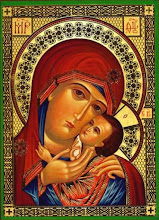
On icons depicting the Virgin Mary are the letters ΜΡ ΘΥ, which is the abbreviation of Μητηρ Θεου (Mother of God). In contrast to Roman Catholic depictions of Mary, Orthodox icons seldom depict her without Jesus (in fact, to my knowledge, the only icon of Mary in which Christ is not visible—but certainly present—is the icon of the Annunciation), but show her holding Christ and pointing to Him as if to say “Do whatever He tells you.” (Jn 2.5)

Veneration
One thing that is very troubling to Protestant sensibilities is the Orthodox practice of venerating icons.

When one enters an Orthodox house of worship, one is likely to see parishioners bowing their heads, lighting candles, and making the sign of the Cross before the icons, and even kissing them. These actions are horrifying to a Protestant, and especially to one, such as myself, raised in the Baptist faith.

But, why is this practice so distressing? Are the Orthodox worshipping these icons? The Orthodox will say certainly not; that there is a big difference between worship or adoration—which are for the Holy Trinity alone—and the veneration, reverence, honor, and respect, which are paid to sacred items and holy people: worship is a total giving over of the self to be united with God, while veneration is showing delight for what God has done.

For millennia the Jews have understood the difference between veneration and worship: they kiss the mezuzah on their door post, they kiss the tallit before putting it on, they kiss the Torah before reading it in the Synagogue. Certainly Christ Himself did likewise when reading the Scriptures in the Synagogue. I doubt anyone confused these actions with idol worship.

And I think it’s a safe bet that I can get away with kissing a picture of my wife, or my grandfather’s headstone, or even a letter that he wrote without anyone accusing me of worshipping those items or the family members they call to mind. (I don’t know of a single Christian who will deny that humans are created in the image of God. In Genesis 1.26 God is quoted as saying “Let Us make man in Our image” (LXX: εικονα). So, when we kiss our loved ones, we are literally venerating icons of God!)

As a member of the Selfridge Honor Guard, I attended hundreds of funerals where a grieving next-of-kin would kiss the folded Flag and never once did it occur to me that that person might be worshipping the flag or the person in whose memory the flag was presented.*

The truth is, if I’m not scandalized by this…


…what reason could I possibly have to be distressed by a Christian kissing an image of Christ?

Anyone who has been to the Vietnam Veterans Memorial in Washington, D.C. is sure to have seen people kneeling, laying flowers, lighting candles, kissing the wall, or bowing their heads in prayer. There is nothing improper or sacrilegious about this. It’s a very human and heartfelt expression of honor and respect, and no one will deny that those who made the ultimate sacrifice in service to our Country are deserving of our respect, our gratitude, our honor.

How much more, then, is our honor and respect due to those who lived and died, who surrendered everything, who denied themselves and daily bore their crosses in service to the Lord?

For more information:
The Function of Icons
No Graven Image: Icons and Their Proper Use
What Do Icons Mean?
Is Venerating Icons Idolatry?
The Icon FAQ
Talk given by Fr. Jacob Myers at St John’s Church in Atlanta

*If we truly believe that the Second Commandment strictly forbids the display of “anything in heaven above,” then the U.S. flag itself is a violation of this commandment fifty times over! In which case we violate God’s commandment fifty times whenever we salute, rise to our feet in the presence of, or pledge allegiance to the flag of the United States.

20080831

Communion of Saints, Part 2 – Who Cares?

Last week we learned something about the different understandings of “sainthood” within the Baptist, Lutheran, Roman Catholic, and Orthodox faiths. So, what does this mean to us? What should it mean to us?
What does the Bible say about how we should regard departed saints?

To begin with, the Apostle Paul instructs us to look to him—and other imitators of Christ—as examples of how to live a godly life:

Brethren, join in following my example, and observe those who walk according to the pattern you have in us. (Php 3.17)

Be imitators of me, just as I also am of Christ. (1 Co 11.1)

Therefore I exhort you, be imitators of me. (1 Co 4.16)

The things you have learned and received and heard and seen in me, practice these things, and the God of peace will be with you. (Php 4.9)
That we should, at the very least, look to saints in Heaven and on Earth as examples on which to pattern our lives is something on which I believe all Christians can agree. Beyond this however is generally where Protestants part ways with their Orthodox and Roman Catholic brethren, who not only emulate the lives of departed saints, but also ask for their prayers as often as they ask for the prayers of saints still in the flesh.

This brings us to an activity with which most Protestants strongly disagree: Prayer to the Saints.

Before we go any further, let me make sure we’re on the same page regarding what we mean by “prayer.” One of the definitions that Merriam-Webster provides for “Prayer” is “an earnest request or wish.” This is the definition we will be using. When I refer to “prayer” to the saints, I do not mean worship, adoration, deification, or exaltation. I simply mean asking or requesting their prayer to God, in the same way that I would ask my family or my pastor for their prayers. There is nothing idolatrous or diabolical about it. Let me explain why (see here for a great explanation of this concept):

First of all, the Bible tells us to pray for one another…

Pray in the Spirit on all occasions with all kinds of prayers and requests. With this in mind, be alert and always keep on praying for all the saints. (Eph 6.18)

Pray for each other (Jam 5.16)
…and gives us numerous examples of Christians praying for and with other Christians.

They all joined together constantly in prayer. (Acts 1.14)

They raised their voices together in prayer to God. (Acts 4.23-31)

Peter sent them all out of the room; then he got down on his knees and prayed. (Acts
9.40)

I have not stopped giving thanks for you, remembering you in my prayers. (Eph 1.15-23)
Should these directives and examples apply only to Christians on Earth?
Well, let’s see; according to the Scriptures, everyone in the Church is connected as part of the Body of Christ.

Just as each of us has one body with many members, and these members do not all have the same function, so in Christ we who are many form one body, and each member belongs to all the others. (Rom 12.4-5)

For none of us lives to himself alone and none of us dies to himself alone. (Rom 14.7)

If one part suffers, every part suffers with it; if one part is honored, every part rejoices with it. Now you are the body of Christ, and each one of you is a part of it. (1 Co 12.26-27)

For just as the sufferings of Christ flow over into our lives, so also through Christ our comfort overflows. (2 Co 1.5)

If anyone has caused grief, he has not so much grieved me as he has grieved all of you, to some extent. (2 Co 2.5)
This connection takes place through baptism…
The body is a unit, though it is made up of many parts; and though all its parts are many, they form one body. So it is with Christ. For we were all baptized by one Spirit into one body—whether Jews or Greeks, slave or free—and we were all given the one Spirit to drink. (1 Co 12.12-13)

…having been buried with him in baptism and raised with him through your faith in the power of God, who raised him from the dead. (Col 2.12)

We were therefore buried with him through baptism into death in order that, just as Christ was raised from the dead through the glory of the Father, we too may live a new life. (Rom 6.4)

For all of you who were baptized into Christ have clothed yourselves with Christ. (Gal 3.27)
…and is not broken in the event of physical death:
For I am convinced that neither death nor life, neither angels nor demons, neither the present nor the future, nor any powers, neither height nor depth, nor anything else in all creation, will be able to separate us from the love of God that is in Christ Jesus our Lord. (Rom 8.38-39)
Therefore, there is only one Body of Christ, which includes those in Heaven and on Earth.
There is one body and one Spirit (Eph 4.4)

And God placed all things under his feet and appointed him to be head over everything for the church, which is His body, the fullness of him who fills everything in every way. (Eph 1.22-23)

And He is the head of the body, the church; He is the beginning and the firstborn from among the dead, so that in everything He might have the supremacy. Now I rejoice…for the sake of His body, which is the Church. (Col 1.18,24)
So then, given that everyone in the Church*—in Heaven and on Earth—are united through baptism to the one Body of Christ, and that Christians are instructed to pray for one another, what could possibly be objectionable about asking departed saints for their intercessory prayers in the same way that we ask Christians on Earth for their prayers?

Objections:

The Scriptures refer to everyone who believes in Jesus as “saints.” (Rom 1.7; Eph 3.8; Jude 1.14; Eph 4.11-12; Acts 9.13, 32, 41, 26:10; Rom 8.27, 12.13, 15.25-26, 31, 16.2, 15; 1 Cor 6.1; 2 Cor 1.1, Eph 1.1)

The Orthodox don’t believe that saints exist only in Heaven. But they also don’t believe that only the saints on Earth are able to pray for us, or that only the saints on Earth deserve our prayer requests.

Prayer to the saints violates God warning against “consulting the dead” (Dt 18.10-12)

This commandment is a warning against the occcult; against witches and sorcerors and necromancers trying to conjure up spirits. Seeking the intercessory prayer of departed saints has nothing to do with conjuring spirits. And nowhere does this passage, or any biblical passage, say that we cannot ask the saints in heaven—who, as we have seen, are members of the Body of Christ—to intercede for us.

John Calvin objected on the grounds that “no less insult is offered to the intercession of Christ by confounding it with the prayers and merits of the dead, than by omitting it altogether, and making mention only of the dead.”

Calvin is right. Except that we’re not talking about dead people here, because God “is not the God of the dead but of the living” (Mt 22.31-32). When Elijah and Moses appeared to Jesus and three of His disciples during the Transfiguration (Mt 17.1-4), did God break his own commandment by calling up the dead? No, because Moses and Elijah are alive!
And the Orthodox certainly do not believe that we should pray to the departed saints instead of to God. Rather, they believe that we pray to God alongside the saints, both those who are in Heaven and those who are still in the flesh.

Saints in Heaven can't hear us or see us; therefore, we cannot pray to them.

This assertion assumes that, if we can’t see/hear the departed saints, then they can’t see/hear us; that our earthly limitations apply also to those in Heaven. However, the Scriptures tell us that saints in Heaven do not have the same limitations that we have here on Earth:

However, as it is written: ‘No eye has seen, no ear has heard, no mind has conceived what God has prepared for those who love him’” (1 Co 2.9)

Now we see but a poor reflection as in a mirror; then we shall see face to face. Now I know in part; then I shall know fully, even as I am fully known. (1 Co 13.12)

And just as we have borne the likeness of the earthly man, so shall we bear the likeness of the man from heaven. (1 Co 15.49)

Through these he has given us his very great and precious promises, so that through them you may participate in the divine nature and escape the corruption in the world caused by evil desires. (2 Pt 1.4)
The things of Heaven are beyond anything our finite minds can possibly imagine. To assert that the saints in Heaven are limited in the same ways that we are here on Earth is to assert something that is clearly contrary to Scripture.

Saints in Heaven are not aware of what is happening here on Earth.

The martyrs in Revelation Chapter 6 obviously knew that their deaths had not yet been avenged: "How long, Sovereign Lord, holy and true, until you judge the inhabitants of the earth and avenge our blood?" (v. 10)

In the first Book of Samuel, the Prophet actually prophesied from beyond the grave: “The Lord will hand over both Israel and you to the Philistines, and tomorrow you and your sons will be with me. The Lord will also hand over the army of Israel to the Philistines.” (28.8-19)

The rich man in Luke Chapter 16 knew his relatives hadn’t yet repented: “‘If someone from the dead goes to them, they will repent.’” (vv.19-31) If someone in hell knows the condition of people on earth, why should we believe that those in Heaven are kept in ignorance?

Luke’s Gospel tells us that “there is rejoicing in the presence of the angels of God over one sinner who repents” (15.7-10) If angels are aware of what’s going on down on earth, is it unreasonable to believe that the departed saints, who “will be like the angels in heaven” (Mt 22.30), are also aware?

And the Apostle Paul reminds us that “we are surrounded by such a great cloud of witnesses” (Heb 12.1), who are all around us and can see us whether we can see them or not.

Why bother praying to the Saints when you can go straight to Jesus?

Why bother asking each other for prayer when we can go straight to Jesus?
Any argument against asking for the intercessory prayer of the saints in Heaven is an argument against asking for the prayer of saints on Earth. Orthodox Christians recognize the Church as a community; not as a multitude of individuals who are all on their own, but as a body of believers who can, indeed must, lift each other up in prayer.

GotQuestions.org, a “Christian, Protestant, conservative, evangelical, fundamental, and non-denominational” online ministry asserts that those who seek the intercessory prayer of departed saints believe that “if a saint delivers a prayer to God, it is more effective than us praying to God directly. This concept is blatantly unbiblical. Hebrews 4:16 tells us that we, believers here on earth, can ‘...approach the throne of grace with confidence...’”

The Orthodox agree wholeheartedly that Christians can and should approach God confidently in prayer. However, the Scriptures do, in fact, give us reason to believe that the prayers of the saints in heaven are actually more effective than our prayers here on Earth:

The effectual fervent prayer of a righteous man availeth much. (Jam 5:16)

For the eyes of the Lord are over the righteous, and his ears are open unto their prayers. (1 Pt 3:12)
Is there anyone on Earth more righteous than those in Heaven? (Heb 12:22-23: “the spirits of just men made perfect.”)

1 Timothy 2:5 clearly states that Jesus is the “sole mediator between God and man,” and according to John Calvin, those who “take pleasure in the intercession of saints…dishonour Christ, and rob him of his title of sole Mediator” (Of Prayer, Book III, Ch. XX, Section 21)

Orthodox Christians agree one hundred percent that there is one mediator—Jesus Christ—but do not believe that this means we are not to ask fellow Christians for their prayers. The saints do not, and are not expected to, mediate the covenant of salvation as Christ does (see Heb 9.15, 12.24). Seeking the intercessory prayer of other Christians is not a denial of Christ’s role as the “sole mediator” of this covenant.

Article XXII of the Anglican/Episcopal statement of faith says that “Invocation of Saints, is…vainly invented, and grounded upon no warranty of Scripture, but rather repugnant to the Word of God.”

I think we’ve shown this not to be the case.

Where does that leave us?
Considering all this, it's pretty clear that...

Saints serve as an example to us.

Members of the Church are instructed to pray for one another.

Physical death does not estrange members of the Church in Heaven from members of the Church on Earth.

Saints in Heaven are alive, not dead.

Saints and angels in Heaven have some knowledge of events, present and future, on Earth; and some knowledge of the condition of those on Earth.

The prayers of the saints in Heaven are effective.

Now, my readers, of course, are free to draw their own conclusions. But, the only honest conclusion I can draw is, not only is the Orthodox practice of asking departed Saints for their prayers not a violation of Scripture, but it is clearly a practice that is good and proper and in keeping with sound Christian doctrine.


For further reading:
On the Intercession and Invocation of the Saints

*The Roman Catholic Church recognizes the connection between the Christians on Earth—the Church Militant—and the Christians in Heaven—the Church Triumphant; The Orthodox make no such distinction, regarding all Christians—both in Heaven and on Earth—as The Church. I have heard it said that in the Roman Catholic faith, the veil between the living and departed is much thinner than in Protestant faiths. If this is true, then I believe it’s fair to say that the Orthodox don’t acknowledge any veil at all. And this is a good thing; When you get it through your thick skull that your grandmother is watching you, you’ll start behaving like you should!

20080821

What To Expect

I make no secret of the fact that part of the purpose of this blog is to encourage my friends and family to look into Orthodox Christianity. I’ve said before that I truly believe a sincere inquiry into Orthodoxy will ultimately result in the inquirer becoming Orthodox. However, to someone raised in the Protestant faith, there remains a large obstacle to conversion: becoming comfortable with attending Orthodox worship.

I’m not going to lie to you: it is a big shock to the system the first time you witness an Orthodox Divine Liturgy. When I tell you that Orthodox worship could not possibly be more different from Protestant worship, you'll think I'm exaggerating...until you attend Orthodox Liturgy.

But please don’t let that scare you. If I, a Baptist since childhood, can do it, so can you. Here are some suggestions to prepare you for what you can expect to encounter at an Orthodox church:

Be ready to do a lot of standing. Orthodox houses of worship have historically not included pews. In fact, I learned recently that until the Reformation, it was unusual for any church, eastern or western, to have pews or chairs of any kind that weren’t specifically reserved for the elderly or handicapped. Most (but not all) Orthodox churches in the United States do in fact have pews, but even so, worshippers stand for nearly the entire duration of the Liturgy. Don't worry, you won't raise any eyebrows by sitting for a while.

Expect to see a lot of candles.

And icons.*

Orthodox Christians cross themselves…a lot. If you’ve ever been to a Roman Catholic Mass, you’ve seen people making the Sign of the Cross once or twice during the service. Occasionally you’ll see Lutherans and other high-church Protestants doing this as well. During an Orthodox Liturgy, it is not unusual for worshippers to make the sign of the Cross somewhere in the neighborhood of a hundred times or more! No kidding. They do it after every “Lord Have Mercy,” and at every mention of the Trinity, and then some.

Don’t be too shocked to see people kissing icons.* Orthodox Christians kiss a lot of things: icons, the Bible, the cross, the chalice, the priest, each other. (But don’t panic, they won’t try to kiss you…at first) Calm down, it’s not idolatry. It’s how they show respect and reverence. It comes from the culture of the Middle East, which, in case you didn’t know, is where Christianity originated. Westerners are squeamish about such things, so it takes some getting used to.

You may even see people prostrate themselves. This is not terribly unusual during Orthodox Liturgy, especially in churches without pews (although people still find a way even in churches with pews). Orthodox Christians prostrate by kneeling, placing their hands palm-down on the floor in front of them, and then touching their forehead to the floor between their hands. (The prostration method you see in the movies where people lie flat, face-down on the floor is the western style, not used in Orthodox worship.)

You’re going to hear a lot of Scripture. Nearly every word you hear during the Liturgy is straight out of the Bible. Much of it is from the Psalms.

Don’t be shocked to see Mary honored. She is certainly not worshipped in the Orthodox Church (that is only for God). But, unlike what you’re accustomed to, she is praised and venerated. Just bear with it. She is most often referred to as Theotokos (this is Greek for “God bearer,” which of course is not so much a statement about her as it is about the Incarnation of Christ).*

The entire Liturgy is sung.

But there won’t be any instrumental accompaniment. Very seldom will you find an Orthodox church that uses instruments. Not sure why. Tradition I guess.

And don’t be too surprised if at least part of the Liturgy is in another language. Even at churches that conduct the Liturgy in English (and most do), they’ll still slip in a “Kyrie Eleison” here and there. But don’t worry if you don’t understand it: God does.

The Orthodox use incense
. And it smells really nice. But it has actual liturgical significance as well: it is how God Himself has chosen to be worshipped.

Everything is a big deal in Orthodox worship. At no point should you expect to see anyone casually open their Bible and flip to such-and-such chapter and verse. Everything—and I mean everything—is preceded by prayers and hymns and bowing and kneeling and more prayers and processions and more hymns and incense and more prayers and more bowing. And rightly so; the whole purpose of the Liturgy is to worship Almighty God. Nothing should be done casually.

There are no nurseries or “cry rooms.” Children who are baptized* into the Orthodox Church are full members of the Church and are not excluded from participation in worship.

And, yes that includes Communion. The Orthodox Church does not exclude any of its members—from infants on up—from receiving Communion.* But if you have not been received into the Orthodox Church don’t expect to partake; the Orthodox do exclude non-Orthodox from Communion. Don’t take offense to this, it’s not out of disdain for the non-Orthodox; it’s to preserve the integrity of the Sacrament. In fact, so great is the Orthodox respect for the Body and Blood that not even all Orthodox will receive Communion every Sunday, but only those who have properly prepared for it (i.e. with fasting, confession, etc.).

When you attend Orthodox Liturgy, do so with an open mind. In fact, go ahead and forget everything you ever thought you knew about Christian worship. Stand somewhere in the back, and don’t try to follow along, just watch, and realize that what you're witnessing is an imitation of heavenly worship (Heb 8.5, 12.22-24). What you see will be beautiful and reverential and moving...and you won’t understand any of it the first time. But give it a chance. And when you see something that shocks you (and you will. Believe me), consider the possibility that what you’re seeing isn’t wrong, only different from what you’re used to. It is, after all, the way the Church has done things for two thousand years.

My challenge to all my readers is this: attend Orthodox Liturgy for four Sundays in a row. If after that time you can return to your regular church and not feel that there is something missing—that it lacks reverence or dignity or a sense of sacredness or true God-centered worship—then maybe you should start a blog yourself!

*These items will be addressed more fully in later blog entries.

For further reading:
First Visit to an Orthodox Church: Twelve Things I Wish I'd Known
For Seekers: What To Expect When You Visit