ATTENTION: Visitors looking for the Royal Eagle restaurant website, click here
Showing posts with label Saints. Show all posts

20101206

St Nicholas: He Who Punches Heretics in the Face (and Gives Gifts to Children)

[nicholas-punches-arius.jpg]
source
When President Teddy Roosevelt was a college student, he taught a Sunday School class for elementary school children. During this time, Roosevelt awarded a dollar to a boy in his Sunday School class for beating the snot out of a bully who tormented little girls. "You did exactly right," said Roosevelt with pride. However, the congregation disagreed. They immediately dismissed Roosevelt for teaching the "un-Christian" principle of laying the smack down on those who have it coming to them.
Well, if tradition is true, that little boy was also richly rewarded by Jolly Old Saint Nicholas since the good Saint Nick allegedly "h-slapped" ("heretic slapped") the heresiarch Arius. You see, Arius wrongly taught that Christ was not fully divine. Rather, Arius taught that Christ had been created by God the Father.
During the First Ecumenical Council of Nicea (AD 325), Arius was called upon to defend his position on the inferiority of Christ. Saint Nicholas just couldn't listen to all of Arius' nonsense and so he stood up and laid in to Arius with his fist.
The Emperor Constantine and the bishops present at the Council were alarmed by Nicholas' act of violence against Arius. They immediately stripped Nicholas of his office as a bishop by confiscating the two items that marked out a man as a Christian bishop: Nicholas' personal copy of the Gospels and his pallium (the vestment worn by all bishops in the East).
Now if that were the end of the story, we probably wouldn't know about Saint Nicholas, and our children wouldn't be asking him for presents. However, after Nicholas was deposed, the Lord Jesus Christ and the Blessed Virgin Mary visited Nicholas who was being held in a prison cell for his fist-fight with the heretic.
Our Lord Jesus Christ asked Saint Nicholas, "Why are you here?" Nicholas responded, "Because I love you, my Lord and my God."

Christ then presented Nicholas with his copy of the Gospels. Next, the Blessed Virgin vested Nicholas with his episcopal pallium, thus restoring him to his rank as a bishop.

20101113

St Quentin (d. 278)

Quintin was of noble lineage of the city of Rome, and came into the city of Amiens, showing many miracles. And was taken there of the provost of the city by commandment of Maximian, and was beaten until they that beat him were weary, and after was put in prison, but he was unbound of an angel, and he went into the city and there preached to the people. Then he was taken again, and was strained on the eculee, an instrument to torment saints on, unto the breaking of his veins, and beaten with raw sinews right long, and afterwards he was boiled in burning pitch and oil, and yet for all that he mocked the judge. Then the judge did do put into his mouth quicklime, vinegar, and mustard, and yet always he abode constant and unmovable. And then he was brought into Vermandos, and fixed in him two nails from his head unto his knees, and ten nails between his nails and the flesh of his nails and the flesh on his hands. And at the last the provost made him to be beheaded, and threw the body into the water.


Which body was hid there fifty-five years, and then founden there by a noble woman of Rome. For as she was continually in prayer, she was in a night warned by an angel that she should go hastily unto the castle of Vermandos, and it was commanded to her that she should fetch the body of Saint Quintin in such a place and bury it honourably. And when she came to the said place with a great company, and as she made her prayers, the body of Saint Quintin appeared above the water, sweetly smelling and without corruption, which body she took and buried it worshipfully. And for the sepulture that she made honourably, she that tofore was blind, received her sight again for a reward. And then there she edified a fair church, and returned home to her own place again. In which church now is a fair monastery of monks and a good town called Saint Quintins in Vermandos, where daily be showed many great miracles, especially for the dropsy, etc., and swelling of great bellies for over great superfluity of water. For this sickness in especial he is sought, and many men have been cured and made whole by the merits of this blessed saint and martyr Saint Quintin. To whom pray we that we may be delivered from all infirmities, as far as it shall please God, and necessary for us. Amen
 
source

20100818

St Oswald of Northumbria, King and Martyr

Oswald’s great devotion and faith in God was made evident by the miracles that took place after his death. For at the place where he was killed fighting for his country against the heathen [Aug. 5, 642], sick men and beasts are healed to this day. Many people took away the very dust from the place where his body fell, and put it in water, from which sick folk who drank it received great benefit. This practice became so popular that, as the earth was gradually removed, a pit was left in which a man could stand. But it is not to be wondered at that the sick received healing at the place of his death; for during his lifetime he never failed to provide for the sick and needy and to give them alms and aid. Many miracles are reported as having occurred at this spot, or by means of the earth taken from it; but I will content myself with two, which I have heard from my elders.


Not long after Oswald’s death, a man happened to be riding near the place when his horse suddenly showed signs of distress. It stopped and hung its head, foaming at the mouth, and as its pains increased it collapsed on the ground. The rider dismounted, removed the saddle, and waited to see whether the beast was going to recover or die. At length, having tossed this way and that in great pain for a considerable time, it rolled on to the spot where the great king had died. Immediately the pain ceased, and the horse stopped its wild struggles, then having rolled on its other side, as tired beasts do, it got up fully recovered and began to graze. The traveller, an observant man, concluded that the place where his horse was cured must possess special sancitity, and when he had marked it, he mounted and rode on to the inn where he intended to lodge. On his arrival he found a girl, the niece of the landlord, who had long suffered from paralysis; and when members of the household in his presence were deploring the girl’s diease, he began to tell them about the place where his horse had been cured. So they put the girl in to a cart, took her to the place, and laid her down. Once there she fell asleep for a short while; and, on awaking, she found herself restored to health. She asked for water and washed her face; then she tidied her hair, adjusted her linen headgear, and returned home on foot in perfect health with those who had brought her.”

(source)

20100330

Happy St Patrick's Day!*

"Saint Patrick, the Apostle of the Irish, was seized from his native Britain by Irish marauders when he was sixteen years old. Though the son of a deacon and grandson of a priest, it was not until his captivity that he sought out the Lord with his whole heart. In his Confession, the testament he wrote towards the end of his life, he says, 'After I came to Ireland — every day I had to tend sheep, and many times a day I prayed — the love of God and His fear came to me more and more, and my faith was strengthened. And my spirit was so moved that in a single day I would say as many as a hundred prayers, and almost as many at night, and this even when I was staying in the woods and on the mountain; and I would rise for prayer before daylight, through snow, through frost, through rain, and I felt no harm."


  After six years of slavery in Ireland, he was guided by God to make his escape, and afterwards struggled in the monastic life in Aesir in Gaul [now France], under the guidance of the holy Bishop Germanus. Many years later he was ordained bishop and sent to Ireland once again, about the year 432, to convert the Irish to Christ. His arduous labours bore so much fruit that within seven years, three bishops were sent from Gaul to help him shepherd his flock, 'my brethren and sons whom I have baptized in the Lord -- so many thousands of people,' he says in his Confession.

  His apostolic work was not accomplished without much 'weariness and painfulness,' long journeys through difficult country, and many perils; he says his very life was in danger twelve times. When he came to Ireland, as its enlightener, it was a pagan country; when he ended his earthly life some thirty years later, about 461, the Faith of Christ was established in every corner." (Great Horologion)

  The work of St Patrick and his brethren has been called the most successful single missionary venture in the history of the Church.

  It is said of St Patrick that he chanted the entire Psalter every day.

From Holy Trinity Church

*Today is March 17th according to the patristic Julian calendar

20100318

St. Edward the Martyr, King of the English

Edward was the eldest son of King Edgar the Peacemaker by his first wife, the beautiful Ethelflaeda Eneda (White-Duck). The lady died shortly after the birth of her son and, after her death, Edgar remarried Aelfthrith, daughter of Ealdorman Ordgar of Devonshire. She bore him two sons, Edmund, who died young, and Aethelred. Edward was thirteen years old when his father died in AD 975. An admirable youth, upright in all his dealings and fearing God, he was elected to the throne by the Witan, largely under the influence of St. Dunstan and Ealdorman Aethelwin of East Anglia.
On 18th March AD 978, when Edward was only sixteen, he was assassinated under controversial circumstances. In reality, this surrounded a magnetic power struggle, led by the Mercian anti-monastic party who favoured Edward's half-brother. However, legend tells a very different story. The Anglo-Saxon Chronicle does not record the King's assassin, only that he was killed at eventide at Corfe Castle in Dorset. Henry of Huntingdon says that King Edward was killed by his own people. Florence of Worcester, that he was killed by his own people by order of his step-mother, Queen Aelfthrith. William of Malmesbury says he was killed by Ealdorman Aelfhere of Mercia; but in recording his death, Malmesbury also attributes the crime to Aelfthrith and tells the now traditionally accepted story:
Queen Aelfthrith hated Edward because he had been elected King when she had hoped her own son, Aethelred, would take the throne; and she plotted to have him murdered. One day, the young King was hunting near the Royal Palace of Corfe, in Dorset, where Queen Aelfthrith and Prince Aethelred were staying. Being weary and thirsty, King Edward turned away from his hunting party and rode off to drop in on them and take a rest. When he rode up to the palace gate, Aelfthrith herself came out to greet him with a kiss. The two were on friendly terms as far as the King knew and, without dismounting, he asked his step-mother for a drink. Queen Aelfthrith sent for a cup of wine and the exhausted Edward drank eagerly. But as he drank, Aelfthrith gave a sign to one of her servants, who stepped forward, drew his dagger and stabbed the King in the back! The King cried out in pain, but managed to set his spurs to his horse in an attempt to escape to the safety of his comrades. He slipped from his horse though and, with his leg caught in the stirrup, he was dragged along until the combination of the knife-wound and inflicted head injuries killed him.
Queen Aelfthrith sent out her men to follow the King's bloody trail and retrieve the body. She ordered it buried in Wareham Priory, but not in holy ground or with any Royal pomp. A light from heaven is later said to have shone over King Edward's humble grave and many miracles were reported there. As a good youth, unjustly and cruelly killed, people looked on him as a saint and called him Edward the Martyr. On 20th June AD 980, St. Dunstan translated the body to Shaftesbury Abbey. Relics excavated amongst the ruins, and believed to be his, were for many years the subject of a legal dispute. However, they now reside in the Eastern Orthodox Church in Brookwood (Surrey).

From EBK

See also:

Service to the Holy Martyr Edward, King of England

20100317

The Saint of Second Chances


 From Brits at their Best:

The patron saint of the Irish, Patrick he was born and raised in Britain until kidnapped by Irish pirates, and taken as a slave to Ireland.

Enslaved
Growing up in Britain at the end of the 4th century, Patrick did not give anyone the impression he would become a saint with a capital S. Then his life changed abruptly. A teenager, he was kidnapped by pirates and taken west across the sea, to be sold into slavery in Ireland.

He found himself living outside, herding sheep, cold and hungry and at the mercy of those who owned him. Out of desperation he returned to his childhood faith in Christ. For six years he survived, and prayed. One night he heard the voice of God telling him it was time to leave.

Escape
Patrick decided to go. He walked south. Incredibly no one stopped the runaway slave. He reached Wexford, but couldn't find a ship that would take him. Just before a ship carrying wolfhounds to Gaul shipped anchor, he was allowed to board. The sailors offered him their nipples to be kissed - a sign of welcome that Patrick found a little disconcerting.

They landed in Europe to discover desolation. It is speculated that tribes had recently crossed the frozen Rhine and devastated the Roman Empire.

A sunny sanctuary
Years later, still uncertain of his future but following his visionary inner voice, Patrick made his way across Gaul to the monastery on a sunny little island, now called St. Honorat, that lies in the Mediterranean not far from Cannes. Southern warmth brought him the scents of lavender and basil, lemon and roses. His six years of slavery in Ireland disappeared from his mind like a boat over the horizon.

At the monastery the monks maintained a civilised belief in books and in the siesta, spent in the stone coolness of the monastery's fountain-splashed interior. Patrick learned Latin, though not very well, and the stories and sayings of Christ by heart. He learned to preach, but like some modern graduate students he began to think he could live a companionable academic life, shielded from the hectic life outside, forever.

Dream visions
It was only in his dreams that the ship returned, and he saw the outstretched arms of the Irish imploring him to return, and heard their voices calling to him from across the water. Among those voices was one voice he could not forget, from his boyhood. But for a long time, fear kept him motionless.

He was a priest and a preacher approaching middle age when he had another visionary dream. He heard a voice in Ireland say, “He who has given his own soul for you, He it is who speaks in you. Come back to Eire and free us.”

There are people who ignore their visions and die filled with regrets. Patrick ignored his visions until he was strong enough to face them. He made the free but frightening decision to return to the people who had kidnapped and enslaved him, and preach the love of God. He faced violence, betrayal, church snobbery, and his own fears.

Return to Eire
All too aware of the dangers and his own modest abilities, he left the warm scents of the Mediterranean, the sun, and the sea, the easy comradeship and the library of books, and crossed the mountains to the north, travelling through the wilderness that was Gaul. He sailed over the turbulent northern waters, heading toward the cold, green island where there was not one book and where, fifteen years earlier, he had spent six years as a hungry, naked slave boy.

It was eary in the fifth century. The island rose on the horizon like the grey ship of captivity. This was the dreaded country of his servitude, but it was also the place where poverty and calamity have been better for me than riches.

Faced with assault and assassination, Patrick gave himself to God. That proved enough, though as he also observes, he had to give his whole self sincerely, since God was not enthusiastic about theatrical impersonation.

Patrick was said to have sung Faeth Fiadha, the Deer’s Cry as he travelled –

I arise today through the strength of heaven
light of sun,
radiance of moon,
splendour of fire,
speed of lightning
swiftness of wind,
depth of sea,
stability of earth,
firmness of rock.
I arise today through God's strength to pilot me. . .

Living as if God’s strength piloted him, he travelled around Ireland, talking about the gospel of Isu Mac De (the Gaelic for Jesus the son of God). and founding communities of fellowship.

Seeding community
Despite local hostility, his first community grew as he healed the sick, gave pastoral care, and preached. When Patrick was sure the community could survive, he travelled on with his crook-shaped staff. A few members from the first fellowship came with him to help him plant the second so the second community grew quickly, and Patrick could branch out and start a third and a fourth. He was attacked and, at least once, held captive. That he was not killed was due, he wrote simply, to “the Lord.”

His communities were a stunning turnaround in a land where men and women had often waged bloody tribal wars over the ownership of cattle. The reason for their change of heart is visible, even over the distance of many years. People experienced the gospel for themselves by becoming part of the vibrant and loving Christian community; and the existence of such communities was the living evidence for the truth proclaimed (Celtic Gifts, Robert Van de Weyer).

Attacking slavery
Patrick introduced people to a way of life whose love, fearlessness, and generosity he embodied. He was not afraid. He never hesitated to attack the accepted, profitable way of doing things if he thought it was wrong. The Greek playwright Euripides is the first man in recorded history to denounce slavery, that thing of evil, by its nature evil, forcing a man to submit to what no man should submit to. Patrick was the second or third to denounce slavery –

Patricide, fratricide! ravening wolves eating up the people of the Lord as if it were bread!. . .I beseech you earnestly, it is not right to pay court to such men nor to take food and drink in their company, nor is it right to accept their alms, until they by doing strict penance with shedding of tears make amends before God and free the servants of God. . .

According to the Oxford Dictionary, Germans and Celts called their kinfolk ‘free,’ a word that meant they were ‘dear’ to them and so had personal rights and liberty of action not given to slaves. Patrick declared that everyone was dear to God, and therefore everyone should be free. He created communities that defended and nurtured freedom out of his belief that this is what God wanted.

The Venerable Bede, writing in his Ecclesiastical History of the English People, reported that the communities which Patrick founded in Ireland became havens of education for young English men. And a century after Patrick's death, Aidan brought learning and Christ's teachings of peace back to England, to strife-torn Northumbria.

At a time of year when the grey trees stand bare, throwing the shadows of their branches across the green grass, the starry blue flowers of the periwinkle open, and the dog-tooth violets lift nodding blooms on crook-shaped stems, Patrick laid down his crook-shaped staff. After he was gone, he seemed to those who knew him to be the best part of themselves, the slave who had returned to the place of his servitude to free slaves, the middle aged man who had dared to let his life be transformed, giving hope to us that it isn't too late to transform ours.
I arise today!

20100227

St Raphael of Brooklyn رفائيل هواويني

Proclamation on the Glorification of Our Holy Father Bishop RAPHAEL (30-Apr-2000)

Our holy Father Raphael was born in Syria in 1860 to pious Orthodox parents, Michael Hawaweeny and his second wife Mariam, the daughter of a priest of Damascus. The exact date of Raphael's birth is not known, but he estimated it to be on or near his Name Day, the Synaxis of the Holy Archangels Michael and Gabriel and all the Bodiless Powers of Heaven (November 8). Due to the violent persecution of Christians, at which time their parish priest, St Joseph of Damascus (July 10) and his companions were martyred, the Hawaweeny family was forced to flee to Beirut for their safety. It was here that the future saint first saw the light of day, and not in the city of his parents. Indeed, as the child's life unfolded, it was evident that he would have no continuing city in this world, but would seek the city which is to come (Heb 13:14). On the Feast of Theophany in 1861, he was baptized with the name Rafla, and later that spring the family was able to return to Damascus. The child attended elementary school, where he did very well, but in 1874 it appeared that Michael Hawaweeny would no longer be able to afford his son's tuition. Fortunately, help came from Deacon Athanasius Atallah (later Metropolitan of Homs), who recommended to Patriarch Hierotheus of Antioch that Rafla be accepted as a student of the Patriarchate in preparation for the priesthood. He was such a good student that he was selected to be a substitute teaching assistant in 1877. The following year he was appointed as a teacher of Arabic and Turkish. On March 28, 1879 he was tonsured as a monk by Patriarch Hierotheus, and served as His Beatitude's personal attendant. Since the Balamand Seminary had been closed in 1840, Patriarch JOACHIM III of Constantinople invited the Patriarch of Antioch to send at least one deserving student to study on scholarship at the School of Theology at Halki, and Saint Raphael was the one who was selected to go. On December 8, 1885 he was ordained to the diaconate at the school chapel. In July of 1886 the young deacon received his Certificate of T heology, and returned to his homeland in the hope of serving the Church there. Patriarch Gerasimus of Antioch was impressed with Deacon Raphael, and often took him along on his pastoral visitations of his parishes. When His Beatitude could not be present, Deacon Raphael was asked to preach the Word of God to the people. Deacon Raphael was not satisfied with the extent of his knowledge, and thirsted to learn even more. This did not stem from personal pride or ambition, but came from his fervent desire to benefit others. Truly, the words of King Solomon could be applied to Saint Raphael: "Give an opportunity to a wise man, and he will be wiser; instruct a just man, and he will receive more instruction" (Proverbs 9:9). Therefore, he asked Patriarch Gerasimus to permit him to do graduate studies at a school in Russia, promising to return and serve as the Patriarch's Russian-language secretary. The Patriarch gave his blessing, and Deacon Raphael was accepted as a student at the Theological Academy of Kiev. In 1889 Patriarch Gerasimus ordered the young deacon to take over as head of the Antiochian representation church in Moscow. He was ordained to the holy priesthood by Bishop SYLVESTER, the rector of the Academy, at the request of Patriarch Gerasimus. A month later, he was raised to the rank of archimandrite by Metropolitan IOANNIKII of Moscow, and was confirmed as head of the Antiochian representation church. After two years, Archimandrite Raphael was able to reduce the representation's 65,000 ruble debt by 15,000 rubles. He also arranged for twenty-four Syrian students to come to Russia to further their education, hoping that they would return to Syria and teach others. When Patriarch Gerasimus resigned in order to accept the See of Jerusalem, Archimandrite Raphael regarded this as an opportunity to free the Church of Antioch from its domination by foreign hierarchs. Burning with love for the Church of Antioch, and wishing to restore the administration of the church to its own native clergy and people, Archimandrite Raphael began a campaign of writing letters to some Antiochian bishops and influential laymen. He also wrote articles in the Russian press, drawing attention to the plight of Antioch. His courageous efforts did not meet with success, however, and there was a price to pay for his outspoken criticism. In November of 1891 Metropolitan SPYRIDON, a Greek Cypriot, was elected as Patriarch of Antioch. Many Arabs believed that he had purchased the election by distributing 10,000 lira to several notable people in Damascus. Archimandrite Raphael refused to commemorate the new Patriarch during services at the representation church. As a result, he was suspended from his priestly functions by Patriarch SPYRIDON. Saint Raphael accepted his suspension, but continued to write articles in Russian newspapers in defense of the Antiochian cause. The Patriarchs of Antioch, Constantinople, Alexandria, and Jerusalem successfully petitioned the Tsar to forbid Russian newspapers from publishing his articles. With this door closed to him, Saint Raphael began to publish his writings in book form. Eventually, Patriarch SPYRIDON wrote to the Assistant Overprocurator of Russia, a friend of Saint Raphael's, asking him to persuade Father Raphael to ask for the Patriarch's forgiveness. He did so, and the suspension was lifted. Saint Raphael was allowed to transfer from the jurisdiction of Antioch to the Church of Russia, and to remain there. He went to Kazan, taking a position as instructor in Arabic studies at the theological academy. He remained there until 1895 when he was invited by the Syrian Orthodox Benevolent Society of New York to come to that city to be the pastor of the Arab Orthodox community. When the holy Apostle Paul had a vision of a man entreating him to come to Macedonia to help them (Acts 16:10), he set off on a great missionary journey. When Saint Raphael heard of the needs of his countrymen who were scattered in a strange land, he crossed the ocean to labor in yet another foreign country. Archimandrite Raphael arrived in New York on November 2, 1895, and was welcomed by a delegation of Arab Christians who were awaiting their leader from Russia. On November 5, his first Sunday in America, he assisted Bishop NICHOLAS in serving the Divine Liturgy at the Russian church in New York city. Less than two weeks after his arrival, Archimandrite Raphael found a suitable place in lower Manhattan to set up a chapel, and furnished it with ecclesiastical items that he had brought with him from Russia. Bishop NICHOLAS blessed the new chapel, which was dedicated to St Nicholas of Myra. This zealous pastor remained in New York teaching, preaching, and celebrating the divine services for his parishioners. It was not long, however, before he heard of smaller communities of Arab Christians scattered throughout the length and breadth of North America. Since these Arab immigrants had no pastor to care for them, it was not surprising that some should turn to other denominations, or completely neglect their religious duties. This was an ongoing concern for Saint Raphael throughout the course of his ministry. Although he was not opposed to dialogue with non-Orthodox Christians, nor to friendly relations based on shared beliefs, Saint Raphael never lost sight of the clear line of distinction that exists between the Orthodox and the heterodox. He always insisted that any church unity must be based on the teachings of the seven Ecumenical Councils. The Orthodoxy of Saint Raphael's life and teaching was demonstrated over and over again by his words and his actions. He always upheld and defended the spotless Faith which was "delivered to the saints" (Jude 3). Although at first he did not understand the teachings of the heterodox, he later discovered how far removed they were from Orthodox doctrine. When he realized this, he took steps to protect his flock from harmful influences. He directed his people not to attend heterodox services lest they become confused by "divers and strange doctrines" (Heb 13:9). He believed it would be preferable for the head of the household to read the Hours at home from the Service Book when it was not possible to attend an Orthodox church. In the summer of 1896, Saint Raphael undertook the first of several pastoral journeys across the continent. He visited thirty cities between New York and San Francisco, seeking out the Master's lost sheep in cities, towns, and on isolated farms. He fed the spiritually hungry people with the Word of God in each place where he stopped. He performed marriages, baptisms, heard confessions, and celebrated the Divine Liturgy in the homes of the faithful where there was no church building. In other words, he zealously fulfilled his ministry as a preacher of the Gospel, enduring many hardships and afflictions, and he was watchful in all things concerning the care of his flock (2 Tim 4:5). In 1898, with the blessing of Bishop Nicholas, Saint Raphael produced his first book in the New World -- an Arabic language Service Book called The Book of True Consolation in the Divine Prayers. This book of liturgical services and prayers was very useful to priests in celebrating the divine services, and also to the people in their personal prayer life. The English version published by Archimandrite Seraphim Nassar is still being used today. Between May-November 1898, Saint Raphael set off on his second pastoral tour. During this trip he became convinced of the need for Arabic-speaking priests to serve in the new churches he had established. When he returned to New York, he made a report to Bishop NICHOLAS expressing these concerns. With Bishop NICHOLAS's blessing Saint Raphael was able to bring qualified priests from Syria. He also sought out educated laymen whom he could recommend for ordination. Both as an archimandrite and later as bishop, Saint Raphael would appoint pastors only after obtaining the blessing of the Russian hierarch who headed the American Mission. This was the normal state of affairs in America at the time. Archimandrite Raphael welcomed Bishop Tikhon when the latter replaced Bishop NICHOLAS as the ruling bishop in America. On December 15, Saint Tikhon came to serve the Liturgy at the Syrian church of St Nicholas. Raphael told his people that their new Archpastor was one who "has been sent here to tend the flock of Christ -- Russians, Slavs, Syro-Arabs, and Greeks -- which is scattered across the entire North American continent." At that time, of course, there were no parallel jurisdictions based on nationality. The Church united those of diverse backgrounds under the omophorion of the Russian Archbishop. This was the norm until the Russian Revolution disrupted church life in Russia, and also in America. In March of 1899, Saint Raphael received permission from Bishop Tikhon to start collecting funds for a cemetery, and for building a new church to replace the chapel which was located in an old building on a dirty street. In the spring he left on another pastoral tour of forty-three cities and towns. Traveling by land and sea, and undeterred by the obstacles and difficulties before him, he spent seven months in the northeastern, southern, and midwestern regions of the United States. Saint Raphael ministered to Greeks and Russians as well as Arabs, performing weddings and baptisms, and regularizing the weddings of Orthodox people who had been married by non-Orthodox clergy. He also chrismated some children who had been baptized by Catholic priests. In Johnstown, PA he reconciled those whose personal enmity threatened to divide the Arabic community. Although civil courts had been unable to make peace, Saint Raphael restored calm and put an end to the bitter feud. While in Johnstown, he received a telegram informing him that Metropolitan Meletios (Doumani), had been elected Patriarch of Antioch. With great joy St Raphael told his people that for the first time in 168 years, a native Arab had been chosen as primate of the Antiochian Church. After the new Patriarch had been installed, Archimandrite Raphael was proposed to succeed Meletios as Metropolitan of Latakia. The Patriarch, however, stated that the Holy Synod could not elect Father Raphael because of his important work in America. In 1901, Metropolitan GABRIEL of Beirut wrote to Archimandrite Raphael asking him to be his auxiliary bishop, but he declined, saying that he could not leave his American flock. First, he wanted to build a permanent church, and to acquire a parish cemetery. The latter goal was achieved in August of 1901 when Father Raphael purchased a section of Mt Olivet cemetery on Long Island. In December of 1901 Archimandrite Raphael was elected as Bishop of Zahleh. Patriarch Meletios sent a telegram congratulating him and asking him to return. Father Raphael thanked the Patriarch, but again declined higher office. He said that he wished to complete the project of building a temple for the Syrian community in New York. The following year, he bought an existing church building on Pacific St in Brooklyn, and had it remodeled for Orthodox worship. Bishop Tikhon consecrated the church to the great joy of the faithful in attendance. Thus, Saint Raphael's second major project was finished. Since the number of parishes within the Diocese of North America was growing, Bishop Tikhon found it impossible to visit all of them. The diocese had to be reorganized in order to administer it more efficiently. Therefore, Bishop Tikhon submitted a plan to the Russian Holy Synod which would transfer the See from San Francisco to New York because most parishes and individuals were concentrated in the east. Since various ethnic groups required special attention and pastoral leadership, Bishop Tikhon proposed that Archimandrite Raphael be made his second vicar bishop (the Bishop of Alaska would be his first). In 1903, the Holy Synod of Russia unanimously elected Archimandrite Raphael to be the Bishop of Brooklyn while retaining him as head of the Syro-Arab Orthodox Mission in North America. The Holy Synod announced the election to Patriarch Meletios, who was pleased by their decision. Bishop Tikhon wrote to Saint Raphael to inform him of his election, and Father Raphael sent him a letter of acceptance. Meanwhile, Fr Innocent Pustynsky was consecrated as Tikhon's first auxiliary bishop at St Petersburg's cathedral of Our Lady of Kazan. On the third Sunday of Lent in 1904, Saint Raphael became the first Orthodox bishop to be consecrated on American soil. Bishop Tikhon and Bishop Innocent performed the service at St Nicholas Cathedral in Brooklyn. The new bishop's vestments were a gift from Tsar Nicholas II. Following his consecration, Bishop Raphael continued his pastoral labors, ordaining priests and assigning them to parishes, and helping Bishop Tikhon in the administration of the diocese. At the end of 1904, Bishop Raphael announced his intention to publish a magazine called Al-Kalimat (The Word) as the official publication of the Syro-Arab mission. This would help to link the people and parishes of his diocese more closely together. Bishop Raphael knew that he could not visit all Orthodox Christians across North America in person, but through the ministry of the printed word, he could preach the word of salvation even to people he would never meet. The content was to be spiritual, moral, and churchly so that the magazine could reinforce people in their Faith. The Word would focus on five primary topics: dogmatic truths, ethical teaching, historical and contemporary ecclesiastical subjects, a chronicle of baptisms, weddings, etc., and official pronouncements. The first issue was printed in January 1905, and Saint Raphael considered this milestone as one equal in importance to the acquisition of St Nicholas Cathedral and the parish cemetery. In July of 1905 Bishop Raphael consecrated the grounds for St Tikhon's Monastery and blessed the orphanage at South Canaan, PA. Three days later, he presided at a conference of diocesan clergy at Old Forge, PA, because Archbishop Tikhon was in San Francisco. Among the clergy in attendance were three who would also be numbered among the saints: Fr ALEXIS Toth, Fr Alexander Hotovitzky, and Fr John Kochurov (the last two would die as martyrs in Russia). For the next ten years Bishop Raphael tended his growing flock. With the growth of his New York community came an increase in the number of children, and he was concerned about their future. He wanted to establish an evening school to educate them in a Christian atmosphere, because the future of the Church in this country depended upon the instruction of the youth. Children who did not speak Arabic were already going to non-Orthodox churches where Sunday school classes were conducted in English. Bishop Raphael saw the absolute necessity for using English in worship and in education for the future progress of the Syro-Arab Mission. Taking heed of St Paul's words to pray in a language that people understood (1 Cor.14:15-19), St Raphael recommended the use of the Service Book of the Holy Orthodox Catholic Apostolic Church (translated by Isabel Hapgood) in all of his parishes. In March of 1907 Saint Tikhon returned to Russia and was replaced by Archbishop PLATON. Once again St Raphael was considered for episcopal office in Syria, being nominated to succeed Patriarch GREGORY as Metropolitan of Tripoli in 1908. The Holy Synod of Antioch removed Bishop Raphael's name from the list of candidates, citing various canons which forbid a bishop being transferred from one city to another. On the Sunday of Orthodoxy in 1911, Bishop Raphael was honored for his fifteen years of pastoral ministry in America. Archbishop PLATON presented him with a silver-covered icon of Christ and praised him for his work. In his humility, Bishop Raphael could not understand why he should be honored merely for doing his duty (Luke 17:10). He considered himself an "unworthy servant," yet he did perfectly the work that fell to him (St Ignatius of Antioch, Letter to the Ephesians). Toward the end of 1912, Bishop Raphael became ill while working in his office. Doctors diagnosed him with a heart ailment that eventually caused his death. After two weeks he felt strong enough to celebrate the Liturgy in his cathedral. In 1913-1914 this missionary bishop continued to make pastoral visitations to various cities. In 1915 he fell ill again and spent two months at home, bearing his illness with patience. At 12:40 AM on February 14/27 he rested from his labors. They called him, but he did not answer. They shook him, but he was gone. From his youth, Saint Raphael's greatest joy was to serve the Church. When he came to America, he found his people scattered abroad, and he called them to unity. He never neglected his flock, but traveled throughout America, Canada, and Mexico in search of them so that he might care for them. He kept them from straying into strange pastures, and he protected them from spiritual harm. During twenty years of faithful ministry he nurtured them and helped them to grow. At the time of his death, the Syro-Arab Mission had thirty parishes with 25,000 faithful. He was also a scholar, and the author of several books. He wrote many, if not most, of the articles that appeared in The Word. He served his own Arabic community, and also reached out to Greeks and Russians, speaking to them in their own language. He became fluent in English, and encouraged its use in church services and educational programs. St Raphael came into contact with all sorts of people, and was a gentle father to them. He gained their love and respect by first loving them, and also through his charming personality and excellent character. He was always kind, merciful, and condescending with others, but was strict with himself. He accomplished many good things during his earthly life, and now he joins the holy angels in offering ceaseless prayer and praise to God. Through the prayers of the holy Bishop Raphael, may we also be made worthy of the heavenly Kingdom. Amen.

From OCA.org

For more information:
Making Orthodoxy Real

20100214

St Bridget of Kildare

Her name is also spelled Brigit or Bridget; she is considered, equally with St Patrick (March 17), patroness of Ireland. She was born in Ulster of a noble Irish family which had been converted by St Patrick. She was uncommonly beautiful, and her father planned to marry her to the King of Ulster. But at the age of sixteen she asked her Lord Jesus Christ to make her unattractive, so that no one would marry her and she could devote herself to Him alone. Soon she lost an eye and was allowed to enter a monastery. On the day that she took monastic vows, she was miraculously healed and her original beauty restored.
  Near Dublin she built herself a cell under an oak tree, which was called Kill-dara, or Cell of the Oak. Soon seven other young women joined her and established the monastery of Kill-dara, which in time became the cathedral city of Kildare. The monastery grew rapidly and became a double monastery with both men's and women's settlements, with the Abbess ranking above the Abbot; from it several other monasteries were planted throughout Ireland. (Combined men's and women's monastic communities are virtually unknown in the east, but were common in the golden age of the Irish Church).
  The Saint predicted the day of her death and fell asleep in peace in 524, leaving a monastic Rule to govern all the monasteries under her care. During the Middle Ages her veneration spread throughout Europe.

From Holy Trinity Church, Baltimore

20100213

Sanctus Valentinus

Before Valentine's Day became a celebration of the insipid and the raunchy, it was an occasion to remember the martyrdom of a bishop of the Orthodox Church. The following is from a website called the Struggler:

Yes, Virginia, there was and is a real Saint Valentine who as an early Christian martyr has taken his place in the heavenly mansions prepared by the Savior for those who love Him. He lived in Rome and so long ago when persecutions racked the Church of Christ, that virtually nothing is known of his earthly life.


Given that his name has unfortunately also been conferred upon tokens and practices that are being abused by people today, it seems important that we attempt to discover some overriding element of spiritual truth in the legend about him that has come down to us.

Read the rest here

20100211

Андре́й Рублёв


On this day, the birthday of my brother Andrew, the Church celebrates the feast of another Andrew: the fifteenth-century Russian iconographer Andrei Rublev.*

St Andrei was a monk from Holy Trinity Monastery near Moscow who is famous for having painted many beautiful icons including his most famous work, his ubiquitous iconographic representation of the Holy Trinity, picture above (click on it for a high-resolution image). In 1966, Russian filmakers filmed a biographical account of his life, which was banned by Soviet authorities unitl the 1970s. Read more about the film and view the trailer here: Tarkovsky's "Andrei Rublev"

St Andrei's Trinity icon has been called the "most perfect of all Russian icons and perhaps the most perfect of all the icons ever painted." John Sanidopoulos, author of the article cited above writes that

"The icon of the Holy Trinity is highly praised for its pure representation of Orthodox trinitarian theology. Rublev's genius comes in his presentation of the one Christian God in three hypostases, or persons. The three hypostases of the Holy Trinity - Father, Son, and Holy Spirit - are depicted as equal, yet unique. Rublev's perfect placement of the three persons allows for a feeling of union between the three, all acknowledging each other, while a symbol of the eucharist, the life they have given the world, rests on a table between them. Between them also exists space in which the viewer of the icon almost seems called to enter by the position of the three persons."

Click here for an explanation of the icon's symbolism.
For a further examination of the icon, see the article "The Spirituality of Andrei Rublev’s Icon of the Holy Trinity."
*He is also remembered on July 17/4.

20100205

Martyr Agatha of Palermo in Sicily

The Holy Virgin Martyr Agatha was the fifteen-year-old daughter of rich and respected Christian parents from the city of Palermo (formerly Panormos) in Sicily. During the persecution under the emperor Decius (249-251), the city prefect of Catania, Quintianus, having heard about Agatha's wealth and beauty, sent his soldiers after her to bring her to trial as a Christian.

At Catania they housed the saint with a certain rich woman, who had five daughters. They all attempted to tempt St Agatha with fine clothes, amusements and entertainment, urging her to offer sacrifice to the pagan gods, but the saint disdained all these things. The more they tried to move her, the more resolute she became. She prayed that she might soon face martyrdom.

During her interrogation under Quintianus, the holy martyr was swayed neither by the flattery, nor by the threats, and she was subjected to cruel torments. They also tried to remove her breasts with metal tongs, and when this failed, they used knives.

The holy Apostle Peter appeared to her in prison and healed her wounds. St Agatha was led to torture again, and Quintianus was astonished to see her completely healed, with no trace of cutting. Then the torture began once more.

At this moment an earthquake took place in the city, and many buildings were destroyed. Among those killed were two of Quintianus's advisors. The terrified inhabitants rushed to Quintianus, demanding an end to Agatha's tortures. Fearing a revolt by the people, Quintianus sent St Agatha back to prison. There the martyr, offering thanks to God, peacefully surrendered her soul to the Lord.

(oca.org)

20100125

St. Benedict Biscop, abbot of Wearmouth

He came from a noble Northumbrian family in Britain, and was tonsured a monk in 653 at Lerins in Gaul. In 669 he was made Abbot of the Monastery of Saints Peter and Paul in Canterbury. He traveled to Rome in 671 to be instructed in monastic practice according to the Rule of Saint Benedict (of Nursia). Returning to Northumbria he established two new monasteries, the first to follow St Benedict's Rule in the British Isles. He went to Rome once again in 678-679, this time bringing back the archcantor of St Peter's, who taught the monks of St Benedict's monasteries the chant and liturgical practices used in Rome. Under the holy abbot's guidance, these monasteries became flourishing centers of Christian worship, scholarship and art. The Venerable Bede (May 26) was one of his disciples. Saint Benedict reposed in peace in 689 or 690, having greatly strengthened the Church and the Christian faith in Britain.

From Holy Trinity Church, Baltimore, MD

20100109

The Holy Protomartyr Stephen the Archdeacon

Stephen was a kinsman of the Apostle Paul and one of those Jews who lived in the Hellenic provinces. Stephen was the first of the seven deacons whom the holy apostles ordained and appointed to the service of assisting the poor in Jerusalem. For this, he is called the archdeacon. By the power of his faith, Stephen worked great miracles among the people. The wicked Jews disputed with him, but they were always defeated by his wisdom and the power of the Spirit, Who acted through him. Then the shameful Jews, accustomed to calumnies and slander, incited the people and the elders of the people against the innocent Stephen, slandering him as though he had blasphemed against God and against Moses. False witnesses were quickly found who confirmed this. Stephen then stood before the people, and all saw his face as it had been the face of an angel (Acts 6:15), that is, his face was illumined with the light of grace as was once the face of Moses when he spoke with God. Stephen opened his mouth and enumerated the many good works and miracles that God had performed in the past for the people of Israel, as well as the many crimes and opposition to God on the part of this people. He especially rebuked them for the killing of Christ the Lord, calling them betrayers and murderers (Acts 7:52). And while they gnashed their teeth, Stephen beheld and saw the heavens open and the glory of God. That which he saw, he declared to the Jews: Behold, I see the heavens opened and the Son of Man standing on the right hand of God! (Acts 7:56). Then the malicious men took him outside the city and stoned him to death. Among his persecutors was his kinsman Saul, later the Apostle Paul. At that time, the Most-holy Theotokos, standing on a rock at a distance with St. John the Theologian, witnessed the martyrdom of this first martyr for the truth of her Son and God, and she prayed to God for Stephen. This occurred one year after the descent of the Holy Spirit upon the apostles. Gamaliel, a prince of the Jews and a secret Christian, clandestinely took St. Stephen's body and buried it on his own estate. Thus, this first among the Christian martyrs gloriously reposed and took up his habitation in the Kingdom of Christ God.

20091219

St Nicholas


Today, on the feast day for St Nicholas, I recommend taking a look at this great post at Logismoi:

'Thou Didst Fulfill the Word of the True Shepherd'—St Nicholas the Wonderworker

20091206

Алекса́ндр Не́вский

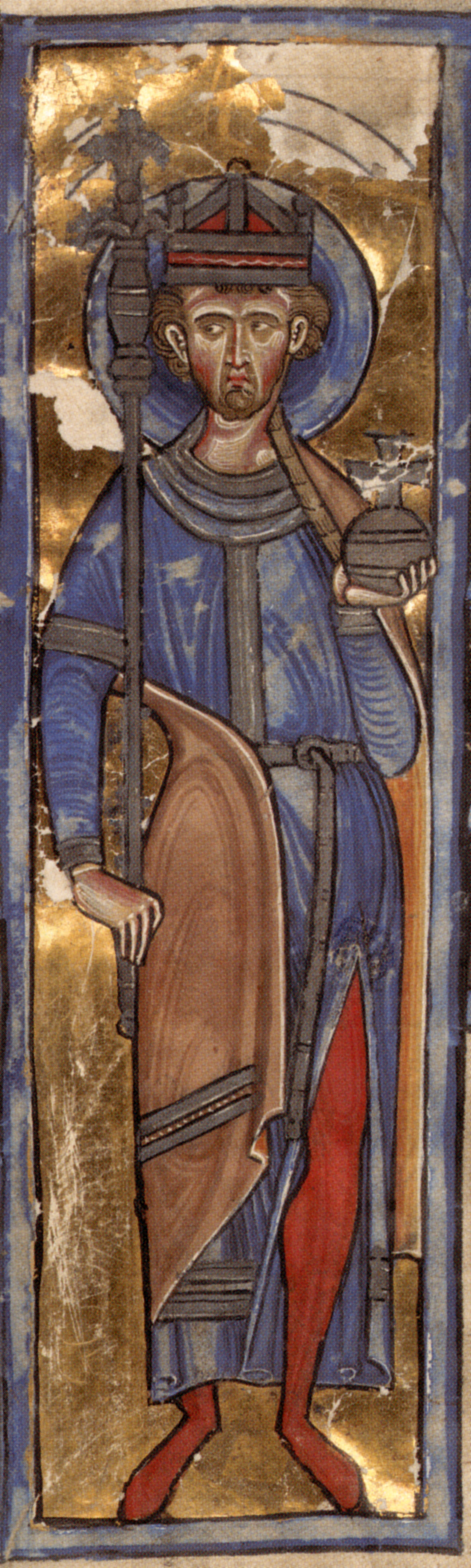
St Alexander Nevsky, the Grand Prince of Novgorod and Vladimir, my father's patron saint, and the man who last year was voted the greatest Russian of all time, is remembered today:


The Holy Prince Alexander Nevsky was born on May 30, 1220 in the city of Pereslavl-Zalessk. His father Yaroslav II, Theodore in Baptism (+1246), "a gentle, kindly and genial prince", was the younger son of Vsevolod III Large Nest (+ 1212), brother of the Holy Prince Yuri Vsevolodovich (February 4). St Alexander's mother, Theodosia Igorevna, a Ryazan princess, was Yaroslav's third wife. Their older son was the Holy Prince Theodore (June 5), who departed to the Lord at age fifteen. St Alexander was their second son.

His childhood was spent at Pereslavl-Zalessk, where his father was prince. The princely tonsure of the lad Alexander (a ceremony of initiation to be soldier) was done in the Savior Transfiguration Cathedral of Pereslavl by St Simon, Bishop of Suzdal (May 10), one of the compilers of the Kiev Caves Paterikon (Lives of the Fathers). From this Elder-hierarch, St Alexander received his first blessing for military service in the name of God, to defend the Russian Church and the Russian Land.

In 1227 Prince Yaroslav, at the request of the people of Novgorod, was sent by his brother Yuri, the Great Prince of Vladimir, to rule as prince in Novgorod the Great. He took with him his sons, Sts Theodore and Alexander. Dissatisfied with the Vladimir princes, the people of Novgorod soon invited St Michael of Chernigov (September 20), and in February 1229 Yaroslav with his sons departed to Pereslavl. The matter ended peacefully: in 1230 Yaroslav with his sons returned to Novgorod, and St Michael's daughter Theodosia was betrothed to St Theodore, the elder brother of St Alexander. After the death of the bridegroom in 1233 the young princess went to a monastery and became famous in monastic exploits as the nun St Euphrosyne of Suzdal (September 25).

From his early years St Alexander went along on his father's campaigns. In 1235 he participated in a battle at the River Emajogi (in present-day Estonia), where the forces of Yaroslav totally routed the Germans. In the following year Yaroslav went to Kiev, "settling" his son, St Alexander, to rule independently as prince at Novgorod. In 1239 St Alexander entered into marriage, taking as wife the daughter of the Polotsian prince Briacheslav. Some histories relate that the day the princess was baptized was the Name Day of her saintly spouse, and she was named Alexandra. His father, Yaroslav, blessed them at betrothal with the holy wonderworking icon of the Theodore Mother of God (the father was named Theodore in Baptism). Afterwards, St Alexander constantly prayed before this icon. Later, it was taken from the Gorodetsk Monastery, where he died, by his brother Basil of Kostroma (+1276), and transferred to Kostroma.

A very troublesome time had begun in Russian history: from the East came the Mongol Horde destroying everything in their path; from the West came the forces of the Teutonic Knights, which blasphemously and with the blessing of the Roman Pope, called itself "Cross-bearers" by wearing the Cross of the Lord. In this terrible hour the Providence of God raised up for the salvation of Russia holy Prince Alexander, a great warrior, man of prayer, ascetic and upholder of the Land of Russia. "Without the command of God there would not have been his prince."

Abetted by the invasion of Batu, by the ruin of Russian cities, by the dismay and grief of the nation, by the destruction of its finest sons and leaders, a horde of crusaders made incursions into the borders of Russia. First were the Swedes. "A king of Roman faith from the midnight land," Sweden, in 1240 gathered a great armed force and sent them to the Neva on many ships under the command of his son-in-law, Yarl (Prince) Birger. The haughty Swede sent his messengers to Novgorod to say to St Alexander: "Fight me if you have the courage, for I am already here and I am taking your land captive."

St Alexander, then not yet twenty years old, prayed a long time in the church of St Sophia, the Wisdom of God. He recited the Psalm of David, saying: "Judge, O Lord, those who injure me, fight against those who fight against me. Take hold of shield and buckler, and rise up to help me" (Ps. 34/35). Archbishop Spyridon blessed the holy prince and his army for the battle. Leaving the church, St Alexander exhorted his troops with words of faith: "The power of God is not in numbers, but in truth." With a smaller force, trusting in the Holy Trinity, the prince hastened towards the enemy to await help from his father, not knowing whether the enemy would attack, nor when.

But there was a miraculous omen: at dawn on July 15 the warrior Pelgui, in Baptism Philip, saw a boat, and on it were the Holy Martyrs Boris and Gleb, in royal purple attire. Boris said: "Brother Gleb, let us help our kinsman Alexander." When Pelgui reported the vision to the prince, St Alexander commanded that no one should speak about the miracle. Emboldened by this, he urged the army to fight valiantly against the Swedes.

"There was a great slaughter of the Latins, and a countless multitude was killed, and their leader was left with a mark upon his face from a sharp spear." An angel of God invisibly helped the Orthodox army: when morning came, on the opposite bank of the River Izhora, where the army of St Alexander was unable to proceed, was a multitude of the slain enemy. Because of this victory at the River Neva on July 15, 1240, the nation called the saint Alexander Nevsky.

The Teutonic Knights remained a dangerous enemy. In a lightning-quick campaign in 1241 St Alexander recaptured the ancient Russian fortress of Kopore, expelling the knights. But in 1242, the Germans succeeded capturing Pskov. The enemy boasted of "subjecting all the Slavic nation." St Alexander, setting forth in a winter campaign, liberated Pskov, that ancient home of the Holy Trinity, and in spring of the year 1242 fought a decisive battle against the Teutonic Order. On the ice of Lake Chud both armies clashed on April 5, 1242. Raising his hands towards the heavens, St Alexander prayed: "Judge me, O God, and judge my strife with a boastful nation and grant help to me, O God, as to Moses of old against Amalek, and to my great-grandfather Yaroslav the Wise against accursed Svyatopolk."

By his prayer, by the help of God, and by military might the Crusaders were completely destroyed. There was a terrible slaughter, and there was such a crashing of striking spears and swords that it seemed as though the frozen lake were in motion and not solid ice, since it was covered with blood. When they turned to flee, the enemy was pursued and slashed by Alexander's army "as if they sped through the air, and there was nowhere for the enemy to flee." Later, they led a multitude of captives behind the holy prince, marching in disgrace.

Contemporaries clearly understood the universal historical significance of the Great Battle of the Ice, and the name of St Alexander was celebrated throughout Holy Russia, "through all the lands, from the Egyptian Sea to Mount Ararat, from both sides of the Varangian Sea to Great Rome."

The western boundaries of the Russian land were safely secured, and it was time to guard Russia from the East. In 1242 St Alexander Nevsky and his father Yaroslav journeyed to the Horde. Metropolitan Cyril blessed them for this new service of many hardships: it was necessary to turn the Tatars from enemies and plunderers into honorable allies, and this required "the meekness of an angel and the wisdom of a snake."

The Lord crowned the holy mission of the defenders of the Russian land with success, but this required years of hardship and sacrifice. Prince Yaroslav passed from this life. Having made an alliance with Khan Batu, he was required, however, to travel to faraway Mongolia, to the capital of all the nomadic empire. The situation of Batu himself being precarious, he sought the support of the Russian princes, wishing to break with his own Golden Horde from faraway Mongolia. And there in turn, they trusted neither Batu nor the Russians.

Prince Yaroslav was poisoned. He died in agony, surviving the Holy Martyr Michael of Chernigov, whose relative he nearly became, by only ten days. Since his father bequeathed him an alliance with the Golden Horde, it was necessary for St Alexander Nevsky to hold fast to it in order to avert a new devastation of Russia. Sartak, the son of Batu, had accepted Christianity, and was in charge of Russian affairs with the Horde. He became his friend, and like a brother to him. Vowing his support, St Alexander allowed Batu to launch a campaign against Mongolia, to become the chief power in all the Great Steppes, and to raise up the Tatar Christian leader, Khan Munke (most of his Tatar Christians were Nestorians) on the throne in Mongolia.

Not all the Russian princes possessed the wisdom of St Alexander Nevsky. Many hoped for European help in the struggle against the Mongol Yoke. St Michael of Chernigov, Prince Daniel of Galich, and Andrew, St Alexander's brother, conducted negotiations with the Roman Pope. But St Alexander well knew the fate of Constantinople, seized and devastated by Crusaders in the year 1204. His own personal experience taught him not to trust the West. The alliance of Daniel of Galich with the Pope, giving him nothing in return, was a betrayal of Orthodoxy, a unia with Rome. St Alexander did not want this to happen to his Church.

When ambassadors of the Roman Pope appeared in 1248 to seduce him also, he wrote in answer that the Russians were faithful to the Church of Christ and to the belief of the Seven Ecumenical Councils: "These we know very well, but we do not accept your teaching." Catholicism was unsuitable for the Russian Church, and a unia signified a rejection of Orthodoxy, a rejection of the source of spiritual life, a rejection of the historical future foreordained by God, and the dooming of itself to spiritual death.

In the year 1252 many Russian cities rose up against the Tatar Yoke, supporting Andrew Yaroslavich. The situation was very risky. Again there arose a threat to the very existence of Russia. St Alexander had to journey to the Horde once more, in order to prevent a punitive Tatar incursion on the Russian lands. Defeated, Andrew fled to the Swedes seeking the help of those very robbers whom his great brother had crushed with the help of God at the Neva.

St Alexander became the ruling Great Prince of All Rus: Vladimir, Kiev and Novgorod. A great responsibility before God and history lay upon his shoulders. In 1253, he repelled a new German incursion against Pskov; in 1254 he made a treaty with Norway concerning peacetime borders; in 1256 he went on a campaign to the Finnish land. The chronicler called it "the dark campaign," because the Russian army went along through the polar night, "going to impassable places, unable to see neither day nor night". Into the darkness of paganism St Alexander brought the light of Gospel preaching and Orthodox culture. All the coastal region was enlightened and opened up by the Russians.

In 1256 Khan Batu died, and soon his son Sartak was poisoned, the one who was like a brother to Alexander Nevsky. The holy prince journeyed a third time to Sarai in order to confirm peaceful relations of Rus and the Horde with the new Khan, Berke. Although the successor to Batu had accepted Islam, he needed the alliance with Orthodox Rus. In 1261, by the diligent efforts of St Alexander and Metropolitan Cyril, a diocese of the Russian Orthodox Church was established at Sarai, the capital of the Golden Horde.

There followed an epoch of great Christianization of the pagan East, and St Alexander Nevsky prophetically speculated about the historical vocation of Rus. The holy prince used every possibility to uplift his native land and the ease its allotted cross. In 1262 by his decree in many of the cities the Tatar collectors of tribute and the conscription of soldiers were stopped. They waited for a Tatar reprisal. But the great intercessor of the nation again journeyed to the Horde and he wisely directed the event into quite another channel. Having been dismissed for the uprising of the Russians, Khan Berke ceased to send tribute to Mongolia and proclaimed the Golden Horde an independent entity, making it a veritable shield for Russia from the East. In this great uniting of the Russian and Tatar lands and peoples the future multi-national Russian State was matured and strengthened. Later, within the bounds of the Russian Church, was encompassed nearly the entire legacy of Ghenghis Khan to the coasts of the Pacific Ocean.

This diplomatic journey of St Alexander Nevsky to Sarai was his fourth and last. The future of Rus was rescued, his duty before God was fulfilled. But his power was wholly devoted, and his life put to the service of the Russian Church. On the return journey from the Horde St Alexander fell deathly ill. Unable to reach Vladimir, in a monastery at Gorodets the prince-ascetic gave up his spirit to the Lord on November 14, 1263, completing his difficult earthly path by receiving the monastic schema with the name of Alexis.

Metropoltan Cyril, the spiritual Father and companion of the holy prince, said in the funeral eulogy: "Know, my child, that already the sun has set for the land of Suzdal. There will be no greater prince in the Russian land." They took his holy body to Vladimir, the journey lasted nine days, and the body remained undecayed.

On November 23, before his burial at the Nativity Monastery in Vladimir, there was manifest by God "a wondrous miracle and worthy of memory." When the body of St Alexander was placed in the crypt, the steward Sebastian and Metropolitan Cyril wanted to take his hand, in order to put in it the spiritual gramota (document of absolution). The holy prince, as though alive, reached out his hand and took the document from the hand of the Metropolitan. "Because of their terror, and they were barely able to stumble from his tomb. Who would not be astonished at this, since he was dead and the body was brought from far away in the winter time."

Thus did God glorify the saintly Soldier-Prince Alexander Nevsky. The universal Church glorification of St Alexander Nevsky took place under Metropolitan Macarius at the Moscow Cathedral in 1547. The Canon to the saint was compiled at that time by the monk Michael of Vladimir.


from oca.org

20091014

King Harold II


On this date in 1066, the last Orthodox king of England, Harold Godwinson, mere days after battling Viking raiders in the north, died in defense of his homeland against the invading Norman forces in the Battle of Hastings on the southern coast of England. The leader of the invasion, William, duke of Normandy, often known today as "William the Conquerer," had long believed himself entitled to the English crown, but had found his nobles less than enthusiastic about risking an invasion. Only when William had secured a papal blessing for the invasion--in return for promising to suppress the English Church and install Norman bishops loyal to Rome--was he able to raise an army suitable for the undertaking.

Christians of Anglo-Saxon England had always recognized the Pope as their patriarch and most of them were probably not aware that, twelve years prior, the church of Rome had severed ties with the churches of the East. Thus, it must have come as a terrible shock to see their attackers, thundering toward them on their massive war horses, flying the papal banner.

On the day he died,
the God-loving King Harold, together with his loyal troops, commended themselves to God, for those whom they had honored as brethren and leaders in the Faith had foresaken them. Shouting the Orthodox English battle cry, which invoked the aid of the Holy Cross, King Harold and his faithful soldiers faced down their foes and would have had the victory in a closely matched battle...
The blessed King Harold was shot in the eye with an arrow. He plucked it out and continued to fight bravely. In the end, however, he was cut down by Norman knights and hacked to pieces. His body was desecrated, and many Norman Crusaders abused the remains of the fallen king, a thing to which not even pagans and Turks had been wont to do with the remains of their foes (Orthodox Tidings).
After the Norman invasion, English bishops were imprisoned, exiled or put to death, and were replaced by French-speaking Norman bishops. Thus England became Roman Catholic and remained so until 1534, when King Henry VIII declared himself the head of the Church of England. It is a well-known story, but one with a little-known epilogue:
To the Orthodox mind, there is an even more direct link with Hastings. Harold's daughter (born 1056) was to flee England after the Invasion for friendly Denmark and thence Russia. Here she married the future Grand-Prince of Kiev, Vladimir Monomach, in the Cathedral of Our Saviour in Chernigov in April 1074. Vladimir, himself half-Greek, was the grandson of St Anne of Novgorod, who had been baptised by the Glastonbury monk and missionary, St Sigfrid of Sweden. Among the children of Vladimir and Gytha was St Mstislav-Harold (in holy baptism, Theodore, feasted on 15 April), who bore a Slav name as well as that of his maternal grandfather. According to chroniclers, 'no woman in all the world was ever happier than her', Gytha had twelve children, another of whom, George (Yuri), founded Moscow. (Orthodox England)
Read more here:
The Fall of Orthodox England
Entry from OrthodoxWiki
Entry from Wikipedia
King Harold's Battle Force
About Bosham and the Battle
BBC article about grave of King Harold II
Royal Mystery on Brink of Solution

20091011

Good King Wenceslas


Today, Christians who observe the Old Calendar celebrate the life of King Wenceslas of Bohemia, who was martyred in 935. The Following is from Holy Trinity Church in Baltimore:

The Holy Nobleborn Prince Vyacheslav (Wenceslaus) of the Czechs was a grandson of the holy Martyress and Princess Liudmila (Comm. 16 September), and he was raised by her in deep piety. He began to rule at age 18 after the death of his father prince Bratislav (+ 920). In spite of his youthful age, he ruled wisely and justly and concerned himself much about the Christian enlightenment of the people. The holy prince was a widely educated man, and he studied in the Latin and Greek languages. Saint Vyacheslav was peace-loving. He built and embellished churches, and in the Czech capital Prague he raised up a magnificent church in the name of Saint Vitus, and he had respect for the clergy. Envious nobles decided to murder the saint and at first to incite his mother against him, and later to urge his younger brother, Boleslav, to occupy the princely throne. Boleslav invited his brother to the dedication of a church, and then asked him to tarry and stay for still another day. In spite of the warnings of his servants, the holy prince refused to believe in a conspiracy and exposed his life to the will of God. On the following day, 28 September 935, when the nobleborn Vyacheslav went to matins, he was wickedly murdered at the doors of the church by his own brother by birth and that one's servants. His body was stabbed and thrown down without burial. The mother, hearing about the murder of her son, found and placed him in a recently consecrated church at the princely court. They were not able to wash off the blood splashed on the church doors, but after 3 days it disappeared by itself. Repenting himself, the perpetrator of the fratricide transferred the relics of Saint Vyacheslav to Prague, where they were placed in the church of Saint Vitus, which the martyr himself had constructed.

St Wenceslas is also the subject of a well-known Christmas carol. The song, which recounts a legendary event in the saint's life, is really not about Christmas at all; rather it tells a story that supposedly took place on St Stephen's Day, which in the Western Church is the day after Christmas (in the Eastern Church it is two days after):

Good King Wenceslas looked out, on the Feast of Stephen,
When the snow lay round about, deep and crisp and even;
Brightly shone the moon that night, tho' the frost was cruel,
When a poor man came in sight, gath'ring winter fuel.
"Hither, page, and stand by me, if thou know'st it, telling,
Yonder peasant, who is he? Where and what his dwelling?"
"Sire, he lives a good league hence, underneath the mountain;
Right against the forest fence, by Saint Agnes' fountain."
"Bring me flesh, and bring me wine, bring me pine logs hither:
Thou and I will see him dine, when we bear them thither."
Page and monarch, forth they went, forth they went together;
Through the rude wind's wild lament and the bitter weather.
"Sire, the night is darker now, and the wind blows stronger;
Fails my heart, I know not how; I can go no longer."
"Mark my footsteps, good my page. Tread thou in them boldly
Thou shalt find the winter's rage freeze thy blood less coldly."
In his master's steps he trod, where the snow lay dinted;
Heat was in the very sod which the saint had printed.
Therefore, Christian men, be sure, wealth or rank possessing,
Ye who now will bless the poor, shall yourselves find blessing.


Read more here.

20090823

Martyr and Archdeacon Laurence of Rome

The Martyrs Archdeacon Laurence, Pope Sixtus, Deacons Felicissimus and Agapitus, the Soldier Romanus were citizens of Rome, and suffered in the year 258 under the emperor Valerian (253-259). Holy Pope Sixtus, born at Athens, received a fine education, preached in Spain and was made bishop in Rome following the martyr's death of Holy Pope Stephen (253-257, commemorated on August 2). These were times when a pope occupying the Roman throne, was known to choose death for the faith. In a short while St Sixtus also was arrested and put in prison together with his deacons Felicissimus and Agapitus.

When the holy archdeacon Laurence visited Pope Sixtus, whom they held in prison, he cried out with tears: "Whither art thou gone, father? Why hast thou forsaken thine archdeacon, with whom always thou hast offered the Bloodless Sacrifice? Take thy son with thee, that I may be thy companion in having blood shed for Christ!" St Sixtus answered him: "I have not forsaken thee, my son. I am old and go to an easy death, but yet greater sufferings await thee. Know, that after three days upon our death thou shalt follow after me. And now go, take the church treasury and distribute it to the poor and needy Christians." St Laurence zealously did the bidding of the holy hierarch.

Having heard, that Pope Sixtus had been taken to trial with the deacons, St Laurence went there so as to witness their deed, and he said to the holy bishop: "Father, I have already fulfilled thy command, and distributed by hand thine treasury; forsake me not!" Hearing something about treasure, soldiers put him under guard, and the other martyrs were beheaded (+6 August 258). The emperor locked up St Laurence in prison and ordered the chief jailer Hyppolitus to keep watch over him. In prison St Laurence with prayer healed the sick gathered together with him and he baptized many.

Astonished by this, Hyppolitus himself believed and accepted Baptism from St Laurence together with all his household. Soon the archdeacon Laurence was again brought to the emperor and commanded to produce the hidden treasure. St Laurence answered: "Give me a period of three days, and I shalt show thee this treasure". During this time the saint gathered up a crowd of the poor and the sick, who ate only because of the charity of the Church, and bringing them he explained: "Here are the vessels in which is contained the treasure. And everyone, who puts their treasure in these vessels, will receive them in abundance in the Heavenly Kingdom".

After this they gave St Laurence over to fierce tortures, urging him to worship idols. The martyr was scourged (with a fine iron flail with sharp needles), they burned his wounds with fire, and struck at him with metal switches. At the time of the martyr's suffering, the soldier Romanus suddenly cried out: "St Laurence, I behold a bright youth, who standeth about thee healing thy wounds. Beseech thy Lord Christ not to forsake me!" After this they stretched St Laurence on a rack and returned him to prison to Hyppolitus. Romanus brought there a waterpot with water and besought the martyr to baptize him. And immediately after the Baptism of the soldier, he was beheaded (+9 August). When they took St Laurence to his final torture, St Hyppolitus wanted to declare himself a Christian and die together with him, but the confessor said: "Conceal for now thy confession in thy heart.

After some length of time I shall summon thee, and thou shalt hear and come unto me. Weep not for me, but rather rejoice, for I go to receive a glorious crown of martyrdom." They placed him in an iron cage, under which they set an intense fire, and the flames of the fire flicked towards the body of the martyr. St Laurence, glancing at the governor, said: "Here now, you burn only but one side of my body, turn over the other and do my whole body". Dying, he uttered: "I thank Thee, Lord Jesus Christ, that Thou hast accounted me worthy to enter into Thy gates" -- and with these words he gave up the spirit.

St Hyppolitus took the body of the martyr by night, he wrapped it in a shroud with ointments and gave it over to the priest Justin. Over the relics of the martyr in the home of the widow Kyriake they made an all-night vigil and Divine Liturgy. All the Christians present partook of the Holy Mysteries and with honor they buried the body of the holy martyr Archdeacon Laurence in a cave on 10 August 258. St Hyppolitus and other Christians suffered three days after the death of St Laurence (13 August), as he had foretold them of this.

Troparion - Tone 4 Victorious martyr of Christ our God,by the sign of the Cross you gave sight to the blind;you distributed the riches of the Church to the poor;you were tried by fire and no evil was found in you.As you endured the burning,may your prayers extinguish the flames of our many sins,blessed Archdeacon Lawrence!

Kontakion - Tone 2 Your heart burned with divine fireas the flames of the passions died within you.God-bearing martyr Lawrence, the pillar of those who struggle,you cried out in the midst of your contest:"Nothing can separate me from the love of Christ."


From oca.org

20090804

The Holy Myrh-Bearer Equal-unto-the-Apostles Mary Magdalene

The Holy Myrh-Bearer Equal-unto-the-Apostles Mary Magdalene. On the banks of Lake Genesareth (Galilee), between the cities of Capharnum and Tiberias, was situated the small city of Magdala, the remains of which have survived to our day. Now at this place stands only the small village of Mejhdel.

In Magdala sometime formerly the woman was born and grew up, whose name has entered forever into the Gospel account. The Gospel tells us nothing about the youthful years of Mary, but tradition informs us, that Mary from Magdala was young and pretty, and led a sinful life. It says in the Gospels, that the Lord expelled seven devils from Mary. From the moment of healing Mary led a new life. She became a true disciple of the Saviour.

The Gospel relates that Mary followed after the Lord, when He went with the Apostles through the cities and villages of Judea and Galilee preaching about the Kingdom of God. Together with the pious women – Joanna, wife of Khuza (steward of Herod), Susanna and others, she served Him from her own possessions (Lk 8, 1-3) and undoubtedly, shared with the Apostles the evangelic tasks, in common with the other women. The Evangelist Luke, evidently, has her in view together with the other women, stating that at the moment of the Procession of Christ onto Golgotha, when after the Scourging He took on Himself the heavy Cross, collapsing under its weight, the women followed after Him weeping and wailing, but He consoled them. The Gospel relates that Mary Magdalene was present on Golgotha at the moment of the Lord's Crucifixion. While all the disciples of the Saviour ran away, she remained fearlessly at the Cross together with the Mother of God and the Apostle John.

The evangelists enumerate among those standing at the Cross moreover also the mother of the Apostle James the Less, and Salome, and other women followers of the Lord from Galilee itself, but all mention first Mary Magdalene; but the Apostle John aside the Mother of God, names only her and Mary Cleopas. This indicates how much she stood out from amidst all the women gathered round the Lord.

She was faithful to Him not only in the days of His Glory, but also at the moment of His Extreme Humiliation and Insult. As the Evangelist Matthew relates, she was present at the Burial of the Lord. Before her eyes Joseph and Nikodemos went out to the tomb with His lifeless Body; before her eyes they covered over the entrance to the cave with a large stone, behind which went the Sun of Life...

Faithful to the Law in which she was trained, Mary together with the other women stayed all the following day at rest, because it was the great day of the Sabbath, coinciding in that year with the Feast of Passover. But all the rest of the peaceful day the women succeeded in storing up aromatics, to go at dawn Sunday to the Grave of the Lord and Teacher and according to the custom of the Jews to anoint His Body with funereal aromatics.

It is necessary to suggest that, having agreed to go on the first day of the week to the Tomb early in the morning, the holy women, having gone separately on Friday evening to their own homes, did not have the possibility to meet together with one another on Saturday, and how only at the break of dawn the following day did they go to the Sepulchre, not all together, but each from their own house.

The Evangelist Matthew writes, that the women came to the grave at dawn, or as the Evangelist Mark expresses, extremely early before the rising of the sun; the Evangelist John, as it were elaborating upon these, says that Mary came to the grave so early that it was still dark. Obviously, she waited impatiently for the end of night, but it was not daybreak when round about darkness still ruled – she ran there where lay the Body of the Lord.

Now then, Mary went to the Tomb alone. Seeing the stone pushed away from the cave, she rushed away in fear thither where dwelt the close Apostles of Christ – Peter and John. Hearing the strange message that the Lord was gone from the tomb, both Apostles ran to the tomb and, seeing the shroud and winding cloths, they were amazed. The Apostles went and told no one nothing, but Mary stood about the entrance to the gloomy tomb and wept. Here in this dark tomb still so recently lay her lifeless Lord. Wanting proof that the tomb really was empty, she went down to it – and here a strange light suddenly prevailed upon her. She saw two angels in white garments, the one sitting at the head, the other at the foot, where the Body of Jesus had been placed. She heard the question: "Woman, why weepest thou?" – she answered them with the words which she had said to the Apostles: "They have taken my Lord, and I do not know, where they have put Him". Having said this, she turned around, and at this moment saw the Risen Jesus standing about the grave, but she did not recognise Him.

He asked Mary: "Woman, why weepest thou? Whom dost thou seek?" She answered thinking that she was seeing the gardener: "Sir, if thou hast taken him, tell where thou hast put Him, and I will reclaim Him".

But at this moment she recognised the Lord's voice, a voice which was known from the day He healed her. This was the voice in those days and years, when together with the other pious women she followed the Lord through all the cities and places where His preaching was heard. She gave a joyful shout "Rabbi" that means Teacher.

Respect and love, fondness and deep veneration, a feeling of thankfulness and recognition at His Splendour as great Teacher – all came together in this single outcry. She was able to say nothing more and she threw herself down at the feet of her Teacher, to wash them with tears of joy. But the Lord said to her: "Touch me not, for I am still not ascended to My Father; but go to My brethren and tell them: "I ascend to My Father and your Father and to My God and to your God".

She came to herself and again ran to the Apostles, so as to do the will of Him sending her to preach. Again she ran into the house, where the Apostles stayed still in dismay, and announced to them the joyous message "I have seen the Lord!" This was the first preaching in the world about the Resurrection.

The Apostles were obliged to proclaim the Glad Tidings to the world, but she proclaimed it to the Apostles themselves...

Holy Scripture does not tell us about the life of Mary Magdalene after the Resurrection of Christ, but it is impossible to doubt, that if in the terrifying minutes of Christ's Crucifixion she was the foot of His Cross with His All-Pure Mother and John, undoubtedly, she stayed with them during all the happier time after the Resurrection and Ascension of Christ. Thus in the Book of the Acts of the Apostles Saint Luke writes: that all the Apostles with one mind stayed in prayer and supplication, with certain women and Mary the Mother of Jesus and His brethren.

Holy Tradition testifies, that when the Apostles departed from Jerusalem for preaching to all the ends of the earth, then together with them also went Mary Magdalene to preach. A daring woman, whose heart was full of reminiscence of the Resurrection, she went beyond her native borders and set off to preach in pagan Rome. And everywhere she proclaimed to people about Christ and His Teaching, and when many did not believe that Christ is risen, she repeated to them what she had said to the Apostles on the radiant morning of the Resurrection: "I have seen the Lord!" With this preaching she made the rounds of all Italy.

Tradition relates, that in Italy Mary Magdalene visited the Emperor Tiberias (14-37 AD) and proclaimed to him about Christ's Resurrection. According to tradition, she took him a red egg as a symbol of the Resurrection, a symbol of new life with the words: "Christ is Risen!" Then she told the emperor about this, that in his Province of Judea was the innocently condemned Jesus the Galilean, an holy man, a maker or miracles, powerful before God and all mankind, executed on the instigation of the Jewish High-Priests and the sentence affirmed by the procurator named by Tiberias, Pontius Pilate.

Mary repeated the words of the Apostles, that believing in the Redemption of Christ from the vanity of life is not as with perishable silver or gold, but rather the precious Blood of Christ is like a spotless and pure Lamb.

Thanks to Mary Magdalene the custom to give each other paschal eggs on the day of the Luminous Resurrection of Christ spread among Christians over all the world. On one ancient hand-written Greek ustav, written on parchment, kept in the monastery library of Saint Athanasias near Thessalonika (Solunea), is an established prayer read on the day of Holy Pascha for the blessing of eggs and cheese, in which it is indicated, that the Hegumen (Abbot) in passing out the blessed eggs says to the brethren: "Thus have we received from the holy fathers, who preserved this custom from the very time of the holy apostles, wherefore the holy equal-unto-the-apostles Mary Magdalene first showed believers the example of this joyful offering".

Mary Magdalene continued her preaching in Italy and in the city of Rome itself. Evidently, the Apostle Paul has precisely her in view in his Epistle to the Romans (16, 6), where together with other ascetics of evangelic preaching he mentions Mary (Mariam), who as he expresses "has done much for us". Evidently, she extensively served the Church in its means of subsistence and its difficulties, being exposed to dangers, and sharing with the Apostles the labours of preaching.

According to Church tradition, she remained in Rome until the arrival of the Apostle Paul, and for two more years still, following his departure from Rome after the first court judgment upon him. From Rome Saint Mary Magdalene, already bent with age, moved to Ephesus where unceasingly laboured the holy Apostle John, who with her wrote the first 20 Chapters of his Gospel. There the saint finished her earthly life and was buried.

Her holy relics were transferred in the IX Century to the capital of the Byzantine Empire – Constantinople, and placed in the monastery Church of Saint Lazarus. In the era of the Crusader campaigns they were transferred to Italy and placed at Rome under the altar of the Lateran Cathedral. Part of the relics of Mary Magdalene are located in France near Marseilles, where over them at the foot of a steep mountain is erected in her honour a splendid church.

The Orthodox Church honours the holy memory of Saint Mary Magdalene – the woman, called by the Lord Himself from darkness to light and from the power of Satan to God.

Formerly immersed in sin and having received healing, she sincerely and irrevocably began a new life and never wavered from the path. Mary loved the Lord Who called her to a new life. She was faithful to Him not only then – when He having expelled from her the seven demons and surrounded by enthusiastic crowds passed through the cities and villages of Palestine, winning for Himself the glory of a miracle-worker – but also then when all the disciples in fear deserted Him and He, humiliated and crucified, hung in torment upon the Cross. This is why the Lord, knowing her faithfulness, appeared to her first, and esteemed her worthy to be first proclaiming His Resurrection.

Courtesy of Holy Trinity Church, Baltimore, MD