ATTENTION: Visitors looking for the Royal Eagle restaurant website, click here
Showing posts with label Mary. Show all posts

20100828

The Falling-Asleep ("Dormition") of our Most Holy Lady Mother of God and Ever-Virgin Mary

Troparion (Tone I): In giving birth thou didst preserve thy virginity,/ and in thy falling asleep thou hast not forsaken the world, O Theotokos./ Thou hast been, translated to life, as thou art the Mother of Life.// And by thy supplications thou dost deliver our souls from death.

Kontakion (Tone II): The tomb and mortality could not hold the Theotokos,/ who is untiring in her supplications/ and our certain hope in her intercessions./ For, as the Mother of Life, she hath passed over to the Life// Who dwelt within her ever-virgin womb.
 
The following is from a sermon by St Gregory Palamas, Archbishop of Thessalonika (emphases added):
My present talk for your appreciation is occasioned both by love, and by necessity. I speak not only by reason of my love for you, and whereof I desire that the word of salvation should gain way to your God-loving hearing, and in such manner, be imbibed of by your souls; but also, wherein it be very needful for me, in conjunction with the churchly laudations, to expound on the majesty of the ever-Virgin Mother of God. And howso this wish, being twofold against the customary wont, doth impel and incline, and thus also inevitably need compel; though word canst not comprehend, that which is higher than any word, like as the sight canst not fix its gaze upon the sun. And insofar as it be not proper to speak about that which is beyond all words, therein ought primarily the love for the Mother of God to be consecrated in psalmody. If "venerable in the eyes of the Lord be the death of His holy ones" (Ps. 115 [116]: 15), and "the memory of the righteous one is with praises" (Prob. 10:7), then how much moreso – is the memory of the Holiest of the holy ones, through Whom – hath become all sanctification for the holy ones, – is the memory of the Ever-Virgin Mother of God, She Whose memory it now becometh us to celebrate with most exalted praises? We now make celebration of the holy Dormition, or Repose, through which was She brought low before the Angels, and yet did She excel beyond compare the Angels and the Archangels, and being over them by the consequent Power of Her closeness to God and by the fore-ordained over the ages wondrous deeds wrought over Her. It was on Her account that the God-inspired prophets did prophesy, and the miracles that beforehand did point out this great and universal wonder – the ever-Virgin Mother of God; manifest of the Spirit; in various ways being the foretype of the future actuality; manifesting the promise to beget without seed He born of God the Father in eternity... The King of all greatly desired the mysteried beauty of the ever-Virgin, and within Her did transpire the incarnating of the Power of the MostHigh, not through darkness and fire as it was for the God-inspired Moses, and not through means of storm and clouds as was manifest His Presence to the Prophet Elias (Elijah), nor by means of some pretext did the Power from on High overshadow the all-pure and virginal womb. What inexpressibly transpired within Her and of Her was that the Word of God came forth incarnated in the flesh, "to appear upon earth and live amongst mankind" (Baruch 3: 38), deifying our nature and granting us, according to the Divine Apostle, that "which the Angels have desire to look forward to" (1 Pet. 1: 12) – and in this is the wondrous glorification and the all-pure glory of the ever-Virgin Mary.

And what words are there, appropriate to explain what transpired after the inexplicable birth? Whereof, the Word of God issuing from on high and begotten through Her in Her co-operating and co-willing, She also is glorified together with Him in the dignity with which He is exalted, conjoined in His great and wondrous majesty. But with the going up to Heaven of He Incarnate of Her, She in turn through what came to Her of Him, – the excelling majesty of mind and word, as it were emulating Him with manifold deeds and prayers, and likewise solicitude for all the world, and the inspiring of preachers to all the ends of the earth. And all and everywhere She was the sole support and consoler, and in every way co-operating in the proclamation of the Gospel good-news, and clearly proving Herself in it with a life filled with struggle and mastery over mind and word. Whereof, certainly, Her life and death hath carried over into Heavenly and immortal life; and the remembrance of it is a joyous feast and universal solemnity. Into the hands of Her Son was taken the God-bearing spirit of the Ever-Virgin Mary; and indeed a short while afterwards, Her kindred body was translated by Him into the eternal Heavenly habitations. And all this was fully just and proper. In actual fact, many were vouchsafed over the ages the Divine condescension, glory and might, as David likewise sayeth: "For me exceedingly be esteemed Thine company, O God, and exceedingly assured be their dominion. I do look over them, and more than the sands be they numbered" (Ps. 138 [139]: 17-18). "Many a daughter, – according to Solomon, – hath acquired riches, and many have wrought power" (Prov. 31: 29-30). And here is She – the All-Pure Virgin Mary, and She is most exceedingly exalted over all and for all: She alone hath come betwixt God and the human race, She alone of all surpassing all nature is manifest the Mother of God by nature, and through the mysteried Birth-giving She hath become the Queen of everything both in the world and of transcendent creation. And in such manner being exalted over all subject to Her through Her Herself, and having Herself been made participant of utmost choosing through the Divine Spirit, She is become the highest of any of the most exalted and most-blest Queen of blessed lineage.

And now indeed She hath celestial proper habitation, as it were a palace most becoming Her, into which today She be translated from earth, to stand at the right side of the Almighty "adorned in golden robes, aglitter" (Ps. 44 [45]: 9-10), as expressed of Her by the psalmodist prophet. Beneathe the gilded garb Her God-worthy body is aglitter with manifold virtues – wherefore She alone with the Son in God-glorified body hath celestial habitation: for the earth, the grave and death have not power to hold on ultimately to the life-originative and God-receiving body more radiant than the heavens and of heaven the habitation of the heavens. And actually, if a soul having habitation (within it) of the grace of God, forsaking the mundane, it is borne up to heaven, as becometh clear from many an example, and we do believe this: therefore, how could there not be carried up from earth to heaven that body, not only having accepted within itself the Only-Begotten and Praeternal Son of God, the inexhaustible well-spring of grace, but moreover having begotten and manifest Him? How didst Thou, though dust subject to decay, Who being yet three years of age, and not yet having in Thyself the Prae-Celestial Indwelling, not yet having begotten the Incarnated One, – how didst Thou come to take up habitation in the Holy of Holies? [Vide 21 November account of feast of Entry of the Virgin into the Temple.] Wherefore, it is in that the body, having by nature begotten, is co-glorified with the God-becoming glory (together) with He-Begotten, and it is co-resuscitated, as expressed in prophetic song, together with the three-day first-resurrected Christ, in being His "Ark of Holiness" (Ps. 131 [132]: 8). There was, moreover, the evidence of Her [assumption into heaven] for the Apostles – the plaschanitsa and burial cloths, which alone remained in the grave and which alone were found in it by those having come to look things over: just precisely the way formerly it had transpired with Her Son and Lord. But here it was unnecessary that She should tarry a certain while upon the earth, as formerly had Her Son and God; and therefore, She was straightaway taken up from the grave into celestial habitation, from whence to shine with a resplendid radiance, illumining from thence all the earthly realm. And for all the faithful this is something worthy of veneration, worthy of praise and of song. Moreover, with what was said at the start, – that She was diminished for a short time before the Angels (in the sense of tasting of death), – this also should serve to the increase in everything in the majesty of the Mother of God. Wherefore also it be entirely proper that everything be united together and considered for the presentday solemnity.

And thus it is proper, that She containing the Fulfillment of all and the Existant before all should Herself achieve all and become foremost of all by Her virtues and utmost worthiness. And thus it is, that over all the ages it helped matters that all the best individual figures were the best, but that they possessed only the beneficences of God (each individually) whether angelic or human, – but all this She doth combine within Herself, and She alone inexpressibly and supra-abundantly: finding immortality through mortality, and in the flesh finding heaven together with Her Son and God, and from that time thereof there is the abundant outpouring of supra-abundant grace for all those honouring Her. She moreover doth bestow the boldness to hasten unto Her, the vessel of so many a beneficence: generously doth She distribute blessings and for us doth never cease this useful bestowing and gracious help.

Seeing in Her the source and treasury of every blessing, whosoever declares, that the Virgin is made perfect by virtue and by living virtuously, is as one for whom there is the sensory light for the creatures living beneathe it – which is the sun. But if he transfer his mental gaze to the Sun, eternally shining forth to mankind from This Virgin, – if gazing towards this Sun, Which by nature and supra-abundance hath everything, which be granted Her by grace, then the Virgin therewith doth stand forth amidst the heavens. And this be so because of the deigning of God through all blessedness, that She hath attained to an inheritance, by far the most precious, moreso than any beneficence beneathe or beyond the skies, – just as the sky is more vast than the sun, but the sun doth shine brighter than the sky.

What word is there to describe Thine God-seemly beauty, O Virgin Mother? It is impossible indeed to explain all about Thee in reasonings and words: so much doth it exceed both mind and word. But I mustneed sing Thine praises, if Thou permit out of love for mankind. For in as Thou – art the fount of all gracious gifts and the fullness of all righteousness, the chosen and inspired image of every blessing and every good, as only alone worthy of the gifts of the Spirit, and particularly alone as having held in Thine womb He its treasure, and having co-wrought miraculous habitation for Him; and wherefore now, having passed through mortality into immortality, and rightly gone forth from earth to Heaven, into the Praeternal habitation, Thou art become co-residing in eternal time, and there (dwellest Thou), not forsaking care for Thine inheritance, but with incessant supplications to Him moving Him to mercy for all. How much closer to God of all those closest to God is the Mother of God, and how much the greatest hath She been vouchsafed, in comparison with all (meaning not only the earth-born, but all even of the Angelic holy ranks).

It was about the angelic chief-ranks that Isaiah earlier once wrote: "and the Seraphim do stand round about Him" (Is. 6: 2). But concerning Her [the Mother of God] on the other hand is David: "the Queen stood at Thy right side" (Ps. 44 [45]: 9-10). Do you not see the variance of standing? And from this variance it is possible to discern also the variance of rank according to worthiness: since the Seraphim – are but around God, while next right beside Him – the One-Only Queen, Which be praised of and glorified by God Himself, announcing as it were concerning Her to His (Angelic) Powers that are round about and saying, as was said in the Song of Songs: "Thou art fair, My Dear" (Song 6: 4), a light most sparkling, a Divine paradise most sweet and of all the world both visible and invisible the most beautiful. And She in all due justice doth stand not only nearby, but at the right side: since that, where Christ is enthroned in the Heavens, She also there now doth stand, having gone up from earth to Heaven, – not only that She did desire this, nor mutually most of all it was wanted thus in accord with some most essential laws, but rather, it was because She is His true Throne. This Throne saw also Isaiah amidst the choir of the Seraphim and he called it high and exalted (Is. 6: 1), thus indicating (by this) the exalting of the Mother of God over the Heavenly Powers. Wherefore the prophet also did present these angels as glorifying God of Her and proclaiming: the blessing of the Glory of the Lord from His place (Ezek. 3: 12). The Patriarch Jacob, contemplatively surmising this, cried out: "for awesome be this place: this be naught other than the house of God, and this the Heavenly gate" (Gen. 28: 17). And David again, in gathering together with the multitude of the saved, as though it were to avail himself of certain tonal strings or the consonant varied notes about Her the Ever-Virgin into one harmony from over the various generations, expresses it in psalmody concerning Her, saying: "I wilt remember Thy name from every generation unto generation: whereof people shalt confess Thee unto ages of ages forever" (Ps. 44 [45]: 17-18).

Do ye not see, that the whole of creation doth glorify This the Virgin Mother, and not only over the course of some prescribed interval, but rather unto ages of ages forever? It is possible hence to deduce, moreover, that She ceaseth not through all the ages to be of benefit to all creatures. Isaiah pointed this out clearly: he saw, that the Seraphim did not directly take hold the offertory coal, but took hold of it by means of a tong, by which he touched it to the mouth of the prophet, bestowing cleansing (Is. 6: 6). This vision of the tongs was identical with that great sight which Moses did contemplate – the bush amidst the flame not consumed (Ex. 3: 2). Who knows, is not this bush and these tongs the Virgin Mother, without burn receiving the Fire of Divinity, such that there was the Archangel present at the Conception [during the Annunciation], by which through Her was adjoined to the human race the Burier of the sin of the world cleansing us through this inexplicable conjoining?

If recompense be in measure of love towards God, and the loving Son be beloved of by His Father, and there be manifest the abode of Both, mysteriedly abiding and dwelling in such as conform to the promise of the Lord (Jn. 14: 21), – then who would love Him more than His Mother, for Whom be He the Only-Begotten, but also begotten virginally, so that for Her there be a twofold cause of love of Him co-united and conjoined (with Her)? And who more than His Mother would be beloved by the Only-Begotten, – and moreover Begotten of Her inexplicably in the fullness of time while yet having been Begotten of the One Only Father in eternity, – how could there not be increase in conformity in mete propriety and honour befitting Her under the law, from Him Who was come to fulfill the law?

And thus, since through Her alone was come unto us He that did "appear upon earth and live amongst mankind" (Baruch 3: 38), and before Her being unseen, such that in the time following He manifest Himself to all as the fount of Divine illumination, and the fulfilled revelation of the Divine mysteries, and the full embodiment of spiritual gifts, being moreover uncontained of all, save Her. She Herself, foremost amongst all the repository of the most exceedingly excellent plenitude of He That filleth all in all, Herself doth furnish to all of Him That containeth all, bestowing to each as is possible in accord and in proportion to the purity of each, since that She is both the repository and the Mediatrix of the riches of God.

If such be the eternal law in the heavens, that through the less there enter into communion those having great power amidst the great, then certainly the Virgin Mother doth possess farmost exceedingly incomparable influence. It is through Her that there be conjoined to God all, who otherwise would not be conjoined. And Her they do recognise as the repository of He That containeth all, which but know God, and would praise Her together with God all who but praise God. She Herself is the pardoner of all that went before Her, and intercessor of all that came after Her, and Mediatrix of eternal blessings. She – is the reason of the prophesies of the prophets, the principal of the Apostles, the affirmation of the martyrs, the foundation of the teachers. She – is the glory of the earth-born, the joy of the Heavens, and the praise of all creatures. She – is the source, the fount and tap-root of inexpressible blessings; She – is the supreme perfecting of all the holy.

O Virgin Divine and now Heavenly! How can I relate everything about Thee? How might I glorify Thee, Thou the Treasury of Glory? Through Thee is illumined the gaze of reason, through Thee is enlightened the spirit discerned of the Holy Spirit, in as Thou art rendered repository and vessel of Its gifts; yet not such which Thou wouldst affirm unto Thyself, but such as Thou wouldst fulfill all with the gifts of grace. For the Master of inexhaustible treasures foreordaineth them unto Thee for the bestowing; else why would He have wrought the blessings, and otherwise remain hidden and unbegotten? Wherefore, O Lady, grant abundantly to all Thy people and this Thine inheritance both Thy mercy and Thine gifts. Grant deliverance from the misfortunes afflicting us; behold, how much and how greatly we are oppressed from both without and within. By Thy might transform all for the best; bestow for our sufferings Thine help and healing, granting unto our souls and our bodies abundant grace for every need. And if we be not, make us worthy receptacles and as such vouchsafe that we, saved and strengthened by Thy grace, might glorify Him Incarnated of Thee for our sakes – the Praeternal Word, together with His Father Without-Beginning and Life-Creating Spirit, both now and ever and unto ages of ages. Amen.
 
(source)

20100222

Washington

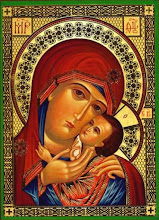
I recently read a vicious and quite uninformed criticism of this image. It's difficult to see, but it is a Renaissance painting depicting the coronation of the Virgin Mary in heaven as described in Revelation 12.

I found this criticism on an anti-Catholic website that was so ugly, uncharitable and filled with falsehoods and misrepresentations of Roman Catholic and Orthodox beliefs and practices, that I have chosen not even to provide a link. It's simply not worth directing people there.

The website uses words like "blasphemous" and "abominable," to describe images of Mary. It is sad, really, that people see an image of someone we love and admire, and whose example we strive to emulate, and they immediately charge blasphemy and idolatry.

So, with that in mind, I would like to remember the the 278th anniversary of the birth of our first president by posting some pictures not entirely unlike the one above. In fact, if one were to superimpose the Virgin Mary's face over that of Mr Washington, one might elicit charges of idolatry.

I invite my readers to consider whether the image above is really any more objectionable than those that follow:


This last image appears in the eye of the Capitol rotunda in Washington D.C. It is called "The Apotheosis of Washington." Apotheosis literally means "deification."

20090828

Feast of the Dormition

This month [today], Christians remember the Dormition—or falling asleep—of the Mother of God. Every day we celebrate those who have fallen asleep in the Lord because “the memory of the just is blessed” (Prov 10.7) and “precious in the sight of the Lord is the death of his saints” (Ps 116.15), and what is precious to God is, or at least ought to be, precious to us. But this celebration is different. The Dormition is one of the twelve Great Feasts of the Church because it shows us again a glimpse of our own salvation.

It has been said that what is true of Mary ought to be true of us. Like her, we are born into a world corrupted by sin and need the salvation of Christ. And when we imitate her life of humility, purity, holiness, obedience and love, we too can expect to join her Son in Glory.

Nearly every religion in the world believes in the afterlife, but only in Christianity do we “look for the resurrection of the dead.” The feast of the Dormition affirms this belief. It is a celebration of hope in the Resurrection. It is a reminder that we can trace our destiny through the life and actions of Mary.

Those Christians who have forgotten about Mary—and, sadly, there are a few who have done just that—would do well to remember how our lives ought to reflect her unconditional “Yes” to God. They that “hear the word of God and keep it” (Lk 11.28), who commit themselves to heavenly rather that earthly things, who respond to the Lord's call with “be it unto me according to thy word” as Mary did, will also “participate in the divine nature” (2Pet 1.2-4). They whose “soul magnifies the Lord,” can rest assured that “the Lord will exalt the humble” and “fill the hungry with good things” (Lk 1.46-55). The Feast of the Dormition reminds us of this awesome reality.

Grosse Pointe News, 20 Aug 2009

20090625

Theotokos, revisited

I try to avoid engaging guests of the monastery in discussions of theology; that's a job best left to the professionals. But the other day a woman who was part of a tour group from a local church confronted me in the gift shop in order to explain to me why we are wrong to refer to Mary as the Mother of God. "God doesn't have a mother," she insisted. "He's eternal." I briefly laid out in clear terms (or what I thought were clear terms) why it is that we affirm that it is entirely proper, in fact necessary, to call Mary, not only the Mother of God, but the Birthgiver of God, or Theotokos.

"I've heard all those arguments before," she muttered, as she waved me off and walked away.

Okay. I know she won't be reading this, but I'll write it as if she will.

We certainly don't shy away from calling Mary the Mother of God (she is identified on icons with the letters ΜΡ ΘΥ. which is an abbreviation of Μητηρ Θεου, the Greek for "Mother of God"). But dogmatically, the Church takes it one step further. According to the Third Ecumenical Council:

If anyone will not confess that the Emmanuel is very God, and that therefore the Holy Virgin is the [Birthgiver] of God (Θεοτόκος), inasmuch as in the flesh she bore the Word of God made flesh [as it is written, “The Word was made flesh”] let him be anathema.

So calling Mary Mother of God is all well and good, but if you stop there, you might be tempted to think that Mary had simply adopted Jesus and raised Him as His mother. But that's not what we believe. We believe that, from the very instant of His conception in the womb, Christ was fully God. He didn't become God some time later, which is the teaching that got Nestorius in so much trouble. So, when Mary gave birth to Jesus, she didn't give birth to a child who would someday take on divinity. She actually gave birth to God.

We don't belive that Mary is coeternal with God or that she is the mother of the Trinity. She didn't give Jesus his divinity, but she did give Him his humanity. They actually shared DNA. I heard recently that when a woman gives birth to a child, she carries some of that child's cells inside her body for the rest of her life.

Just give that a second to sink in.

Is it any wonder that we celebrate and marvel at this awesome mystery, that even the angels themselves don't fully comprehend! Who isn't awestruck at the very thought!

"He whom the entire universe could not contain was contained within your womb, O Theotokos."

And is it possible really to belive in the Incarnation and reject the belief that Mary is the Birthgiver of God? And how does one explain the reaction of Elizabeth, who was "filled with the Holy Spirit," if Mary isn't the Mother of God?

"And why is it granted to me that the mother of my Lord should come to me?" (Luke 1.43)

So, in short, insisting that Mary is not the Birthgiver of God makes one a Nestorian heretic, a denier of the Incarnation, and a rejecter of Holy Scripture. Basically, a non-Christian.

20090407

The Annunciation of our Most Holy Lady, the Theotokos and Ever-Virgin Mary

The Feast of the Annunciation is one of the earliest Christian feasts, and was already being celebrated in the fourth century. There is a painting of the Annunciation in the catacomb of Priscilla in Rome dating from the second century. The Council of Toledo in 656 mentions the Feast, and the Council in Trullo in 692 says that the Annunciation was celebrated during Great Lent.

The Greek and Slavonic names for the Feast may be translated as "good tidings." This, of course, refers to the Incarnation of the Son of God and the salvation He brings. The background of the Annunciation is found in the Gospel of St Luke (1:26-38). The troparion describes this as the "beginning of our salvation, and the revelation of the eternal mystery," for on this day the Son of God became the Son of Man.

There are two main components to the Annunciation: the message itself, and the response of the Virgin. The message fulfills God's promise to send a Redeemer (Genesis 3:15): "I will put enmity between you and the woman, between your seed and her seed; he shall crush your head, and you shall lie in wait for his heel." The Fathers of the Church understand "her seed" to refer to Christ. The prophets hinted at His coming, which they saw dimly, but the Archangel Gabriel now proclaims that the promise is about to be fulfilled.

We see this echoed in the Liturgy of St Basil, as well: "When man disobeyed Thee, the only true God who had created him, and was deceived by the guile of the serpent, becoming subject to death by his own transgressions, Thou, O God, in Thy righteous judgment, didst send him forth from Paradise into this world, returning him to the earth from which he was taken, yet providing for him the salvation of regeneration in Thy Christ Himself."

The Archangel Gabriel was sent by God to Nazareth in Galilee. There he spoke to the undefiled Virgin who was betrothed to St Joseph: "Hail, thou who art highly favoured, the Lord is with thee: blessed art thou among women. And, behold, thou shalt conceive in thy womb, and bring forth a son, and shalt call his name Jesus. He shall be great, and shall be called the Son of the Most High: and the Lord God shall give unto him the throne of his father David: And he shall reign over the house of Jacob for ever; and of his kingdom there shall be no end."

In contrast to Eve, who was readily deceived by the serpent, the Virgin did not immediately accept the Angel's message. In her humility, she did not think she was deserving of such words, but was actually troubled by them. The fact that she asked for an explanation reveals her sobriety and prudence. She did not disbelieve the words of the angel, but could not understand how they would be fulfilled, for they spoke of something which was beyond nature.

Then said Mary unto the angel, How shall this be, seeing I know not a man?" (Luke 1:34).

"And the angel answered and said unto her, The Holy Ghost shall come upon thee, and the power of the Most High shall overshadow thee: therefore also that which shall be born of thee shall be called the Son of God. And, behold, thy cousin Elisabeth hath also conceived a son in her old age: and this is the sixth month with her, who was called barren. For with God nothing shall be impossible.' And Mary said, 'Behold the handmaid of the Lord; be it unto me according to thy word.' And the angel departed from her" (Luke 1: 35-38)."

In his Sermon 23 on the day of the Annunciation, St Philaret of Moscow boldly stated that "the word of the creature brought the Creator down into the world." He explains that salvation is not merely an act of God's will, but also involves the Virgin's free will. She could have refused, but she accepted God's will and chose to cooperate without complaint or further questions.

The icon of the Feast shows the Archangel with a staff in his left hand, indicating his role as a messenger. Sometimes one wing is upraised, as if to show his swift descent from heaven. His right hand is stretched toward the holy Virgin as he delivers his message.

The Virgin is depicted either standing or sitting, usually holding yarn in her left hand. Sometimes she is shown holding a scroll. Her right hand may be raised to indicate her surprise at the message she is hearing. Her head is bowed, showing her consent and obedience. The descent of the Holy Spirit upon her is depicted by a ray of light issuing from a small sphere at the top of the icon, which symbolizes heaven. In a famous icon from Sinai, a white dove is shown in the ray of light.

There are several famous icons of the Annunciation. One is in the Moscow Kremlin in the church of the Annunciation. This icon appeared in connection with the rescue of a prisoner by the Mother of God during the reign of Ivan the Terrible. Another is to be found in the Dormition Cathedral in Moscow (July 8). It was originally located in Ustiug, and was the icon before which St Procopius the fool (July 8) prayed to save the city from destruction in 1290. One of the most highly revered icons in Greece is the Tinos icon of the Annunciation (January 30).

The Annunciation falls during Lent, but it is always celebrated with great joy. The Liturgy of St Basil or St John Chrysostom is served, even on the weekdays of Lent. It is one of the two days of Great Lent on which the fast is relaxed and fish is permitted (Palm Sunday is the other).

From OCA

20090323

How We Worship

From St Innocent Orthodox Church (bold and italics have been added)

The Eastern Orthodox understanding of worship begins with the scriptural understanding that there are other heavenly or spiritual beings: angels and archangels, cherubim and seraphim. The Scriptures teach that in worship, believers are surrounded by and worship within this communion of heavenly hosts. As the Prayer of Entrance says, "O Sovereign Lord, our God, Who appointed in heaven the orders and armies of angels and archangels for the service of Your glory, grant that the holy angels may enter with us to serve and glorify Your goodness with us." Or, as the prayer during the Thanksgiving acknowledges of God, "for this liturgy which You are pleased to accept from our hands, though there stand before You thousands of archangels, and myriads of angels, cherubim and seraphim, six-winged, many-eyed, soaring high on their wings; singing, proclaiming, shouting the Hymn of Victory."

In other words, we should worship God on earth as he is shown to be worshiped in heaven. As the letter to the Hebrews tells us, there is "a heavenly pattern" behind the liturgical life of the Church of then (Israel) and now. If we consider the Old Testament pattern and the visions of heavenly worship found in Isaiah, Ezechiel and Revelation, several elements are consistent:
      • use of light, candles, candelabras

      • use of vestments, crowns

      • thrones

      • incence, smoke

      • liturgical (fixed) prayers, patterns and expressions

      • physical movements (bowing down, prostrations, etc)
These are the elements found in Orthodox worship. However strange they may seem to one raised in the Western/Protestant Christian tradition, they are soundly Scriptural and hark back to the earliest apostolic times.

Worship in the Kingdom
Consistent with the earliest Christian beliefs, worship involves this heavenly host because Christian worship takes place in the Kingdom of God before the heavenly throne (see, for example, Isaiah 6: 1-8). Also gathered around the throne are all the Saints who Christians remember and who join in the worship. Christians pray for those who partake of the gifts of the Eucharist, and say "Furthermore, we offer to You this spiritual worship for those who in faith have gone on before us to their rest: forefathers, fathers, patriarchs, prophets, apostles, preachers, evangelists, martyrs, confessors, ascetics and every righteous spirit made perfect in faith, especially for our most holy, most pure, most blessed and glorious Lady, the Mother of God and Ever-virgin Mary". Christians throughout the ages have affirmed the "great cloud of witnesses" (Heb. 12: 1), those Saints who have gone before. Christians pray for them even as they believe and expect the Saints pray for them.

The Physical Dimension of Worship
The Scriptures teach that God created human beings as physical as well as spiritual beings. To deny this physical aspect of being human is to deny the nature of the creation. The challenge is to affirm this physical aspect of being human in a manner which is edifying and which builds up and conforms the believer to the image of Christ.

Furthermore, the Incarnation of Jesus, the taking on of human flesh and possession of both human and divine natures, is the ultimate affirmation of the inherent goodness of creation. To deny the physical side of being human, or to affirm the spiritual at the expense of the physical, is simply not Christian. In Orthodox worship all senses are involved, through the smell of incense, the sight of candles and icons, the hearing of prayers and music, and the taste of the Eucharist.

Read the rest here

20090207

Mary, Part 5 - The Ark

This post is adapted from a study entitled "The Ark and the Mary the Theotokos" [sic]

The liturgical readings and hymns for the feast of the Dormition of Theotokos make it clear that the Church sees the Ark of the Covenant as the type of Mary the Theotokos who is herself the type or icon of the Church. As we shall see, this typology is solidly scriptural and it was clearly understood by the holy fathers:

Athanasius of Alexandria: “O noble Virgin, truly you are greater than any other greatness. For who is your equal in greatness, O dwelling place of God the Word? To whom among all creatures shall I compare you, O Virgin? You are greater than them all O [Ark of the] Covenant, clothed with purity instead of gold! You are the ark in which is found the golden vessel containing the true manna, that is, the flesh in which divinity resides.” (Homily of the Papyrus of Turin)

Gregory the Wonder Worker: “Let us chant the melody that has been taught us by the inspired harp of David and say, 'Arise, O Lord, into your rest; you and the ark of your sanctuary.' For the Holy Virgin is in truth an ark, wrought with gold both within and without, that has received the whole treasury of the sanctuary.” (Homily on the Annunciation to the Holy Virgin Mary)

The Septuagint is especially significant if one considers the parallel between Exodus and Luke: At the Annunciation, Gabriel declared: “The Holy Ghost shall come upon thee, and the power of the Highest shall overshadow thee” (Lk 1.35). Here, the word translated “overshadow” [ἐπισκιάσει] is used nowhere else in the New Testament. It occurs only once more in the Greek Scriptures (LXX and NT), specifically in Exodus 40:34-35 (EOB): The cloud covered the tabernacle of witness and the tabernacle was filled with the glory of the Lord. Moses was not able to enter into the tabernacle of testimony, because the cloud overshadowed it and the tabernacle was filled with the glory of the Lord.

In the LXX, the word often translated as “settled down upon” (“the cloud had settled on it”) is the same as Luke's word “overshadow.” Clearly, Luke is making a correspondence between the power and glory of God overshadowing Mary just as it overshadowed the Ark of the Covenant in the tent. The rest of Luke’s account makes this typology very obvious:


The Ark of the Old Covenant Mary: The Ark of the New Covenant
The Ark traveled to the house of Obed-Edom inthe hill country of Judea (2Sm 6.1-11)Mary traveled to the house of Elizabeth and Zechariah in the hill country of Judea (Lk 1.39)
Dressed as a priest, David danced and leapt in front of the Ark (2Sm 6.14)John the Baptist—of priestly lineage—leapt in his mother's womb at the approach of Mary (Lk 1.41)
David asks, “How can the Ark of the Lord come to me?” (2Sm 6.9)Elizabeth asks, “Why is this granted me, that the mother of my Lord should come to me?” (Lk 1.43)
David shouts in the presence of the Ark (2Sm 6.15)Elizabeth “exclaimed with a loud cry” in the presence of the Mary (Lk 1.42)
The Ark remained in the house of Obed-Edom for three months (2Sm 6.11)Mary remained in the house of Elizabeth for three months (Lk 1.56)
The house of Obed-Edom was blessed by the presence of the Ark (2Sm 6.11)The word blessed is used three times (Lk 1.39-45)
The Ark returns home and later on goes Jerusalem to be placed in the temple (2Sm 6.12; 1Kg 8.9-11)Mary returns home and later on goes Jerusalem, where she presents the incarnate Word of God in the temple (Lk 1.56, 2.21-22).

Other similarities between the Ark and the Theotokos are presented below:

Inside the Ark of the Old Covenant Inside Mary, Ark of the New Covenant
The stone tablets of the law = the word of God engraved in stoneThe body of Jesus Christ = the Word of God made Flesh
The jar filled with manna from the wilderness which was a miraculous bread from heaven Jesus, the bread of life from heaven (Jn 6.41)
The rod of Aaron that budded to establish his status as true high priestThe actual and eternal Great High Priest of the God Most High
Vision of the ArkVision of the Woman
"And the temple of God was opened in heaven, and there was seen in his temple the ark of his testament: and there were lightnings, and voices, and thunderings, and an earthquake, and great hail." (Rev 11.19)"And there appeared a great wonder in heaven; a woman clothed with the sun, and the moon under her feet, and upon her head a crown of twelve stars." (Rev 12:1)

20081223

Mary, Part 4 - Veneration

"There is an equal harm in both these heresies, both when men demean the Virgin and when, on the contrary, they glorify Her beyond what is proper." St. Epiphanius of Cyprus, Panarion: Against the Collyridians

Pope Pius IX, in his 1854 bull Ineffabilis Deus, formally defined as dogma of the Roman Catholic Church the doctrine of the Immaculate Conception. According to this belief, Mary's soul, "in the first instant of its creation and in the first instant of the soul's infusion into the body, was, by a special grace and privilege of God, in view of the merits of Jesus Christ, her Son and the Redeemer of the human race, preserved free from all stain of original sin."

It would take someone with far more knowledge than I have to provide a proper explanation of the Orthodox Church's objection to this doctrine. Such an explanation would involve a look at the Church's understanding of original sin, and a discussion of Mary's human nature, which she would necessarily have had to pass along to her Son. It will suffice for now to say that the Orthodox Church has never accepted the Roman Catholic doctrine of the Immaculate Conception. (However, those of my readers who are interested in learning more about the Orthodox understanding of this subject can find excellent and fascinating essays by two prominent Orthodox bishops here and here)

The Orthodox feel, not only that the doctrine of the Immaculate Conception is incorrect, but also that it clears the way for more objectionable teachings. For example, there is a movement underway among Roman Catholic clergy and laity to petition the Pope for an official bestowing on Mary of the titles "Co-Redemptrix," and "Mediatrix of all Graces."

At the extreme opposite end of the Marian spectrum is the Protestant attitude toward Mary, which can be summed up in two words:

"Mary who?"

Never have I been to a Protestant church service in which Mary--if she is mentioned at all--is referred to as anything other than as an historical figure. In my twenty years as a Baptist, I don't know that I ever heard a pastor utter the name "Mary" when he wasn't flanked either by Christmas trees or Easter lilies. In the Lutheran church that Kathryn and I attended, more than thirty stained glass windows adorn the walls of the nave depicting all twelve Apostles, Sts Paul, Polycarp, and Athanasius, Ruth and Naomi, and even Dorcas, the dressmaker from Acts chapter 9. Can you guess who is not shown?

Why is there such an aversion to Mary among Protestants? The best sense I have been able to make of it is that it is a reaction to the excesses of Roman Catholic Marian devotion. An article quoted on the This is Life! blog sums up why this is not a good thing (emphases are my own):

The Church catholic has always kept Jesus and Mary close together, as evidenced by the ecumenical confession of Mary as Theotokos, "Mother of God." This title was formally authorized by the General Council of Ephesus (A.D. 431), a council convened not to address Mariology but Christology. At a deep intuitive level, the Church has understood that her confession of the Incarnation of the eternal Word is intrinsically connected to the veneration of the blessed Virgin. Yet for some reason Protestants, including the overwhelming majority of Anglicans, do not intuit this connection. . . .

Something is very wrong with Protestantism. Our ecclesial communities do not generate a devotion to Mary. This absence of Marian devotion suggests to me a theological flaw. . . .

The Protestant, of course, immediately protests: "I believe in the Incarnation as strongly as any Catholic or Orthodox Christian!" But the fact remains that all of Protestantism has lost Mary, and many forms of Protestantism are now on the verge of losing Christ.

This raises a critical question for me: Is a Protestant competent to offer judgment on Marian devotion or Marian titles? I am beginning to suspect that no matter how "orthodox" we Protestants think we are in our doctrine of the Incarnation, we in fact are not. We have not faithfully appropriated the orthodox doctrine, because we have deleted Mary from the Church's life of worship and prayer.

This deletion of Mary is both evidence of our deficiency in our understanding of the Incarnation and a cause of this deficiency. Something is very wrong when our teaching and love of Christ does not generate the kind of hymnody, veneration, and devotion that is common in Orthodoxy and Catholicism. . . .

Within the tradition and history of the Church, a lively faith in Jesus as the incarnate Word has gone hand-in-hand with a lively veneration of his blessed Mother. Yet for Protestants, Mary remains a person of the past, much like Abraham, David, and John the Baptist. One must wonder if we really have understood the mystery of the Incarnation.
Mary herself said, "From henceforth all generations shall call me blessed." This is not something I have seen in Protestantism. But she also said "My soul doth magnify the Lord." not vice versa, as often seems to be the case in Roman Catholicism. Not until I found Orthodox Christianity did I finally see what it means to give Mary her due honor; only then did I discover a middle ground between the Roman Catholic deification of Mary and her near omission by Protestants.

Mary is given a special place in the Orthodox Church, where she is hailed as being "more honorable than the Cherubim and more glorious, beyond compare, than the Seraphim." But she is not seen as a goddess, nor as the fourth person of the Trinity; She is not given honor that is due to God alone: "Just as with the Holy Icons, the veneration due Mary is expressed in quite different words in the Greek writings of the Fathers than that due God." In the Orthodox Church, Mary is very seldom depicted without Christ (the image above is from a Roman Catholic website), and is attributed only with the power to intercede for us to her Son. She is lauded for her obedience to God and for her example of humility and piety.

According to the Orthodox Christian Information Center, Orthodox Christians "do not 'worship' the Virgin Mary. We 'venerate' her and show her great honor. Nor have we ever, like the Latins, developed the idea that the Theotokos was born without sin (the Roman Catholic dogma of the Immaculate Conception) or that she is a co-redemptor with Christ (the cult of the Redemtrix in the Latin Church). The consensus of the Church Fathers rejects such ideas, and the Orthodox Church adheres to that consensus."

Orthodox Christians recognize that, "where the God-Man is, so also, in Him, His Mother, His saints, His angels and His righteous ones are present. In Him—and only in Him—we have fellowship with them and ask their help. His Mother is truly Mother of us all in the Church, where she holds the most exalted position, closest to Christ, but she does not act independently from Him. She is not the Mother of the Church, nor the Mediatrix of all graces, nor the Co-Redemptrix" (Orthodox Info)

For more information:
The Veneration of the Virgin Mary in the Orthodox Church
The Orthodox Veneration of Mary the Birthgiver of God
Veneration of the Virgin Mary

20081123

Q&A

Q: Excuse me, did I just hear the priest say "most holy Theotokos save us"? Please explain how that is not blatantly contrary to Scripture, since "no one comes to the Father, except through" Jesus, (Jn 14.6), who came to "save that which was lost" (Matt 18.11), and since "there is no other name under heaven given among men, whereby we must be saved (Acts 4.12). Calling upon Mary to "save us" is in direct opposition to the teachings of the Bible!

A: Yeah, that freaked me out the first time I heard it, too. It was at the very first Vespers service that I attended at a local Greek parish, and I thought, "This could be the deal-breaker." It bothered me so much that I confronted the priest afterwards.

He admitted that it is a difficult thing for a Protestant to hear, and that it troubled him the first time he heard it, too (he was a convert from Pentecostalism). He explained to my satisfaction why this phrase is not improper or contrary to biblical teaching, but it is still a little uncomfortable for me to heard it, even now, especially having come from a faith tradition in which Mary is little more than an afterthought. I suppose it just takes some getting used to.

So, is the statement "Theotokos, save us" really attributing to Mary something that should only be attributed to God? Is this usurping the work of Christ? It seems to, but rest assured that Orthodox Christians do not believe for one second that Mary died on the cross for our sins, or that she rose from the dead, or that she is seated at the right hand of the Father, etc. Any Orthodox Christian will tell you that it was Christ and Him alone "who for us men and for our salvation came down from the heavens." The prayers and hymns and writings of the Orthodox Church testify again and again to this foundational, non-negotiable truth.

Well, then if the Bible says, and the Orthodox believe, that there is no other name whereby we must be saved, isn't the statement in question plainly contrary to both? It would appear so, but if this sort of language were truly contrary to biblical teaching then we would, of course, expect no similar use of the word "save" in Scripture, except in reference to the direct work of God. Right?

However, we read in the Bible that St Paul hopes to save the Jews through his example (Rom 11.14), and that he believes that by being "all things to all men" he may save some (1Co 9.22). He also tells husbands and wives that they are able to save each other (1Co 7.16), and says that he himself was saved through the prayer of the Philippians (Php 1.19).

Paul later tells his protégé Timothy that he can save himself and others by his adherence to doctrine (1Ti 4.16), and that a woman can be saved by bearing and raising a faithful Christian (2.15).

St Peter is said to be able to save entire households merely by his words (Acts 11.14), and St Jude instructs us to save people with fear (Jude 1.23). St James tells us that prayer can save the sick (Jam 5.15), and that when we convert a sinner, we save a soul and "cover a multitude of sins" (v.20).

Clearly it's not contrary to biblical teaching to believe that we have a role in the salvation of others. We don't save them by dying on the cross, of course, but by preaching the Gospel, by prayer, by being a good example. It's worth mentioning at this point that the Orthodox do not believe, as their Protestant brethren do, that salvation is the result of a one-time, momentary conversion of faith. Rather, it requires daily, hourly, minute-by-minute conversion. That is, constant repentance and self-denial. That's why serious Orthodox Christians go to church every day, and surround themselves with religious imagery, and give alms, and fast regularly, and pray constantly, and make the sign of the cross about eleven-thousand times a day: not because they believe these good works will earn them a place in heaven, but because they want to stay constantly focused on Christ, and away from self, and tuned-in to what is true and honest and just and pure and lovely. It is also why Orthodox Christians rely on the prayers and good council of other Orthodox Christians: to keep them on the straight and narrow. It is in this manner that Orthodox Christians save each other, just like Sts Paul, Peter and Timothy did.

Is it really unreasonable, then, to think that Mary can likewise save us?

Should we not look to her for her prayer and for her example of obedience, so that we will not deliberately keep on sinning, but will continue grounded and settled in the faith; so we will continue to do the will of God, and work out our salvation with fear and trembling; so that we will not be cut off, or disqualified, or denied; so we won't come out worse in the end than we were at the beginning and be assigned a place with the unbelievers?

Like so many other things in the Orthodox Church, the phrase "Most holy Theotokos, save us," is indeed arresting and horrifying to a lifelong Protestant like me. But, like so many other initially arresting, horrifying aspects of Orthodoxy, this phrase does prove, on close examination, to be perfectly consistent with biblical teaching. And as I become more and more familiar with the context surrounding certain Orthodox statements and actions and disciplines, the more clearly I can see how much sense they make within the broader scope of Orthodox worship and devotion.

Read these for more information:
Orrologion (blog): On Prayer to the Saints; or, "Everything which is God's became man's"
Pillar and Ground of Truth (blog): "Most holy Theotokos, save us!" Part 1, Part 2, Part 3

20081019

Mary, Part 3 - Theotokos


In April 428, a man named Nestorius became Archbishop of Constantinople, a position which was, and is, one of great honor and influence within the Church. During his tenure, he took issue with, and began to preach against, use of the title Theotokos (Θεοτόκος: "God bearer") for Mary, claiming that the divine and human natures of Christ were separate, and so Christotokos (Χριστοτόκος: "Christ bearer") was a more appropriate term.

Other Church leaders, including Cyril, the Archbishop of Alexandria, rejected the teaching that Christ's natures were separate, and convened a Church council in Ephesus in 431 to define, once and for all, the proper understanding of this vital aspect of the Incarnation. They determined that while Christ did, in fact, have two natures, they existed together in hypostasis (ὑπόστᾰσις). Therefore, they reasoned, while Mary was certainly the mother of Christ, to call her simply Christotokos leaves too much room for error with regard to our understanding of Christ's Incarnation. Ultimately, the Church condemned Nestorius as a heretic and declared that Mary is, and shall be, properly referred to as Theotokos.

So, why didn't the Church just define Mary as Mήτηρ τοῦ Θεοῦ (Mother of God)? Because one can mother a child without necessarily bearing him. "Theotokos" actually refers to physical childbirth, while "Mother of God" implies nurturing and rearing. Mary certainly did raise and nurture Christ, but one can to that to an adopted child as well. To say Mary bore Christ leaves no room for doubt that Mary, a virgin, did in fact give birth to a child as prophesied, and that that child was, in fact, God.

Theotokos is a title that the Church has used for more than 1500 years, and that is, in fact, entirely consistent with Scripture (see Lk 1.43), and yet I never once heard it while I was a Protestant. Is there something objectionable about this title? The Church is very clear that it is not intended to imply that Mary is greater than, or equal to, God, or that she is the mother of the Christ's deity or of the Holy Trinity. The title Theotokos is not meant to elevate Mary, but to safeguard a proper understanding of the Incarnation. As Matthew Gallatin writes, "when you face the fact that Mary is Jesus' mother, you realize that what you call her must be entirely consistent with who you believe Jesus to be" (Thirsting for God, p.160).

If the Church felt, and has taught for more than fifteen centuries, that calling Mary Theotokos was necessary in order to affirm the doctrine of the Incarnation, what reason could I have to ignore or reject it? And could I do so and truly hope to affirm the Incarnation myself?

The Mother of God

20080928

Mary, Part 2 - Ever Virgin

As I have already mentioned, I grew up hearing very little about Mary. In fact, the only two specific teachings about Mary that I can even recall from my years as a Baptist were that she was a virgin at the time of Christ’s birth, and that she did not remain a virgin all her life. And I had no problem with either of these doctrines; it seemed to me that the Bible was pretty clear on both of them.

Upon closer examination, however, I can see now that the Bible isn’t quite as clear on this second teaching as I had originally thought. Although the teaching of the Church on the matter is clear indeed: Mary remained a virgin before, during, and after the birth of Christ. This teaching has been with the Church since the beginning, was confirmed by the Fifth Ecumenical Council, and received no serious opposition until long after the Reformation. In fact, Luther, Calvin, Zwingli, Bullinger, and John Wesley all recognized Mary’s perpetual virginity. Denial of this doctrine, it seems, is a fairly recent innovation.

So, who cares, really? Is it that important to insist that Mary remained a virgin her entire life? The Greek Archdiocese says that “the Orthodox Church proclaims the Gospel of Jesus Christ. This is our message, our reason for being, the very life of our life. Teaching about Mary is really meant for the initiates, those who have already accepted the Gospel and have committed themselves to Christ and to service in His Church. What Mary teaches us about the Incarnation of the Word of God requires that we first accept the Incarnation.”

Deacon Fr. John Whiteford writes that, “this doctrine is not taught for the sake of upholding the sanctity of the Virgin Mary, but because of the uniqueness and holiness of her Son. Consider the following verse: ‘Then said the LORD unto me; This gate shall be shut, it shall not be opened, and no man shall enter in by it; because the LORD, the God of Israel, hath entered in by it, therefore it shall be shut.’ (Ezekiel 44:2). This has always been interpreted by the Fathers of the Church to be a typological reference to the Virgin Mary and the Incarnation. When we consider that God took flesh from the Virgin's womb, it is not difficult to imagine that this womb would remain virgin.”

I have heard Mary referred to also as the Ark of the New Covenant. This is another bit of Marian typology about which I really can’t say a whole lot, other than, if Joseph recognized her as such, he surely would rather have not suffered the same fate as Uzzah (2Sam 6.6-7).

(The guys at “Our Life in Christ” have put together a fascinating series of podcasts on this very topic. You can find them at Ancient Faith Radio, or click here to listen to the first one)

So, what are some of the objections to Mary’s perpetual virginity?

“Until”
. . . and [Joseph] did not know her until she had brought forth her firstborn Son” (Mt 1.25).

The thinking goes: If Joseph did not "know" Mary until she gave birth to Jesus, then clearly he "knew" her afterwards.

It is important, first of all, to keep in mind that the Bible was not written in English, and that not all Greek (or Hebrew or Aramaic) idioms convey the same meaning in English as they were originally intended. This is one that doesn't. In English, the word "until" (or "till" or "unto") indicates a particular status up to a point in time, while implying a different status after that point. In the original language, "until" (Greek: ἕως or ἕως οὗ) does not necessarily imply a change of status. Consider the following passages:

And he buried him in a valley in the land of Moab, over against Bethpeor: but no man knoweth of his sepulchre unto (ἕως) this day (Dt 34.6).

Therefore Michal the daughter of Saul had no child until (ἕως) the day of her death (2Sam 6.23).

In his days may the righteous flourish, and abundance of peace till (ἕως οὗ) the moon is no more (Ps 72.7).

The Lord said unto my Lord, Sit thou at my right hand, until (ἕως) I make thine enemies thy footstool (Ps 110.1).

His heart is established, he shall not be afraid, until (ἕως οὗ) he see his desire upon his enemies (Ps 112.8).

So our eyes wait upon the Lord our God, until (ἕως οὗ) that he have mercy upon us (Ps 123.2).

"...if the mighty works, which have been done in thee, had been done in Sodom, it would have remained until (ἕως) this day" (Mt 11.23).

"...and, lo, I am with you always, even unto (ἕως) the end of the world" (Mt 28.20).

Till (ἕως οὗ) I come, give attendance to reading, to exhortation, to doctrine (1Tim 4.13).

We have also a more sure word of prophecy; whereunto ye do well that ye take heed, as unto a light that shineth in a dark place, until (ἕως οὗ) the day dawn, and the day star arise in your hearts (2pet 1.19)
It is not necessary that “until” in any of these verses is intended to indicate a reversal. Nor, according to the Church, is this the intent of Matthew 1.25.

“Firstborn”
Again, a problem with language. In English, the word "firstborn" implies a secondborn. However, in Greek, the word for "firstborn," prototokos (πρωτοτόκος), does not imply subsequent children. Exodus 13.2 identifies the “firstborn” (πρωτότοκον) as the child that “openeth the womb.” Likewise Numbers 3.12 (πρωτοτοκου). The Mosaic Law required parents to sanctify their firstborn son to the Lord (see Ex 34.20). Are we to believe that parents were expected to do so only after the second son was born?
Consider also whether the "firstbegotten" mentioned in Hebrews 1.6 could possibly imply a "secondbegotten." In the following passages, "firstborn" or "firstbegotten" indicate Christ's status as Heir to the Kingdom rather than order of birth:

For whom he did foreknow, he also did predestinate to be conformed to the image of his Son, that he might be the firstborn (πρωτότοκον) among many brethren (Rom 8.29).

Who is the image of the invisible God, the firstborn (πρωτοτόκος) of every creature (Col 1.15).

And he is the head of the body, the church: who is the beginning, the firstborn (πρωτοτόκος) from the dead; that in all things he might have the preeminence (Col 1.18).

To the general assembly and church of the firstborn (πρωτότοκον), which are written in heaven, and to God the Judge of all, and to the spirits of just men made perfect (Heb 12.23).

And from Jesus Christ, who is the faithful witness, and the first begotten (πρωτοτόκος) of the dead, and the prince of the kings of the earth (Rev 1.5).
Brothers and Sisters
Several passages in the New Testament (Mt 12.46–47, 13.55–56; Mk 3.31–32, 6.3; Lk 8.19–20; Jn 2.12, 7.3–5; Acts 1.14; 1Co 9.5) mention Christ’s brothers and sisters. The word used in every case, adelphos (αδελφος), is usually translated “brother,” but is often used less specifically. As Fr. John Hainsworth writes, the word adelphos, “which can mean ‘brother,’ ‘cousin,’ ‘kinsman,’ ‘fellow believer,’ or ‘fellow countryman,’ is used consistently throughout the LXX [i.e., the Old Testament], even when cousin or kinsman is clearly the relation described. (as in Genesis 14:14, v.16; 29:12; Leviticus 25:49; Jeremiah 32:8, 9, 12; Tobit 7:2; etc.).

“Lot, for instance, who was the nephew of Abraham (cf. Genesis 11:27–31), is called his brother in Genesis 13:8 (αδελφοι) and 14:14–16 (αδελφος, αδελφον). The point is that the commonly used Greek word for a male relative, adelphos, can be translated ‘cousin’ or ‘brother’ if no specific family relation is indicated.”

These "brothers" and "sisters" of Jesus are understood to be His cousins, or, as is the case with James* and Jude, His step-brothers. These two were Joseph’s sons by his first wife, Solomonia, who had died, leaving Joseph a widower. They weren’t sons of Mary, but they were, in a sense, brothers of Christ, and are referred to as such by the Orthodox Church.

*That's James of the Seventy (Mt 13.55, Mk 6.3, Acts 12.17, 15.13, Epistle of James), not James the son of Zebedee (Mt 4.21, Mk 3.17, Lk 5.10), or James the son of Alphaeus (Mt 10.3, Mk 3.18, Lk 6.15, Acts 1.13), both of the Twelve.

In fact, there is no place in the Scriptures where the “brothers and sisters” of Christ are referred to as the “sons and daughters” of Mary. Nowhere is Mary said to have had other children. Which is why Christ saw fit, as He hung on the cross, to entrust the care of His mother to His disciple John. Such an act would have been a grave insult to Mary’s other children, had there been any.

Marriage
Another objection to the doctrine of Mary’s perpetual virginity is her marriage to Joseph. If Mary and Joseph were married, the argument goes, shouldn’t they have been having sex? Perhaps, but, get this: the Bible never actually says that Mary and Joseph ever married. Yeah, that’s right. It says they were betrothed, or “espoused” (Mt 1.18), but it does not say that they went on to be married. The rite of betrothal, which in first-century Jewish culture came right before marriage, was a formal, legal state of “engagement” that conferred all the responsibilities of marriage with none of the, ahem, benefits. The Orthodox Church, in fact, still observes the rite of betrothal to this day. Betrothal was regarded as somewhere between our modern “engagement” and marriage. It wasn’t quite marriage, so “knowing” each other would have been improper. However, betrothed couples could be referred to as “husband” (Mt 1.19) and “wife” (v.20; Lk 2.5), and breaking off a betrothal required a divorce.

So, if they weren’t to be married, what was the point of putting Mary and Joseph together? It was his duty to support her while she reared the Messiah, and to protect her from suspicions about the legitimacy of her pregnancy.

Something we didn't learn about in the Protestant world is that Mary was, from a very young age, devoted to a life of celibacy and service to God. I suppose you might call her a first-century nun. The story goes that Mary’s parents Joachim and Anna, “praying for an end to their childlessness, vowed that if a child were born to them, they would dedicate it to the service of God” (oca.org). They fulfilled their promise once Mary reached the age of three, and brought her to the Temple, where she stayed until she reached puberty, when she was placed in the care of a widower named Joseph.

Knowing this makes it easy to understand why she responded the way she did when the Archangel Gabriel appeared to her and proclaimed:

“Hail, thou that art highly favoured, the Lord is with thee: blessed art thou among women. Thou hast found favour with God. And, behold, thou shalt conceive in thy womb, and bring forth a son.”

To which she answered, “Well, duh! I am about to get married, after all.”

No. She responded by asking, “How can this be?”

Why did she ask this? Was she confused as to the biological process of childbirth?

No. She knew that, given her vow of celibacy, childbirth would have been impossible. Her response might as well have been: “I’m sorry, but you must have me confused with someone else. You see, I am a consecrated virgin…”

What else?
Okay, I think, at the very least, it's reasonable to admit that the Scriptures allow for the possibility that Mary had no other children besides Jesus, and that she and Joseph never "knew" each other, or should have. In other words, the Bible does not explicitly deny that Mary remained ever-virgin.

But what do others have to say? Those who know more about the nuances of the original text, and about the theology and history of the Church than I or any of my readers do, or ever will?

"The Book [the Protoevangelium] of James [records] that the brethren of Jesus were sons of Joseph by a former wife, whom he married before Mary. Now those who say so wish to preserve the honor of Mary in virginity to the end, so that body of hers which was appointed to minister to the Word . . . might not know intercourse with a man after the Holy Spirit came into her and the power from on high overshadowed her. And I think it in harmony with reason that Jesus was the firstfruit among men of the purity which consists in [perpetual] chastity, and Mary was among women. For it were not pious to ascribe to any other than to her the firstfruit of virginity" (Origen, Commentary on Matthew 2:17; c. 248).

"If they [the brethren of the Lord] had been Mary’s sons and not those taken from Joseph’s former marriage, she would never have been given over in the moment of the passion [crucifixion] to the apostle John as his mother, the Lord saying to each, ‘Woman, behold your son,’ and to John, ‘Behold your mother,’ as he bequeathed filial love to a disciple as a consolation to the one desolate" (St Hilary of Poitiers, Commentary on Matthew 1:4; c. 354).

"Let those, therefore, who deny that the Son is by nature from the Father and proper to his essence deny also that he took true human flesh from the ever-virgin Mary" (St Athanasius, Discourses Against the Arians 2:70; c. 360).

"We believe that God was born of a virgin, because we read it. We do not believe that Mary was married after she brought forth her Son, because we do not read it" (St Jerome, Against Helvidius: The Perpetual Virginity of Mary 21; c. 383).

"Imitate her [Mary], holy mothers, who in her only dearly beloved Son set forth so great an example of material virtue; for neither have you sweeter children [than Jesus], nor did the Virgin seek the consolation of being able to bear another son" (St Ambrose of Milan, Letters 63:111; c. 388).

"In being born of a Virgin who chose to remain a Virgin even before she knew who was to be born of her, Christ wanted to approve virginity rather than to impose it. And he wanted virginity to be of free choice even in that woman in whom he took upon himself the form of a slave" (St Augustine, Holy Virginity 4:4; c. 401).

"Heretics called Antidicomarites are those who contradict the perpetual virginity of Mary and affirm that after Christ was born she was joined as one with her husband" (St Augustine, Heresies 56; c. 428).

"[T]he Word himself, coming into the Blessed Virgin herself, assumed for himself his own temple from the substance of the Virgin and came forth from her a man in all that could be externally discerned, while interiorly [sic] he was true God. Therefore he kept his Mother a virgin even after her childbearing" (St Cyril of Alexandria, Against Those Who Do Not Wish to Confess That the Holy Virgin is the Mother of God 4; c. 430).
And what about those Reformers we mentioned?

"Christ, our Savior, was the real and natural fruit of Mary's virginal womb... This was without the cooperation of a man, and she remained a virgin after that" (Martin Luther, Luther's Works, eds. Jaroslav Pelikan, vols. 1-30)

"Christ . . . was the only Son of Mary, and the Virgin Mary bore no children besides Him . . . I am inclined to agree with those who declare that 'brothers' really mean 'cousins' here, for Holy Writ and the Jews always call cousins brothers" (Martin Luther, Pelikan, ibid., v.22:214-15).

"Helvidius displayed excessive ignorance in concluding that Mary must have had many sons, because Christ’s ‘brothers’ are sometimes mentioned" (John Calvin, Harmony of Matthew, Mark & Luke, sec. 39).

"Under the word ‘brethren’ the Hebrews include all cousins and other relations, whatever may be the degree of affinity" (John Calvin, ibid.).

"‘Fidei expositio,’ the last pamphlet from his pen . . . There is a special insistence upon the perpetual virginity of Mary" (re: Huldreich Zwingli, G. R. Potter, Zwingli, London: Cambridge Univ. Press, 1976, pp.88-9,395)

"Bullinger (d. 1575) . . . defends Mary’s perpetual virginity . . . and inveighs against the false Christians who defraud her of her rightful praise" (Re: Heinrich Bullinger, In Hilda Graef, Mary: A History of Doctrine and Devotion, combined ed. of vols. 1 & 2, London: Sheed & Ward, 1965, vol.2, pp.14-5).

"A true Protestant may express his belief in these or the like words...that [Christ] was made man, joining the human nature with the divine in one person; being conceived by the singular operation of the Holy Ghost, and born of the blessed Virgin Mary, who, as well after as before she brought Him forth, continued a pure and unspotted virgin" (John Wesley, Letter to a Roman Catholic, 1749)
So Where Does That Leave Us?
If a new look—actually the original look—at the Scriptures, which made Mary's perpetual virginity at least plausible, wasn't enough to win me over, then that plus the testimony of the Church Fathers and the decision of the Fifth Ecumenical Council and the consistent witness of the Church through the centuries and the testimony of the Reformers, were more than enough to make me reconsider what I thought I knew about Mary.

And, really, why should I resist accepting this teaching? Is it that difficult to accept that a person could remain a virgin their whole life? For anyone who believes something so incredible as the Virgin Birth or the Death and Resurrection of Christ, believing that someone could live a life of celibacy—something practiced by pious and devout Christian men and women even to this day—should be no problem. Especially when that "someone" is the most pious and devout Christian who ever lived.

In closing, I will quote an article from the Orthodox Christian Information Center, which says that "while non-Orthodox Christian denominations may differ with regard to their assessment of the significance of the Mother of God, this does not explain the views of those who would like to believe—an incredible, if not demonic thing—that a woman chosen by the God of the universe to bear His Incarnate Son would simply return, after this miraculous event, to the world of the flesh. If St. Paul praises the chaste life, if Christians are called to become eunuchs for the sake of the Kingdom, and if, at least in the Orthodox, Catholic, Anglican, and Lutheran Churches, monks and nuns are called to uphold the standard of virginity and purity, how could any rational person suggest that the woman called to bear the Son of God would be exempt from such a pious commitment?

"The Fathers of the Church have written at length on these matters. Suffice it to say that ancient Christian tradition supported the idea that the Mother of God was ever-virgin, just as Church Fathers and Councils condemned heretics in the early Church who, like their counterparts today, questioned the spiritual eminence of the Theotokos."

For further reading:
The Ever-Virginity of the Mother of God
The Perpetual Virginity of Blessed Mary
Why is Mary Considered Ever-Virgin?

20080907

Icons

According to Fr. Thomas Hopko of St Vladimir's Seminary, "icons bear witness to the reality of God's presence with us in the mystery of faith. The icons are not just human pictures or visual aids to contemplation and prayer. They are the witnesses of the presence of the Kingdom of God to us, and so of our own presence to the Kingdom of God in the Church."

Icons, in case you're wondering, do not violate the Second Commandment. If it were God’s intention to forbid all images (the word “icon” comes from the Greek word εἰκών, which means "image"), He, in all likelihood, would not have commanded their use in the Tabernacle and in the Temple (cherubim, almond flowers, pomegranates, gourds, palm trees, lilies, lions, bulls, etc.), or even the display of the bronze serpent in the Book of Numbers (21.4-9). God’s commandment was clearly not intended to forbid the creation of images, but rather their worship.

The Church has always practiced the display and veneration of icons, although there have been periods during her history when icons were strongly opposed by certain factions. Finally, near the end of the eighth century, the Church convened a council that affirmed once and for all the display and veneration of sacred images.

Right up through the Reformation, most Christian bodies retained the use of images (including statues). Even to this day all but the most iconoclastic of Protestant churches display images of some kind or another: the Cross, Noah’s ark, prints of Warner Sallman’s famous Head of Christ (left), pictures of missionaries, or the pastor’s image on the Jumbotron. The difference between these uses of images, and the use of holy icons in the Orthodox Church is that the latter understands the theology and doctrine surrounding the display of sacred images.

Icons in the Orthodox Church are more than just decoration (although they certainly are beautiful to look at), they are a theological statement about the Incarnation of Christ, Who is the “image of God” (εἰκών του Θεου) (2 Cor 4.4). According to Metropolitan Kallistos Ware, the Orthodox Church recognizes that “God took a material body, thereby providing that matter can be redeemed: ‘The Word made flesh has deified the flesh,’ said John of Damascus. God had ‘deified’ matter, making it ‘spirit-bearing’; and if flesh has become a vehicle of the Spirit, then so—though in a different way—can wood and paint” (The Orthodox Church, p.33). In other words, it's okay to use material items in our worship of God.

Instruction
I have heard icons referred to as “theology in color.” What the Bible is to paper and ink, the icon is to wood (or plaster) and paint. What the Scriptures teach us through the printed page, the icons teach us with colors and shapes. Icons often depict events from the Bible or from Church history and therefore serve as tools of instruction in much the same way that stained-glass windows have historically in the Western Church. However, icons tend to be much heavier on symbolism. Every color, every posture, even the position of the hands, has a specific theological significance.

Icons are not portraits and are not intended to be realistic in the way that other paintings usually are, but are intended to communicate a spiritual reality. One of the techniques often used to achieve this is called “inverse perspective,” which you can read about here or here or here. Iconographers are pious, disciplined people who pray and fast prior to and during the creation of an icon; with each stroke of the brush a prayer is offered to God. Iconographers aren't free to alter the style of icons as they see fit, but use a style and a technique and a fomat that has been preserved unchanged in the Church for nearly a hundred generations. They are very careful to write (iconographers are said to "write," rather than "paint" icons) these images in precisely the same way they have been written since the Church began. I envision ancient monastic scholars praying over every penstroke as they transcribe the Scriptures, taking great pains not to alter a comma, lest they distort the meaning of the text. The same is true for inconographers and the way they pass on spiritual Truth through color.

Sacred Space
When you walk into an Orthodox temple, you know you're in a sacred place; a place that has been set aside solely for the purpose of worship. An Orthodox house of worship will never be mistaken for a theater or a high school auditorium, or any other secular venue. When you’re standing among images of saints and angels, you know where you are and for what purpose!

Worship in Heaven
Christian worship is intended to imitate heavenly worship (Heb 8.5). The interior of an Orthodox temple reflects that worship. One reason for the icons is to show us the “great could of witnesses” that worship with us. When the Jews worshipped in the Tabernacle and later in the Temple, they were surrounded by images of Heaven. Those images didn’t include Saints until Christ released the saints from Sheol and escorted them to Paradise. Now, in continuity with that ancient worship, the Orthodox Church shows us Heaven with the saints and martyrs, ascetics, virgins, unmercenaries, wonderworkers, and Apostles all around, worshipping the Trinity alongside us.

On an icon depicting Christ are the letters IC XC. This is the Greek abbreviation (the first and last letter of each word) of Ιησους Χριστος, which in English is Jesus Christ. On many icons, the fingers on the right hand of the person depicted will be positioned to mimic these four letters: index finger=I; middle=C; ring and thumb=X; pinky=C

In Christ’s halo is a cross, on the arms of which are the words “Ο ΩΝ,” which means “He Who Is,” or “I Am” (Exodus 3:14, Revelation 4:8).

On icons depicting the Virgin Mary are the letters ΜΡ ΘΥ, which is the abbreviation of Μητηρ Θεου (Mother of God). In contrast to Roman Catholic depictions of Mary, Orthodox icons seldom depict her without Jesus (in fact, to my knowledge, the only icon of Mary in which Christ is not visible—but certainly present—is the icon of the Annunciation), but show her holding Christ and pointing to Him as if to say “Do whatever He tells you.” (Jn 2.5)

Veneration
One thing that is very troubling to Protestant sensibilities is the Orthodox practice of venerating icons.

When one enters an Orthodox house of worship, one is likely to see parishioners bowing their heads, lighting candles, and making the sign of the Cross before the icons, and even kissing them. These actions are horrifying to a Protestant, and especially to one, such as myself, raised in the Baptist faith.

But, why is this practice so distressing? Are the Orthodox worshipping these icons? The Orthodox will say certainly not; that there is a big difference between worship or adoration—which are for the Holy Trinity alone—and the veneration, reverence, honor, and respect, which are paid to sacred items and holy people: worship is a total giving over of the self to be united with God, while veneration is showing delight for what God has done.

For millennia the Jews have understood the difference between veneration and worship: they kiss the mezuzah on their door post, they kiss the tallit before putting it on, they kiss the Torah before reading it in the Synagogue. Certainly Christ Himself did likewise when reading the Scriptures in the Synagogue. I doubt anyone confused these actions with idol worship.

And I think it’s a safe bet that I can get away with kissing a picture of my wife, or my grandfather’s headstone, or even a letter that he wrote without anyone accusing me of worshipping those items or the family members they call to mind. (I don’t know of a single Christian who will deny that humans are created in the image of God. In Genesis 1.26 God is quoted as saying “Let Us make man in Our image” (LXX: εικονα). So, when we kiss our loved ones, we are literally venerating icons of God!)

As a member of the Selfridge Honor Guard, I attended hundreds of funerals where a grieving next-of-kin would kiss the folded Flag and never once did it occur to me that that person might be worshipping the flag or the person in whose memory the flag was presented.*

The truth is, if I’m not scandalized by this…


…what reason could I possibly have to be distressed by a Christian kissing an image of Christ?

Anyone who has been to the Vietnam Veterans Memorial in Washington, D.C. is sure to have seen people kneeling, laying flowers, lighting candles, kissing the wall, or bowing their heads in prayer. There is nothing improper or sacrilegious about this. It’s a very human and heartfelt expression of honor and respect, and no one will deny that those who made the ultimate sacrifice in service to our Country are deserving of our respect, our gratitude, our honor.

How much more, then, is our honor and respect due to those who lived and died, who surrendered everything, who denied themselves and daily bore their crosses in service to the Lord?

For more information:
The Function of Icons
No Graven Image: Icons and Their Proper Use
What Do Icons Mean?
Is Venerating Icons Idolatry?
The Icon FAQ
Talk given by Fr. Jacob Myers at St John’s Church in Atlanta

*If we truly believe that the Second Commandment strictly forbids the display of “anything in heaven above,” then the U.S. flag itself is a violation of this commandment fifty times over! In which case we violate God’s commandment fifty times whenever we salute, rise to our feet in the presence of, or pledge allegiance to the flag of the United States.