ATTENTION: Visitors looking for the Royal Eagle restaurant website, click here
Showing posts with label History. Show all posts

20110310

BBC's "History of Christianity"

Here is a fascinating and well-made* documentary on Orthodox Christianity produced by the BBC. Enjoy.

*but not perfect. At around the 18:08 mark, the narrator refers to something he calls "Iconoclast Orthodoxy," which, of course, is a contradiction in terms. Then the map shown at 30:40 identifies Carthage as one of the ancient patriarchates. They apparently confused it with Alexandria.

20101206

St Nicholas: He Who Punches Heretics in the Face (and Gives Gifts to Children)

[nicholas-punches-arius.jpg]
source
When President Teddy Roosevelt was a college student, he taught a Sunday School class for elementary school children. During this time, Roosevelt awarded a dollar to a boy in his Sunday School class for beating the snot out of a bully who tormented little girls. "You did exactly right," said Roosevelt with pride. However, the congregation disagreed. They immediately dismissed Roosevelt for teaching the "un-Christian" principle of laying the smack down on those who have it coming to them.
Well, if tradition is true, that little boy was also richly rewarded by Jolly Old Saint Nicholas since the good Saint Nick allegedly "h-slapped" ("heretic slapped") the heresiarch Arius. You see, Arius wrongly taught that Christ was not fully divine. Rather, Arius taught that Christ had been created by God the Father.
During the First Ecumenical Council of Nicea (AD 325), Arius was called upon to defend his position on the inferiority of Christ. Saint Nicholas just couldn't listen to all of Arius' nonsense and so he stood up and laid in to Arius with his fist.
The Emperor Constantine and the bishops present at the Council were alarmed by Nicholas' act of violence against Arius. They immediately stripped Nicholas of his office as a bishop by confiscating the two items that marked out a man as a Christian bishop: Nicholas' personal copy of the Gospels and his pallium (the vestment worn by all bishops in the East).
Now if that were the end of the story, we probably wouldn't know about Saint Nicholas, and our children wouldn't be asking him for presents. However, after Nicholas was deposed, the Lord Jesus Christ and the Blessed Virgin Mary visited Nicholas who was being held in a prison cell for his fist-fight with the heretic.
Our Lord Jesus Christ asked Saint Nicholas, "Why are you here?" Nicholas responded, "Because I love you, my Lord and my God."

Christ then presented Nicholas with his copy of the Gospels. Next, the Blessed Virgin vested Nicholas with his episcopal pallium, thus restoring him to his rank as a bishop.

20100824

Fall of Rome

On this date 1600 years ago, the Visigoths sacked Orthodox Rome.

It all started when the Huns charged into eastern Europe near the end of the fourth century, sending terrified tribes running for their lives and in search of new homes. The Roman emperor Valens granted the Visigoths permission to settle a parcel of land along the south bank of the Danube river, but when famine broke out, the Romans chose not to supply the refugees with food. The Goths revolted and the Romans struck back, with the emperor himself leading the Roman army into battle against the barbarians. The defeat of the Roman army and the death of the emperor at the battle of Adrianople boosted the confidence of the Visigoths who petitioned Rome for better treatment and for a homeland to call their own. Alaric, king of the Visigoths, began a series of sieges on Rome, broken periodically by sessions of attempted negotiation. After four years, his forces entered the city, by which time the citizens of Rome were diseased and starving.

"By a skilful disposition of his numer forces, who impatiently watched the moment of an assault, Alaric encompassed the walls, commanded the twelve principal gates, intercepted all communication with the adjacent country, and vigilantly guarded the navigation of the Tyber, from which the Romans derived the surest and most plentiful supply of provisions. The first emotions of the nobles, and of the people, were those of surprise and indignation, that a vile Barbarian should dare to insult the capital of the world: but their arrogance was soon humbled by misfortune; and their unmanly rage, instead of being directed against an enemy in arms, was meanly exercised on a defenceless and innocent victim.

"The senate, who in this emergency assumed the supreme powers of government, appointed two ambassadors to negotiate with the enemy. When they were introduced into [Alaric's] presence, they declared, perhaps in a more lofty style than became their abject condition, that the Romans were resolved to maintain their dignity, either in peace or war; and that, if Alaric refused them a fair and honorable capitulation, he might sound his trumpets, and prepare to give battle to an innumerable people, exercised in arms, and animated by despair. “The thicker the hay, the easier it is mowed,” was the concise reply of the Barbarian; and this rustic metaphor was accompanied by a loud and insulting laugh, expressive of his contempt for the menaces of an unwarlike populace, enervated by luxury before they were emaciated by famine.

"At the hour of midnight, the Salarian gate was silently opened, and the inhabitants were awakened by the tremendous sound of the Gothic trumpet. Eleven hundred and sixty-three years after the foundation of Rome, the Imperial city, which had subdued and civilized so considerable a part of mankind, was delivered to the licentious fury of the tribes of Germany and Scythia."
(Edward Gibbon, Decline and Fall of the Roman Empire, Chapter 31)

Below is a dramatization by the BBC of the events surrounding the sack of Rome. What the video fails to mention, however, is that the Roman Empire continued for another thousand years in the East after Rome fell.


After the Visigoths conquered Rome, they didn't stay put, but continued south looking for ships to transport them to Africa. When Alaric died en route, his second-in-command Athaulf took over as king and led his people north, where they eventually settled in the Aquitaine region of what is not southwestern France. Their territory grew into what is now Spain and in the late sixth century, the Visigoths, who had been Arians, adopted the Nicene Faith.

20100802

Old Roman Chant

I recently purchased a beautiful CD called "Chants de l'Eglise de Rome: Période Byzantine." It is a recording of hymns from a period in history when the Eastern style of worship had a strong influence on the Church of Rome.

Historically, Rome was always kind of the oddball of the Christian world. They used a different language, had different liturgical practices, and the bishop of the Roman church was the only Orthodox patriarch in the west. These and other differences contributed to the slow drifting apart of the Eastern and Western halves of the Church, and eventually led to the tragic split that became formal in the middle of the eleventh century.

About four hundred years before that split, the Italian peninsula was heavily populated by Eastern Christians (Greek, Arab, etc) whose influence is apparent in the art, architecture, and music of that era.

The liner notes from the CD tell the story in more detail:
OLD ROMAN CHANT 7th-8th CENTURIES
Byzantine period

The repertory to which the works on this record belong is commonly called the "Old Roman." It is the early chant of the Church of Rome, anterior to that which is today called the "Gregorian," which came into existence in the Carolingian Empire, probably in the region of Metz, deriving its structure from the Roman chant, but completely modifying its ornamentation.

The early chant of the Church of Rome took shape during the 7th and 8th centuries. Its distinctly Oriental character, which gives it the aspect of an ornamented cantilation, is by no means surprising when one remembers that at this period Italy was dependent not only on the Byzantine Emperor, but was also a land of asylum for a large Greek colony which had sought refuge there.

In fact, after the invasion of Palestine by the Persians, the number of Syrian and Greek monasteries multiplied in Italy from the South as far as inside Rome itself. And the iconoclast quarrel was all the more reason for the monks to flee from the Orient and re-assemble in the Italian peninsula. Between 726 and 775 nearly fifty thousand monks took refuge in Southern Italy. Many popes of Syrian or Greek origin presided over the destinies of the Church of Rome at the period (fourteen out of twenty popes between 644 and 772 were Greek-speaking). The "Liber pontificalis" mentions, besides their Oriental origins, the musical competence of three of them: Leo II, Sergius I, and Gregory III. It was under the influence of these popes that the Roman liturgy became profoundly Eastern in character.

Introduced into Gaul by Pepin the Short and then under Charlemagne, the Old Roman chant gave birth to the Carolingian chant, similar in musical structure, but very different in ornamentation.

Paradoxically the Carolingian chant later became the official "Gregorian" chant, even to the point of supplanting in Rome itself the Old Roman, which finally disappeared in the 13th century.
Although a number of Roman popes were speakers of Greek, the lingua franca of the western Church at the time was Latin. So, while the hymns on this CD all sound very Byzantine, they are all in Latin rather than in Greek. That's just fine with me, as Latin, in my opinion, is a far prettier language than Greek.

Here is a sample from the CD. It is a hymn called "Terra Tremuit" ("the earth trembled") which is based on Psalm 76:


Terra tremuit et quievit
dum resurgeret in iudicio Deus, alleluia.
Notus in Iudea Deus in Israel magnum nomen eius, alleluia,
dum resurgeret in iudicio Deus, alleluia.
Et factus est in pace locus eius et habitatio eius in Sion, alleluia,
dum resurgeret in iudicio Deus, alleluia.
Ibi confregit cornua arcum, scutum, gladium et bellum,
iluminans tu mirabiliter a montibus aeternis, alleluia.
Terra tremuit et quievit, dum resurgeret in iudicio Deus, alleluia.

(The earth trembled and was still,
when God arose in judgment, alleluia.
In Judah is God known: His name is great in Israel, alleluia,
when God arose in judgment, alleluia.
His dwelling is in peace and in repose, and in Sion is His habitation, alleluia,
when God arose in judgment, alleluia.
There He broke bow arrows, shield, sword, and war weapons,
you are glorious, more wonderful than eternal mountains, alleluia.
The earth trembled and was still,
when God arose in judgment, alleluia)

20100524

Agia Sophia

This is a fascinating documentary that I recommend to anyone who--like me--is at all interested in history and architecture, especially the churchy kinds.

A couple things to pay attention to as you watch this: First of all, you will see several beautiful aerial shots of the cathedral as is today; remember that the minarets surrounding it and the huge gold crescent at the peak of its dome were not there when it was built. The dome, of course was topped by a cross.

Also, you may notice the images of seraphim on the pendentives in the interior of the church, just below the dome. These are mosaics that were very recently--like last year!--discovered and exposed. They had, like all the sacred imagery in the church, been plastered over when the Turks took over in 1453. You can read more about them here.

And one last thing. The cathedral is not named in honor of St Sophia.  The word "άγία," although it can be translated as "saint" (which comes from the Latin word "sanctus," meaning "holy"), in this case refers to the Holy Wisdom--or Aγία Σοφία--of God. (see 1Co 1.20, 2.7; James 3.17)

Enjoy.

20100426

Vank Cathedral

While we're on the topic of Armenians...
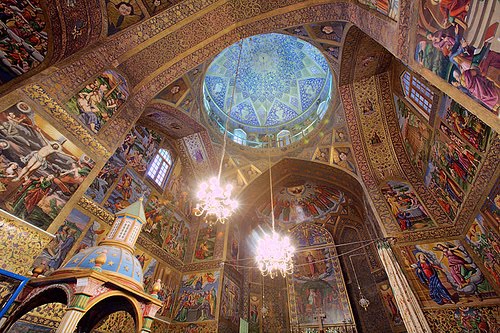
I was conducting research for one of my classes this week when I came across something very interesting. In the early seventeenth century, during the reign of Shah Abbas I of the Persian Safavid dynasty, a number of Armenian Christians settled in his capital city of Isfahan. There they built a church, which they completed in 1664. When I saw pictures of it, my jaw nearly hit the floor.

Before we get to the pics, let me just say that I am all for the construction of church buildings in a style consistent with the local culture. By that I do not mean local "pop culture." I mean architecture according to the established norms. I think that can be done without sacrificing important ancient liturgical elements or forsaking whatever it is that allows a proper expression of worship. Building in a style consistent with local heritage speaks to the populace in an architecural language they can understand. It makes that church a part of the enduring cultural legacy of the place, rather than just a visitor from the outside. I think, in other words, that it makes more sense to build a church in China that looks like this, rather than like this. But that's just me.

(Wanna see how this works here at home? Compare the Roman Catholic Baltimore Basilica--built in a neoclassical style that was consistent with a popular architectural style of the period in which it was built, but is enduring and relevant [sorry!] today--with the Cathedral of Our Lady of Angels in Los Angeles, which is...just...awful).

Whoever built Vank Cathedral in Isfahan certainly had an eye for Persian architecture and design. My guess is that they hired local artisans and builders, who applied the styles with which they were familiar.
As you look at these pictures, keep in mind that this is not a mosque, it is a Christian church.
(Click on the pictures for a better view)


20100409

NPR: In Rare Instance, Greek Orthodox Easter Aligns With West


"Well, this is a phenomenon that no one has in recorded history. Usually the dates of Easter either coincide every four years or they're one week behind or two weeks behind, accordingly. But this year and next year, 2011, is a phenomenon of the Easters coming together back to back. And this I think God's speaking to us. Now, if we don't act on this, he's not going to have too much patience with us because it's never going to happen again for 800 years."

Read transcript here

20100318

St. Edward the Martyr, King of the English

Edward was the eldest son of King Edgar the Peacemaker by his first wife, the beautiful Ethelflaeda Eneda (White-Duck). The lady died shortly after the birth of her son and, after her death, Edgar remarried Aelfthrith, daughter of Ealdorman Ordgar of Devonshire. She bore him two sons, Edmund, who died young, and Aethelred. Edward was thirteen years old when his father died in AD 975. An admirable youth, upright in all his dealings and fearing God, he was elected to the throne by the Witan, largely under the influence of St. Dunstan and Ealdorman Aethelwin of East Anglia.
On 18th March AD 978, when Edward was only sixteen, he was assassinated under controversial circumstances. In reality, this surrounded a magnetic power struggle, led by the Mercian anti-monastic party who favoured Edward's half-brother. However, legend tells a very different story. The Anglo-Saxon Chronicle does not record the King's assassin, only that he was killed at eventide at Corfe Castle in Dorset. Henry of Huntingdon says that King Edward was killed by his own people. Florence of Worcester, that he was killed by his own people by order of his step-mother, Queen Aelfthrith. William of Malmesbury says he was killed by Ealdorman Aelfhere of Mercia; but in recording his death, Malmesbury also attributes the crime to Aelfthrith and tells the now traditionally accepted story:
Queen Aelfthrith hated Edward because he had been elected King when she had hoped her own son, Aethelred, would take the throne; and she plotted to have him murdered. One day, the young King was hunting near the Royal Palace of Corfe, in Dorset, where Queen Aelfthrith and Prince Aethelred were staying. Being weary and thirsty, King Edward turned away from his hunting party and rode off to drop in on them and take a rest. When he rode up to the palace gate, Aelfthrith herself came out to greet him with a kiss. The two were on friendly terms as far as the King knew and, without dismounting, he asked his step-mother for a drink. Queen Aelfthrith sent for a cup of wine and the exhausted Edward drank eagerly. But as he drank, Aelfthrith gave a sign to one of her servants, who stepped forward, drew his dagger and stabbed the King in the back! The King cried out in pain, but managed to set his spurs to his horse in an attempt to escape to the safety of his comrades. He slipped from his horse though and, with his leg caught in the stirrup, he was dragged along until the combination of the knife-wound and inflicted head injuries killed him.
Queen Aelfthrith sent out her men to follow the King's bloody trail and retrieve the body. She ordered it buried in Wareham Priory, but not in holy ground or with any Royal pomp. A light from heaven is later said to have shone over King Edward's humble grave and many miracles were reported there. As a good youth, unjustly and cruelly killed, people looked on him as a saint and called him Edward the Martyr. On 20th June AD 980, St. Dunstan translated the body to Shaftesbury Abbey. Relics excavated amongst the ruins, and believed to be his, were for many years the subject of a legal dispute. However, they now reside in the Eastern Orthodox Church in Brookwood (Surrey).

From EBK

See also:

Service to the Holy Martyr Edward, King of England

20100106

LXX v. Masoretic

This is an interesting video, but he speaks very fast so be prepared to listen fast...

20091226

Twelve Days of Christmas

Christmas is the first day of a twelve-day celebration that concludes on the eve of Theophany (i.e. celebration of the Baptism of Christ, Jan 6/19).

Everybody in the western world is familiar with the song about the Twelve Days of Christmas; I recently learned that it was written in 16th century England when Roman Catholics were being persecuted for their faith.

Partridge in a pear tree...Christ
Two Turtle Doves...Old and New Testaments
Three French Hens...Faith, Hope and Love
Four Calling Birds...The Four Gospels
Five Golden Rings...The first Five Books of the Old Testament, the "Pentateuch"
Six Geese A-laying...The six days of creation
Seven Swans A-swimming...The seven gifts of the Holy Spirit
Eight Maids A-milking...The eight beatitudes
Nine Ladies Dancing...The nine Fruits of the Holy Spirit
Ten Lords A-leaping...The Ten Commandments
Eleven Pipers Piping...The eleven faithful Apostles
Twelve Drummers Drumming...The twelve points of doctrine in the Nicene Creed

20091014

King Harold II


On this date in 1066, the last Orthodox king of England, Harold Godwinson, mere days after battling Viking raiders in the north, died in defense of his homeland against the invading Norman forces in the Battle of Hastings on the southern coast of England. The leader of the invasion, William, duke of Normandy, often known today as "William the Conquerer," had long believed himself entitled to the English crown, but had found his nobles less than enthusiastic about risking an invasion. Only when William had secured a papal blessing for the invasion--in return for promising to suppress the English Church and install Norman bishops loyal to Rome--was he able to raise an army suitable for the undertaking.

Christians of Anglo-Saxon England had always recognized the Pope as their patriarch and most of them were probably not aware that, twelve years prior, the church of Rome had severed ties with the churches of the East. Thus, it must have come as a terrible shock to see their attackers, thundering toward them on their massive war horses, flying the papal banner.

On the day he died,
the God-loving King Harold, together with his loyal troops, commended themselves to God, for those whom they had honored as brethren and leaders in the Faith had foresaken them. Shouting the Orthodox English battle cry, which invoked the aid of the Holy Cross, King Harold and his faithful soldiers faced down their foes and would have had the victory in a closely matched battle...
The blessed King Harold was shot in the eye with an arrow. He plucked it out and continued to fight bravely. In the end, however, he was cut down by Norman knights and hacked to pieces. His body was desecrated, and many Norman Crusaders abused the remains of the fallen king, a thing to which not even pagans and Turks had been wont to do with the remains of their foes (Orthodox Tidings).
After the Norman invasion, English bishops were imprisoned, exiled or put to death, and were replaced by French-speaking Norman bishops. Thus England became Roman Catholic and remained so until 1534, when King Henry VIII declared himself the head of the Church of England. It is a well-known story, but one with a little-known epilogue:
To the Orthodox mind, there is an even more direct link with Hastings. Harold's daughter (born 1056) was to flee England after the Invasion for friendly Denmark and thence Russia. Here she married the future Grand-Prince of Kiev, Vladimir Monomach, in the Cathedral of Our Saviour in Chernigov in April 1074. Vladimir, himself half-Greek, was the grandson of St Anne of Novgorod, who had been baptised by the Glastonbury monk and missionary, St Sigfrid of Sweden. Among the children of Vladimir and Gytha was St Mstislav-Harold (in holy baptism, Theodore, feasted on 15 April), who bore a Slav name as well as that of his maternal grandfather. According to chroniclers, 'no woman in all the world was ever happier than her', Gytha had twelve children, another of whom, George (Yuri), founded Moscow. (Orthodox England)
Read more here:
The Fall of Orthodox England
Entry from OrthodoxWiki
Entry from Wikipedia
King Harold's Battle Force
About Bosham and the Battle
BBC article about grave of King Harold II
Royal Mystery on Brink of Solution

20090821

Fifth Century Church in Connecticut

I thought the first Christians in the New World were Vikings, but I guess I was wrong. This is almost too incredible to believe. It comes from Ancient American via the Orthodox Christian Information Center:

In the stillness of Cockaponset State Forest, southern Connecticut, near the town of Guilford, masterfully carved from solid rock, stands North America’s oldest Christian church. Recent epigraphic evidence found here suggests that it is 1500 years old, and linked to a voyage of Christian Byzantine monks who fled from North Africa during the 5th Century, in the wake of the Vandal invasions. Greek and North African inscriptions, Greek cupule patterns in the form of Chrismons (monograms of Christ), baptismal fonts, a cathedra or throne, candelabras and an altar have been found at the site.

Read the rest here.

20090718

Holy Royal Martyr Grand Duchess Elizabeth

Saint Elizabeth was the older sister of Tsarina Alexandra [and grand-daughter of Queen Victoria of the U. K.], and was married to the Grand Duke Sergius, the governor of Moscow. She converted to Orthodoxy from Protestantism of her own free will, and organized women from all levels of society to help the soldiers at the front and in the hospitals.

Grand Duke Sergius was killed by an assassin's bomb on February 4, 1905, just as St Elizabeth was leaving for her workshops. Remarkably, she visited her husband's killer in prison and urged him to repent.

After this, she began to withdraw from her former social life. She devoted herself to the Convent of Sts Martha and Mary, a community of nuns which focused on worshiping God and also helping the poor. She moved out of the palace into a building she purchased on Ordinka. Women from the nobility, and also from the common people, were attracted to the convent.

St Elizabeth nursed sick and wounded soldiers in the hospitals and on the battle front. On Pascha of 1918, the Communists ordered her to leave Moscow, and join the royal family near Ekaterinburg. She left with a novice, Sister Barbara, and an escort of Latvian guards.

After arriving in Ekaterinburg, St Elizabeth was denied access to the Tsar's family. She was placed in a convent, where she was warmly received by the sisters.

At the end of May St Elizabeth was moved to nearby Alopaevsk with the Grand Dukes Sergius, John, and Constantine, and the young Count Vladimir Paley. They were all housed in a schoolhouse on the edge of town. St Elizabeth was under guard, but was permitted to go to church and work in the garden.

On the night of July 5, they were all taken to a place twelve miles from Alopaevsk, and executed. The Grand Duke Sergius was shot, but the others were thrown down a mineshaft, then grenades were tossed after them. St Elizabeth lived for several hours, and could be heard singing hymns.

The bodies of St Elizabeth and St Barbara were taken to Jerusalem in 1920, and buried in the church of St Mary Magdalene.

Troparion (Tone 4)

Emulating the Lord's self-abasement on the earth,
You gave up royal mansions to serve the poor and disdained,
Overflowing with compassion for the suffering.
And taking up a martyr's cross,
In your meekness
You perfected the Saviour's image within yourself,
Therefore, with Barbara, entreat Him to save us all, O wise Elizabeth.


From oca.org

20090620

1812


Molieben on the Borodino Field (Egor Zaitsev, 2000-2002) click to enlarge

As we approach July 4th, we will, as we do every year, be hearing a lot of Tchaikovsky's 1812 Overture. So, with that in mind, here is a quiz for my readers:

What does the 1812 Overture have to do with American independence?

a) It celebrates our victory over the British in the War of 1812
b) It was written to commemorate the death of the last signer of the Declaration of Independence.
c) Absolutely nothing whatsoever...but it has cannons!!!

The correct answer, of course, is "c." The 1812 Overture (also known as Торжественная увертюра 1812-ого года) was written to commemorate Russia's successful defense of Moscow from the invading French forces under Napoleon Bonaparte in September of 1812, which culminated in the Battle of Borodino. This battle, according to Wikipedia, "was the largest and bloodiest single-day action of the French invasion of Russia, involving more than 250,000 troops and resulting in at least 70,000 casualties." The battle ended in a draw, but damaged the resources and morale of the French forces, who were further deflated when they headed to Moscow in search of winter quarters only to find the city burned down by the retreating Russian army. Napoleon and this troops were forced to head home, encountering well-deserved hardship and misery the entire way. By the time they reached Poland, Napoleon's Grande Armée had lost ninety percent of its total force.

Tsar Alexander II commissioned the piece in 1880, and two years later it premiered in the plaza in front of Christ the Savior Cathedral in Moscow. Then in May 1891, Tchaikovsky conducted the New York Philharmonic in their performance of the piece at the dedication of Carnegie Hall in Manhattan.

Tchaikovsky, an Orthodox Christian, based the intro of the piece on the Troparion of the Cross, which is a hymn that we have sung many, many times in church:

O Lord, save Thy people,
and bless Thine inheritance!
Grant victory to Orthodox Christians
over their adversaries,
and by virtue of Thy Cross,
preserve Thy habitation.


Spasi Gospodi, lyudi tvoya
I blagoslovi dostoyanie tvoye.
Pobedi pravoslavnim khristianom
Na soprotivniya daruya;
I tvoyei sokhranyaya
Krestom tvoim zhitel'stvo.

Here is an abbreviated version of the 1812 Overture with chorus, but without cannons...sorry:


See also:
"How a rousing Russian tune took over our July 4th"
Full score of 1812 Overture

20090611

Ναός τῆς Ἁγίας τοῦ Θεοῦ Σοφίας


For nearly one thousand years, the Hagia Sophia (Ἁγία Σοφία, which means "Holy Wisdom") was the largest Christian cathedral in the world. Construction began in 532 by order of Emperor Justinian and completed five years later. The church included a silver iconostasis fifty feet tall, and was filled with jeweled mosaics and columns of granite and marble, beneath a dome more than one hundred feet wide, and 182 feet high. It was an architectural wonder, filled with arcades, frescoes, marble tiled floors, rich colors and treasures beyond price. When the cathedral was complete, the emperor declared "Νενίκηκά σε Σολομών!" ("Solomon, I have outdone thee!")

For more than a millennium, spanning the reigns of over one hundred Byzantine emperors, Constantinople was the center of the Christian world. That all ended on this date (May 29 by the Church calendar) 556 years ago.

On that Tuesday morning in 1453, the siege of Constantinople by the Ottoman Turks ended and the city was sacked, ravaged, looted, desecrated, pillaged, burnt, violated, and brought under control of the Muslims where she remains to this day.

According to the diary of Nicolo Barbaro, who was present during the invasion,

The Turks made eagerly for the piazza, five miles from the point where they made their entrance at San Romano, and when they reached it, at once some of them climbed up a tower where the flags of Saint Mark and the Most Serene Emperor were flying, and they cut down the flag of Saint Mark and took away the flag of the Most Serene Emperor, and then on the same tower they raised the flag of the Sultan. When they had taken away these two flags, those of Saint Mark and of the Emperor, and raised the flag of the Turkish dog, then all we Christians who were in the city were full of sorrow because it had been captured by the Turks. When their flag was raised and ours cut down, we saw that the whole city was taken, and that there was no further hope of recovering from this.

For the rest of the day these flags were kept flying on the houses, and all through the day the Turks made a great slaugh­ter of Christians through the city. The blood flowed in the city like rainwater in the gutters after a sudden storm, and the corpses of Turks and Christians were thrown into the Dardanelles, where they floated out to sea like melons along a canal.

The cross which topped the dome of the Hagia Sophia was torn down and replaced by a crescent. Minarets were erected, and what was for centuries the largest, most imported and most beloved Christian church in the world became a mosque. The mosaics and frescoes were plastered over or chiseled away. The iconostasis was looted and the relics of saints and other treasures disappeared. The Hagia Sophia served as a mosque until 1932 when the Turkish president, Mustafa Kemal Atatürk, had it made into a museum. At that time, work began to uncover the mosaics that had long been hidden behind plaster.

Two worthwhile blog posts concerning this tragic event can be found here and here. And there is, I was surprised to learn, a movement underway to restore the Hagia Sophia to use as a Christian church. The organization behind this effort is called the Free Agia Sophia Council of America.

20090609

Venerable Bede, the Church Historian

Saint Bede was a church historian who recorded the history of Christianity in England up to his own time. He was probably born around 673 in Northumbria. We do not know exactly where he was born, but it is likely that it was somewhere near Jarrow.

When he was seven, Bede was sent to St Benedict Biscop (January 12) at the monastery of St Peter at Wearmouth to be educated and raised. Then he was sent to the new monastery of St Paul founded at Jarrow in 682, where he remained until his death. There he was guided by the abbot St Ceolfrith (September 25), who succeeded St Benedict in 690, ruling both Wearmouth and Jarrow.

There is an incident in the anonymous Life of Ceolfrith which may refer to the young Bede. A plague swept through Ceolfrith's monastery in 686, taking most of the monks who sang in the choir for the church services. Only the abbot and a young boy raised and educated by him remained. This young boy "is now a priest of the same monastery and commends the abbot's admirable deeds both verbally and in writing to all who desire to learn them."

Grieved by this catastrophe, Ceolfrith decided that they should sing the Psalms without antiphons, except at Matins and Vespers. After a week of this, he went back to chanting the antiphons in their proper place. With the help of the boy and the surviving monks, the services were performed with difficulty until other monks could be brought in and trained to sing.

St Bede was ordained as a deacon when he was nineteen, and to the holy priesthood at the age of thirty by St John of Beverley (May 7), the holy Bishop of Hexham (687), and later (705) of York. Bede had a great love for the church services, and believed that since the angels were present with the monks during the services, that he should also be there. "What if they do not find me among the brethren when they assemble? Will they not say, 'Where is Bede?'

Bede began as a pupil of St Benedict Biscop, who had been a monk of the famous monastery at Lerins, and had founded monasteries himself. St Benedict had brought many books with him to England from Lerins and from other European monasteries. This library enabled Bede to write his own books, which include biblical commentary, ecclesiastical history, and hagiography.

His books, derived from "ancient documents, from the traditions of our ancestors, and from my own personal knowledge" (Book V, 24) give us great insight into the religious and secular life of early Britain. To read St Bede is to enter a world shaped by spiritual traditions very similar to those cherished by Orthodox Christians. These saints engage in the same heroic asceticism shown by saints in the East, and their holiness fills us with love and admiration. Christians were expected to fast on Wednesdays and Fridays, and there was a forty day Nativity Fast (Book IV, 30).

St Bede became ill in 735. For about two weeks before Pascha, he was weak and had trouble breathing, but experienced little pain. He remained cheerful and gave daily lessons to his students, then spent the rest of the day singing Psalms and giving thanks to God. He would often quote the words of St Ambrose, "I have not lived in such a way that I am ashamed to live among you, and I do not fear to die, for God is gracious" (Paulinus, Life of Saint Ambrose, Ch. 45).

In addition to giving daily lessons and chanting the Psalms, St Bede was also working on an Anglo-Saxon translation of the Gospel of St John, and also a book of extracts from the writings of St Isidore of Seville (April 4). On the Tuesday before the Feast of the Lord's Ascension, the saint's breathing became more labored, and his feet began to swell. "Learn quickly," he told those who were taking dictation from him, "for I do not know how long I can continue. The Lord may call me in a short while."

After a sleepless night, St Bede continued his dictation on Wednesday morning. At the Third Hour, there was a procession with the relics of the saints in the monastery, and the brethren went to attend this service, leaving a monk named Wilbert with Bede. The monk reminded him that there remained one more chapter to be written in the book which he was dictating. Wilbert was reluctant to disturb the dying Bede, however. St Bede said, "It is no trouble. Take your pen and write quickly."

At the Ninth Hour, Bede paused and told Wilbert that he had some items in his chest, such as pepper, incense, and linen. He asked the monk to bring the priests of the monastery so that he could distribute these items to them. When they arrived, he spoke to each of them in turn, requesting them to pray for him and to remember him in the services. Then he said, "The time of my departure is at hand, and my soul longs to see Christ my King in His beauty."

That evening, Wilbert said to him, "Dear Master, there is one sentence left unfinished."

Bede said, "Very well, write it down."

Then the young monk said, "It is finished now."

St Bede replied, "You have spoken truly, it is well finished." Then he asked Wilbert to raise his head so that he could see the church where he used to pray. After chanting, "Glory to the Father, and to the Son, and to the Holy Spirit" to its ending, St Bede fell asleep in the Lord Whom he had loved.

His body was first buried in the south porch of the monastery church, then later transferred to a place near the altar. Today his holy relics lie in Durham Cathedral, in the Galilee chapel. St Bede is the only Englishman mentioned by Dante in the DIVINE COMEDY (Paradiso).

(oca.org)

20090602

Saint Æthelberht, King of Kent


Augustine [Archbishop of Canterbury], thus strengthened by the encouragement of the blessed Father Gregory [Pope of Rome], returned to the work of the Word of God, with the servants of Christ who were with him, and arrived in Britain. The powerful Ethelbert was at that time king of Kent; he had extended his dominions as far as the boundary formed by the great river Humber, by which the Southern Saxons are divided from the Northern. On the east of Kent is the large Isle of Thanet, containing, according to the English way of reckoning, 600 families, divided from the mainland by the river Wantsum, which is about three furlongs in breadth, and which can be crossed only in two places; for at both ends it runs into the sea. On this island landed the servant of the Lord, Augustine, and his companions, being, as is reported, nearly forty men. They had obtained, by order of the blessed Pope Gregory, interpreters of the nation of the Franks, and sending to Ethelbert, signified that they were come from Rome, and brought a joyful message, which most undoubtedly assured to those that hearkened to it everlasting joys in heaven, and a kingdom that would never end, with the living and true God. The king hearing this, gave orders that they, should stay in the island where they had landed, and be furnished with necessaries, till he should consider what to do with them. For he had before heard of the Christian religion, having a Christian wife of the royal family of the Franks, called Bertha; whom he had received from her parents, upon condition that she should be permitted to preserve inviolate the rites of her religion with the Bishop Liudhard, who was sent with her to support her in the faith.

Some days after, the king came into the island, and sitting in the open air, ordered Augustine and his companions to come and hold a conference with him. For he had taken precaution that they should not come to him in any house, lest, by so coming, according to an ancient superstition, if they practised any magical arts, they might impose upon him, and so get the better of him. But they came endued with Divine, not with magic power, bearing a silver cross for their banner, and the image of our Lord and Saviour painted on a board [i.e. a holy icon]; and chanting litanies, they offered up their prayers to the Lord for the eternal salvation both of themselves and of those to whom and for whom they had come. When they had sat down, in obedience to the king’s commands, and preached to him and his attendants there present the Word of life, the king answered thus: "Your words and promises are fair, but because they are new to us, and of uncertain import, I cannot consent to them so far as to forsake that which I have so long observed with the whole English nation. But because you are come from far as strangers into my kingdom, and, as I conceive, are desirous to impart to us those things which you believe to be true, and most beneficial, we desire not to harm you, but will give you favourable entertainment, and take care to supply you with all things necessary to your sustenance; nor do we forbid you to preach and gain as many as you can to your religion." Accordingly he gave them an abode in the city of Canterbury, which was the metropolis of all his dominions, and, as he had promised, besides supplying them with sustenance, did not refuse them liberty to preach. It is told that, as they drew near to the city, after their manner, with the holy cross, and the image of our sovereign Lord and King, Jesus Christ, they sang in concert this litany: "We beseech thee, Lord, for Thy great mercy, that Thy wrath and anger be turned away from this city, and from Thy holy house, for we have sinned. Hallelujah."

There was on the east side of the city, a church dedicated of old to the honour of St. Martin, built whilst the Romans were still in the island, wherein the queen, who, as has been said before, was a Christian, was wont to pray. In this they also first began to come together, to chant the Psalms, to pray, to celebrate Mass, to preach, and to baptize, till when the king had been converted to the faith, they obtained greater liberty to preach everywhere and build or repair churches. When he, among the rest, believed and was baptized, attracted by the pure life of these holy men and their gracious promises, the truth of which they established by many miracles, greater numbers began daily to flock together to hear the Word, and, forsaking their heathen rites, to have fellowship, through faith, in the unity of Christ’s Holy Church. It is told that the king, while he rejoiced at their conversion and their faith, yet compelled none to embrace Christianity, but only showed more affection to the believers, as to his fellow citizens in the kingdom of Heaven. For he had learned from those who had instructed him and guided him to salvation, that the service of Christ ought to be voluntary, not by compulsion.

The same blessed Pope Gregory, at the same time, sent a letter to King Ethelbert, with many gifts of divers sorts; being desirous to glorify the king with temporal honours. The copy of the said letter is as follows:

"To the most glorious lord, and his most excellent son, Ethelbert, king of the English, Bishop Gregory. Almighty God advances good men to the government of nations, that He may by their means bestow the gifts of His lovingkindness on those over whom they are placed. This we know to have come to pass in the English nation, over whom your Highness was placed, to the end, that by means of the blessings which are granted to you, heavenly benefits might also be conferred on your subjects. Therefore, my illustrious son, do you carefully guard the grace which you have received from the Divine goodness, and be eager to spread the Christian faith among the people under your rule; in all uprightness increase your zeal for their conversion; showing forth an example of good works, that you may obtain your reward in Heaven from Him, Whose Name and the knowledge of Whom you have spread abroad upon arth. For He, Whose honour you seek and maintain among the nations, will also render your Majesty’s name more glorious even to posterity."


Bede, Ecclesiastical History of England, Book I, Chs 25,26, 32

20090531

First Ecumenical Council

On the seventh Sunday of Pascha, we commemorate the holy God-bearing Fathers of the First Ecumenical Council.

The Commemoration of the First Ecumenical Council has been celebrated by the Church of Christ from ancient times. The Lord Jesus Christ left the Church a great promise, "I will build My Church, and the gates of hell shall not prevail against it" (Mt. 16:18). Although the Church of Christ on earth will pass through difficult struggles with the Enemy of salvation, it will emerge victorious. The holy martyrs bore witness to the truth of the Savior's words, enduring suffering and death for confessing Christ, but the persecutor's sword is shattered by the Cross of Christ.

Persecution of Christians ceased during the fourth century, but heresies arose within the Church itself. One of the most pernicious of these heresies was Arianism. Arius, a priest of Alexandria, was a man of immense pride and ambition. In denying the divine nature of Jesus Christ and His equality with God the Father, Arius falsely taught that the Savior is not consubstantial with the Father, but is only a created being.

A local Council, convened with Patriarch Alexander of Alexandria presiding, condemned the false teachings of Arius. However, Arius would not submit to the authority of the Church. He wrote to many bishops, denouncing the decrees of the local Council. He spread his false teaching throughout the East, receiving support from certain Eastern bishops.

Investigating these dissentions, the holy emperor Constantine (May 21) consulted Bishop Hosius of Cordova (Aug. 27), who assured him that the heresy of Arius was directed against the most fundamental dogma of Christ's Church, and so he decided to convene an Ecumenical Council. In 325, 318 bishops representing Christian Churches from various lands gathered together at Nicea.

Among the assembled bishops were many confessors who had suffered during the persecutions, and who bore the marks of torture upon their bodies. Also participating in the Council were several great luminaries of the Church: St Nicholas, Archbishop of Myra in Lycia (December 6 and May 9), St Spyridon, Bishop of Tremithos (December 12), and others venerated by the Church as holy Fathers.

With Patriarch Alexander of Alexandria came his deacon, Athanasius (who later became Patriarch of Alexandria (May 2 and January 18). He is called "the Great," for he was a zealous champion for the purity of Orthodoxy. In the Sixth Ode of the Canon for today's Feast, he is referred to as "the thirteenth Apostle."

The emperor Constantine presided over the sessions of the Council. In his speech, responding to the welcome by Bishop Eusebius of Caesarea, he said, "God has helped me cast down the impious might of the persecutors, but more distressful for me than any blood spilled in battle is for a soldier, is the internal strife in the Church of God, for it is more ruinous."

Arius, with seventeen bishops among his supporters, remained arrogant, but his teaching was repudiated and he was excommunicated from the Church. In his speech, the holy deacon Athanasius conclusively refuted the blasphemous opinions of Arius. The heresiarch Arius is depicted in iconography sitting on Satan's knees, or in the mouth of the Beast of the Deep (Rev. 13).

The Fathers of the Council declined to accept a Symbol of Faith (Creed) proposed by the Arians. Instead, they affirmed the Orthodox Symbol of Faith. St Constantine asked the Council to insert into the text of the Symbol of Faith the word "consubstantial," which he had heard in the speeches of the bishops. The Fathers of the Council unanimously accepted this suggestion.

In the Nicean Creed, the holy Fathers set forth and confirmed the Apostolic teachings about Christ's divine nature. The heresy of Arius was exposed and repudiated as an error of haughty reason. After resolving this chief dogmatic question, the Council also issued Twelve Canons on questions of churchly administration and discipline. Also decided was the date for the celebration of Holy Pascha. By decision of the Council, Holy Pascha should not be celebrated by Christians on the same day with the Jewish Passover, but on the first Sunday after the first full moon of the vernal equinox (which occured on March 22 in 325).

(from oca.org)