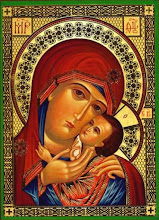
be multiplied unto you through the knowledge of God, and of Jesus our Lord, according as his divine power hath given unto us all things that pertain unto life and godliness, through the knowledge of him that hath called us to glory and virtue: whereby are given unto us exceeding great and precious promises: that by these ye might be partakers of the divine nature... 2pet1.2-4
ATTENTION: Visitors looking for the Royal Eagle restaurant website, click here
Evidently, some people have expressed disagreement with the fact that the Orthodox Church does not practice open Communion. In other words, you have to be an Orthodox Christian (who has properly prepared) in order to receive Communion in and Orthodox Church.
From Touchstone Magazine:
I do not believe that open Communion has created the Christian unity it was supposed to. Some commentators have used the analogy of having premarital sex for sharing Communion before we are united in one church. I've altered that idea to suggest that it's more like a couple who have become estranged, separated, and divorced, some years later now reconciled and desiring to become married to each other again. Should they have relations before they are officially remarried?
O Lord our God, who went with the servant of the Patriarch Abraham into Mesopotamia when he was sent to seek a wife for his master Isaac and, by the means of drawing of water at the well, revealed to him that he should betroth Rebecca; Do Thou Thyself bless the betrothal of these Thy servants, Matthew and Kathryn, and confirm the word they have spoken. Strengthen them in the holy union which is from Thee. For Thou, in the beginning, made them male and female, and by Thee is the woman joined to the man as a helpmate and for the continuation of the human race.
Therefore, O Lord our God, who has sent forth Thy truth to Thine inheritance, and Thy covenant unto Thy servants our fathers, even Thine elect from generation to generation. Look Thou upon Thy servant, Matthew, and upon Thy handmaid, Kathryn, and establish and confirm their betrothal in faith, in oneness of mind, in truth and in love.
Thou, O Lord, declared that a pledge should be given and confirmed in all things. By a ring was power given unto Joseph in Egypt; by a ring was Daniel exalted in the land of Babylon; by a ring was Tamar's integrity revealed; by a ring did our heavenly Father show compassion upon His son, for He said, put a ring on his right hand, and kill the fatted calf, and let us cat and rejoice. Thine own right hand, O Lord, armed Moses in the Red Sea. By Thy true word the heavens were established, and the foundations of the earth were made firm. By Thy mighty word and Thine uplifted arm, the right hands of Thy servants shall be blessed. Therefore, O Master, do Thou now Thyself bless this putting on of rings with Thy heavenly benediction: and let Thine Angel go before them all the days of their life.
For Thou are He who blesses and sanctifies all things, and unto Thee do we ascribe glory, to the Father, and to the Son, and to the Holy Spirit now and ever, and unto ages of ages. Amen.
O God most pure, the Creator of every living thing who transformed the rib of Adam our forefather into a woman and blessing them Thou said, "Be fruitful and multiply, and subdue the earth," making of two one flesh. "For this reason a man shall leave his father and mother and be joined to his wife, so that they are no longer two but one. What therefore God has joined together, let no man put asunder."
Thou opened the womb of Sarah, and blessed Thy servant Abraham, making him the father of many nations. Thou gave Isaac to Rebecca, blessing her in childbearing. Thou joined Jacob and Rachel and from them generated the twelve patriarchs. Thou united Joseph and Asenath, and as the fruit of their generation bestowed on them Ephraim and Manasses. Thou accepted Zacharias and Elizabeth, and proclaimed their child the Forerunner. From the root of Jesse in the flesh Thou caused to blossom forth the ever-Virgin, for Thou was incarnate of her; born for the redemption of the human race.
Thou through Thine unspeakable gift and great goodness came to Cana of Galilee, and blessed that marriage, making it clear it is Thy will that there should be lawful marriage and from it the begetting of children. Do Thou, O Master, accept the prayers of Thy servants. As Thou were present at Cana of Galilee, be Thou also present here with Thine invisible presence.
Bless this marriage, and grant these Thy servants, Matthew and Kathryn, a peaceful life, a long life, chastity, love for one another in the bond of peace, gratitude from their posterity, Grace upon their children, a crown of glory which never fades. Make them worthy to see their children's children; preserve their marriage in purity, granting them of the dew of heaven above, and of the fruitfulness of the earth. Fill their houses with wheat, wine, oil and every good thing, that they may give to those in need. Grant also to, those who are here present with them all their requests which are for their salvation.
For Thou are the God of mercy, compassion and love towards man and to Thee we ascribe glory, to the Father to the Son, and to the Holy Spirit, now and ever, and unto ages of ages. Amen.
Blessed are Thou, O Lord our God, the Priest of mystical and pure marriage, and the Ordainer of the marriage of the body. Thou are the Guardian of immortality and the Good Steward of the means of life. In the beginning, O Master, Thou Thyself created man, and appointed him king over Thy creation saying, "It is not good that man should be alone on earth, let us make a helper fit for him." Then taking one of his ribs. God made woman. Adam, seeing her, said, "This is at last bone of my bones and flesh of my flesh, she shall be called woman because she was taken out of man." For this reason man shall leave his father and mother and be joined to his wife, and the two shall become one. What therefore God has joined together, let no man put asunder.
O Master, our Lord and God, send now also Thy heavenly Grace upon these Thy servants, Matthew and Kathryn. Grant that this Thy handmaid may be subject in all things to her husband, and may Thy servant be the head of his wife that they may live according to Thy will.
Bless them O Lord our God, as Thou blessed Abraham and Sarah, Isaac and Rebecca, Jacob and all the Patriarchs, Joseph and Asenath, Moses and Zipporah, Joachim and Anna and Zachariah and Elizabeth.
Preserve them. O Lord our God. as Thou preserved Noah in the ark, Jonah in the whale and the three Holy Children from the fire, sending upon them the dew from heaven. May that joy, come upon them which the blessed Helena had when she found the precious Cross.
Remember them, O Lord our God, as Thou remembered Enoch, Shem, Elijah, and Thy Forty Holy Martyrs, bestowing upon them crowns from heaven. Remember the parents who have nourished them; for the prayers of parents make firm the foundations of houses. Remember also Thy servants, the groomsmen and the bridesmaids, who have come together in this joy.
Remember, O Lord our God, Thy servant, Matthew, and Thy handmaid, Kathryn, and bless them. Grant them of the fruit of the body, fair children, harmony of soul and body. Exalt them like the cedars of Lebanon like a fruitful vine. Give them fruitfulness like the full ears of grain, that having sufficiency in all things, they may abound in every work that is good and acceptable to Thee. Let them see their children's children, like a newly planted olive orchard around their table. And having obtained favor before Thee may they shine like stars of heaven in Thee, our Lord.
For unto Thee are due all glory, honor and worship to the Father, and to the Son, and to the Holy Spirit, now and ever, and unto ages of ages. Amen.
O Holy God, who created man from the dust, and from man’s rib made woman joining her to him as a helpmate, for it seemed good to Thy Majesty for man not to be alone on earth. Do Thou now, O Master, extend Thy hand from Thy holy dwelling and unite this Thy servant, Matthew, and this Thy handmaid, Kathryn, for by Thee is the husband united to the wife. Unite them in one mind. Wed them into one flesh. Grant them of the fruit of the body and the procreation of fair children.
For Thine is the majesty, and Thine is the kingdom and the power and the glory of the Father and of the Son and of the Holy Spirit now and ever and unto ages of ages. Amen.
The servant of God, Matthew, is crowned unto the handmaid of God, Kathryn, in the Name of the Father, and of the Son and of the Holy Spirit now and ever, and unto ages or ages. Amen.
The handmaid of God, Kathryn, is crowned unto the servant of God, Matthew, in the Name of the Father, and of the Son, and of the Holy Spirit, now and ever, and unto ages of ages. Amen.
O Lord our God, crown them with glory and honor. (thrice)
O Lord our God, who in Thy saving providence did agree by Thy presence in Cana of Galilee to declare marriage honorable: Do thou the same Lord, now also maintain in peace and harmony Thy servants, Matthew and Kathryn, whom it pleases Thee to join together. Cause their marriage to be honorable. Preserve their life blameless. Mercifully grant that they may live together in purity. Enable them to attain to a ripe old age, walking in Thy commandments with a pure heart.
For Thou art our God, the God whose property it is to show mercy and to save, and unto Thee we ascribe glory, to the Father, and to the Son, and to the Holy Spirit, now and ever and unto ages of ages. Amen
O God, our God, who came to Cana of Galilee, and blessed there the marriage feast: Bless, also, these Thy servants, who through Thy good providence are now united together in the Community of Marriage. Bless their goings out and their comings in. Replenish their life with good things. Receive their crowns into Thy kingdom, preserving them spotless, blameless, and without reproach, unto ages of ages. Amen.
May the Father, and the Son, and the Holy Spirit, the all-holy, consubstantial and life-giving Trinity, one Godhead and one kingdom, bless you and grant to you length of days, fair children, prosperity of life and faith, and fill you with abundance of all earthly good things, and make you worthy to obtain the blessings of the promise: through the prayers of the holy Theotokos, and of all the Saints. Amen.
May He who by His presence at the marriage feast in Cana of Galilee declared marriage to be an honorable estate, Christ our true God; through the prayers of His most pure Mother, of the holy, glorious and all-laudable Apostles, of the holy, God-crowned sovereigns, Constantine and Helena, equal to the Apostles, of the holy Great Martyr Procopius; and of all the Saints, have mercy upon us and save us: forasmuch as he is good and loves mankind. Amen.
20090221
BLESSED ART THOU, O Lord God Almighty, Source of all good things, Sun of Righteousness, who shinest forth upon them that were in darkness the light of salvation, through the manifestation of Thine Only-begotten Son and our God; and who hast given unto us, unworthy though we be, blessed purification through hallowed water, and divine sanctification through life-giving Chrismation; who now also hast been graciously pleased to regenerate Thy servant who hast newly received Illumination by water and the Spirit, grant unto him forgiveness of sins, whether voluntary or involuntary. Do Thou, the same Master, compassionate King of all, grant also unto him the seal of the gift of Thy holy, and almighty, and adorable Spirit, and participation in the holy Body and the precious Blood of Thy Christ. Keep him in Thy sanctification; confirm him in the Orthodox faith; deliver him from the evil one, and from his snares. And preserve his soul in purity and uprightness, through the saving fear of Thee; that he may please Thee in every deed and word, and may be a child and heir of Thy heavenly kingdom.
For Thou art our God, the God who shows mercy and saves; and unto Thee do we ascribe glory, to the Father, and to the Son, and to the Holy Spirit, now and ever, and unto ages of ages. Amen.
(Rite of Chrismation)
20090220
GREAT ART THOU, O Lord, and marvelous are Thy works, and there is no word which is sufficient to hymn Thy wonders.
For Thou, of Thine own good will, hast brought into being all things which before were not, and by Thy might, Thou upholdsest creation, and by Thy providence Thou orderest the world. When Thou didst join together the universe out of four elements, Thou didst crown the circle of the year with four seasons. Before Thee tremble all the Powers endowed with intelligence. The sun sings unto Thee. The moon glorifies Thee. The stars meet together before Thy presence. The light obeys Thee. The deeps tremble before Thee. The springs of water are subject unto Thee. Thou hast spread out the heavens like a curtain. Thou hast established the earth upon the waters. Thou hast set round about the sea barriers of sand. Thou hast poured forth the air for breathing. The Angelic Powers serve Thee. The choirs of the Archangels fall down in adoration before Thee. The many-eyed Cherubim and the six-winged Seraphim as they stand around and fly, veil their faces in awe before Thine ineffable glory.
For Thou, who art God inexpressible and everlasting, hast descended upon earth, and hast taken on the semblance of a servant, and wast made in the likeness of man. For, because of the tender compassion of Thy mercy, O Master, Thou couldest not endure to behold mankind oppressed by the Devil; but Thou hast come, and hast saved us. We confess Thy grace. We proclaim Thy mercy. We conceal not Thy gracious acts. Thou hast delivered the generations of our mortal nature. By Thy birth Thou hast sanctified the Virgin’s womb. All creation magnifies Thee, who hast manifested Thyself. For Thou, O our God, hast revealed Thyself upon earth, and dwelt among men. Thou hast hallowed the streams of Jordan, sending down upon them from heaven Thy Holy Spirit, and hast crushed the heads of the dragons who lurked there.
Wherefore, O King who lovest mankind, come Thou now and sanctify this water, by the coming of Thy Holy Spirit.
And grant unto it the grace of redemption, the blessing of the Jordan. Make it the fountain of incorruption, the gift of sanctification, the forgiveness of sins, the remedy of infirmities, the final destruction of demons, unassailable by hostile powers, filled with angelic might. Let those who would ensnare Thy creature flee far from it. For we have called upon Thy Name, O Lord, and it is wonderful, and glorious, and terrible unto adversaries.
Let all adverse powers be crushed beneath the sign of the image of Thy Cross.
We pray Thee, O God, that every aerial and unseen phantom may withdraw itself from us; and that no demon of darkness may conceal himself in this water; and that no evil spirit which instills darkening of intentions and rebelliousness of thought may descend into it with him who is about to be baptized.
But do Thou, Master of all, show this water to be the water of redemption, the water of sanctification, the purification of flesh and spirit, the loosing of bonds, the remission of sins, the illumination of the soul, the laver of regeneration, the renewal of the spirit, the gift of adoption to sonship, the garment of incorruption, the fountain of life. For Thou hast said, O Lord: "Wash, be clean, and put away evil things from your souls." Thou hast bestowed upon us from on high a new birth through water and the Spirit. Wherefore, O Lord, manifest Thyself in this water, and grant that he who is baptized therein may be transformed; that he may put away from him the old man, which is corrupt through the lusts of the flesh, and that he may put on the new man, and be renewed after the image of Him who created him; that being buried, after the pattern of Thy death, in baptism, he may, in like manner, be a partaker of Thy Resurrection; and having preserved the gift of Thy Holy Spirit, and increased the measure of grace committed unto him, he may receive the prize of his high calling, and be numbered with the firstborn whose names are written in heaven, in Thee, our God and Lord, Jesus Christ. For unto Thee are due all glory, dominion, honor, and worship, together with Thy Father, who is from everlasting, and Thine all-holy, and good, and life-giving Spirit, now and ever, and unto ages of ages. Amen.
(From the Rite of Baptism)
20090219
O LORD AND MASTER; who hast created man in Thine own likeness, and bestowed upon him the power of life eternal; who also despisest not those who have fallen away through sin, but hast provided salvation for the world through the Incarnation of Thy Christ: Do Thou, the same Lord, delivering also this Thy creature from the bondage of the enemy, receive him into Thy heavenly kingdom. Open the eyes of his understanding, that the illumination of Thy Gospel may shine brightly in him. Assign unto him an angel of light, who shall deliver him from every snare of the adversary, from encounter with evil, from the demon of the noonday, and from evil thoughts.
Expel from him every evil and unclean spirit which hides and makes its lair in his heart, the spirit of deceit, the spirit of evil, the spirit of idolatry and of every covetousness; the spirit of falsehood and of every uncleanness which operates through the prompting of the Devil. And make him a reason-endowed sheep in the holy flock of Thy Christ, an honorable member of Thy Church, a child of the light, and an heir of Thy Kingdom; that having lived in accordance with Thy commandments, and preserved inviolate the Seal, and kept his garment undefiled, he may receive the blessedness of the Saints in Thy Kingdom.
Through the grace and bounties, and love towards mankind of Thine Only-begotten Son, with whom Thou art blessed, together with Thine all-holy and good and life-giving Spirit: now and ever, and unto ages of ages. Amen.
(From the Rite of Baptism)
20090218
IN THY NAME, O Lord God of truth, and in the Name of Thine Only-begotten Son, and of Thy Holy Spirit, I lay my hand upon Thy servant, who has been found worthy to flee unto Thy holy Name, and to take refuge under the shelter of Thy wings. Remove far from him his former delusion and fill him with the faith, hope and love which are in Thee; that he may know that Thou art the only true God with Thine Only-begotten Son, our Lord Jesus Christ, and Thy Holy Spirit. Enable him to walk in all Thy commandments, and to fulfill those things which are well pleasing unto Thee; for if a man do those things, he shall find life in them.
Inscribe him in Thy Book of Life, and unite him to the flock of Thine inheritance. And may Thy holy Name be glorified in him, together with that of Thy beloved Son, our Lord Jesus Christ, and of Thy life-giving Spirit. Let Thine eyes ever regard him with mercy, and let Thine ears attend unto the voice of his supplication. Make him to rejoice in the works of his hands, and in all his generation; that he may render praise unto Thee, that he may sing, worship and glorify Thy great and exalted Name always, all the days of his life.
For all the Powers of Heaven sing praises unto Thee, and Thine is the Glory, of the Father, and of the Son, and of the Holy Spirit, now and ever, and unto ages of ages.
The following is taken from the article "Baptism and Chrismation," by Bishop Alexander Mileant.
Jesus Christ, the Only-begotten Son of God, came to Earth to destroy sin and grant mankind an opportunity to obtain eternal and joyful life in the Kingdom of Heaven. Spiritual rebirth begins with a man's faith in Jesus Christ, a true desire to be liberated from the tyranny of sin, and a drive to lead a life in accordance with God’s will. Our Lord Jesus Christ likened this spiritual rebirth to the resurrection of the dead when He said: "Most assuredly, I say to you, the hour is coming, and now is, when the dead will hear the voice of the Son of God; and those who hear will live" (John 5:25). However, faith and desire by themselves are not sufficient. What is needed is the power of grace, which realizes the spiritual rebirth of an individual. This power of grace permeates the soul of the person submerged in water during baptism.
One who is purified from sin is emancipated from its tyranny and freed to follow a spiritual life. The Holy Scripture calls this spiritual birth the "first resurrection," as opposed to the second, physical resurrection, which will occur before the end of the world (Rev. 20:5). The baptized person becomes a beloved child of God, His adopted son or daughter, by the grace of Christ.
This does not mean that, because of baptism, a person is freed from all temptations or from the spiritual fight. Spiritual struggles are unavoidable for every person who exists in this world of temptation. But a person who is not baptized lacks the power to fight the bondage of sin, and is enslaved to it, whereas someone who is baptized is liberated from sin and receives assistance to fight against temptations.
Just as the death and resurrection of Christ culminated in Pentecost--the descent of the Holy Spirit on the Apostles--so the baptism of a Christian attains its fulfillment in Chrismation. In Baptism, one puts on the death of Christ, and also his resurrection; in Chrismation, one is given the grace of the Holy Spirit. Thus one can see how the miracle of Pentecost is continually renewed in the Church through these mysteries.
The meaning of Chrismation lies in the most important and fundamental words of the mystery, which make up the concluding utterance: "The seal of the gift of the Holy Spirit." They stand as (a) the concluding act confirming the entry of the baptized person into the Church, and (b) the source of grace-filled strength granted to grow stronger and ripen to perfection in the spiritual life.
St. Cyprian writes, "People baptized in church are imprinted with the Lord’s seal just as the christened Samaritans once received the Holy Spirit from the Apostles Peter and John, through the laying on of hands and prayer…What they were lacking, (namely the Holy Spirit, as they were baptized in the name of Christ only), the Apostles Peter and John fulfilled ... That also happens with us ... we become complete with the Lord’s seal" (Acts 8:14-17). St. Cyprian confirms that the ancients, in speaking of birth through water and the Spirit, understood birth through water to refer to physical baptism, while Chrismation was the birth through the Spirit.
During Apostolic times, the gifts of the Holy Spirit were bestowed through the laying on of hands. We read about this in Acts (8:14-17 and 19:2-6): the Apostle Paul met some disciples in Ephesus who had received only the baptism of John. When he learned of this they "were baptized in the name of the Lord Jesus. And when Paul laid hands on them, the Holy Spirit came upon them."
How was the blessed laying on of hands replaced by anointing with chrism? Most probably, because the Apostles could not physically visit every newly baptized convert and lay hands on him, they replaced this practice by the anointing with chrism, which was blessed by them and distributed to the representatives of many churches. As we are reminded by the Apostle Paul: "Now He who establishes us with you in Christ and has anointed us is God, who also has sealed us and given us the Spirit in our hearts as a guarantee" (2 Cor. 1:21-22). The integral words of the Mystery, "the seal of the gift of the Holy Spirit," thus also have a basis in these words of the Apostle.
Further on, St. Paul writes: "And do not grieve the Holy Spirit of God, by whom you were sealed for the day of redemption" (Ephesians 4:30). In the Holy Scripture, the "day of redemption" refers to baptism, while "being sealed" by the Holy Spirit means the seal of the Holy Spirit that follows immediately after baptism.
The oil of the Chrism and no other substance is used in the Mystery of Chrismation, because even in the Old Testament oil was used to endow people with particular spiritual gifts (Exodus 28:41; 1 Samuel 16:13; 1 Kings 1:39). The renowned third-century writer Tertullian had this to say: "After emerging from the baptismal font, we are anointed with a blessed oil just like the ancients were anointed for priesthood with the oil from the horn."
The narratives from the Acts of the Apostles confirm that, apart from receiving spiritual gifts from the Holy Spirit, the laying on of hands or the Chrismation after baptism served both as a confirmation of the bestowal of Baptism and a seal of the union of those baptized with the Church. That is why these acts were performed by the Apostles themselves, and subsequently, by their successors, i.e., bishops. While a person is born through baptism for a spiritual life, Chrismation makes him a participant in the Church's life of grace.
The following is a short documentary on the history of the ancient Orthodox Church. For more information on the people, places, and events mentioned in the videos, click on the links below.
"Sacrament" is a word that originated in the west, and Orthodox Christians normally refer to Sacraments as the Holy Mysteries. The word mysterion (μυστήριον), which appears at least 22 times in the New Testament (KJV), means not what we commonly understand in modern English language as a "mystery"--like a riddle to be solved--but rather a spiritual Truth, known only by divine revelation.
St John Chrysostom wrote that, "a mystery is so called; because we do not behold the things which we see, but some things we see and others we believe. For such is the nature of our Mysteries. I, for instance, feel differently upon these subjects from an unbeliever" (Homily on 1 Corinthians).
The Orthodox Church regards the life of Faith, indeed the very purpose of human existence, to be nothing less than participation in the life of God. The sacraments are a means to accomplish this. According to Metropolitan Kallistos Ware, "the Church takes material things--water, bread, wine, oil--and makes them a vehicle of the Spirit. In this way the sacraments look back to the Incarnation, when Christ took material flesh and made it a vehicle of the Spirit" (The Orthodox Church, p.274)
Christ Himself used matter to communicate His healing power: He used mud to heal the blind man (Jn 9.1-14), and the hem of His garment to heal the woman with the flow of blood (Lk 8.43-44). Later, handkerchiefs and aprons that had simply touched His Apostles were used to heal the sick (Acts 19.12). Of course, He didn't need these items to heal: He had also healed people merely with His words (Mt 8.16), and by laying hands on them (Lk 4.40). But He showed us through His example that matter can be used to impart the power of the Holy Spirit, as is done through the Holy Mysteries.
Roman Catholics recognize seven--and only seven--Sacraments. Lutherans recognize two or three, depending on whom you ask. Many Christians reject altogether the notion of Sacraments based on their understanding of the "universal priesthood."
Orthodox Christians recognize the same seven sacraments that are known to Roman Catholics. They are:
These seven actions are the only ones that I have heard specifically referred to as "Sacraments" (or "Mysteries") in the Orthodox Church. However, Orthodox Christians do not believe that these are the only sacramental acts. They believe that many other actions can be sacramental as well:
Neither the liturgical book called Euchologion (prayer book), which contains the texts of the sacraments, nor the patristic tradition, however, formally limits the number of sacraments; they do not distinguish clearly between the "sacraments" and such acts as the blessing of water on Epiphany day or the burial service or the service for the tonsuring of a monk that in the West are called sacramentalia. In fact, no council recognized by the Orthodox Church ever defined the number of sacraments; it is only through the "Orthodox confessions" of the 17th century directed against the Reformation that the number seven has been generally accepted (From the Orthodox Information Center)
According to Fr Thomas Hopko, "the more ancient and traditional practice of the Orthodox Church is to consider everything which is in and of the Church as sacramental or mystical."
You hallowed the streams of Jordan, sending down from the Heavens Your Holy Spirit, and crushed the heads of dragons that lurked therein. Do You Yourself, O loving King, be present now also through the descent of Your Holy Spirit and hallow this water. And give to it the Grace of Redemption, the Blessing of Jordan. Make it a fountain of incorruption, a gift of sanctification, a loosing of sins, a healing of sicknesses, a destruction of demons, unapproachable by hostile powers, filled with angelic might. (From the Service of Holy Baptism)
I originally intended to write a post on the sacrament of Baptism, but it turned out to be a far bigger topic than I am in any position to discuss. So I decided to narrow my focus a bit and pass on a few of my observations—and of course the wisdom of others—regarding the practice of infant baptism.
Growing up in the Baptist tradition, I was taught that baptism was a symbolic action indicating a believer's conversion: One accepted Christ as their personal Lord and Savior and was thus born again. They could then be baptized as a public declaration of their personal commitment to Christ. Because infants could not make a conscious decision to follow Christ, they were not to be baptized.
When I left Grace and began attending Christ the King, I had difficulty at first accepting the practice of infant baptism, until I discovered that infants are never excluded from baptism in the Bible. We are told that, when the Apostles preached, entire households were baptized—Lydia’s, the jailer’s, Crispus’s, Stephanas’s—and we are given no indication that infants and young children were excluded from this.
Furthermore, I was unable to find a biblical basis for the teaching that baptism is strictly a symbolic act. Rather, there seems to be quite a bit more to it: 1) It replaces circumcision (Col 2.11–12) 2) Facilitates the forgiveness of sins (Acts 2.38, 22.16) 3) Brings about an infusion of the Holy Spirit (Acts 2.38; Ezk 36:25-27) 4) Marks incorporation into the Body of Christ (Jn 3.5; 1Co 12.12-13) 5) Is key to a person’s Salvation (Tts 3:5; 1Pt 3.20-21; Rom 6.3-4; Mk 16.16)
While I was never 100% on board with other points of Lutheran doctrine, I did come to realize that infant baptism is, at the very least, biblically defensible. So, by the time I began the move toward Orthodoxy, the practice of infant baptism was not even an issue for me.
baptism is not just a symbolic testimony of what God has done in the heart of an adult believer, but is in itself a dynamic means of actually effecting the power of the Gospel (the death and resurrection of Jesus Christ) in a life (Romans 6:4). Christian baptism is the means whereby we encounter and identify with Jesus Christ Himself. This is one of the reasons why Paul explains baptism as the manner in which we genuinely 'put on' or 'clothe' ourselves with Christ (Galatians 3:27). This is not just a metaphor, the Lord actually transforms a person through his baptism.
I have heard it said that, when the "why" of Orthodox baptism is understood, the "when" becomes self evident. To the Orthodox, there was never really a question as to whether infants should be baptized.
Objections Infant baptism is never explicitly mentioned in the Bible. While this is true, we need to be careful about insisting that everything we believe and practice must be spelled out in black and white on the pages of Scripture, because when we do, we put ourselves in the uncomfortable position of having to defend other beliefs and practices that are also not explicitly mentioned: original sin, the Trinity, etc.
There are certainly no clear, undeniable examples of infant baptism in the New Testament, but neither are there any examples of children waiting until the “age of accountability” before being baptized. And if we insist on excluding infants from baptism on the basis of a strict reading of the Scriptures, then we also must exclude women from receiving Communion for the same reason. This is a practice that is found nowhere in the Bible. The truth is that an argument from silence is simply no defense for the rejection of a practice that the Church has accepted for two-thousand years.
That’s not to suggest, of course, that those who appeal to the Scriptures for guidance on practices such as baptism are wrong for doing so. Surely the Apostles did likewise. We should remember, though, that the Apostles had only the Old Testament to turn so, because the New Testament had not even been written yet.
So, imagine if the jailer had approached the Apostles with his infant daughter—supposing he had one; certainly someone did—and asked them to baptize her as well. What would they have said?
“We’re very sorry, Mr Jailer, but according to the Scriptures, the Old Covenant was not for infants, so neither is the New Covenant.”
Nonsense! The Old Covenant was for infants. We know that, from Old Testament times, God not only allowed inclusion of infants into His Covenant, but required it! (Gen 17.9-14) Circumcision was the mark of this inclusion. It incorporated people into the community of Faith, the chosen people of God. Infants who were born into this community were brought—without their verbal consent—into a Covenant relationship with God and His Faith community through circumcision. Saint Paul is clear that baptism is the new circumcision; the "circumcision made without hands" (Col 2.11–12).
The Church has historically downplayed the modern notion of a “personal relationship with Christ,” in favor of what it has always understood to be a community relationship. Children who are baptized in the Orthodox Church are incorporated into a community of faith. They are not on their own. Through baptism, children
receive the faith and life of Christ as revealed in the Church. This is why the Church does not randomly baptize any child off the street but only those whose parents and sponsors present the child for Baptism from within the community of faith and make a pledge to raise the child in the faith. This sacrament is the beginning of faith and God’s response to it " (from Saints Constantine and Elena Orthodox Church).
In the Bible, faith always precedes baptism. It’s interesting to consider that at no point does Christ ever instruct little children to have faith like an adult. Rather, it’s the adults that must have faith like the little children (see Mt 18.3, and Mk 10.15). To suggest that infants don’t have faith is simply contrary to Christ’s teaching. Children are born with faith; a faith more pure than what you or I have; a faith that is to serve as an example to us. Little children unlearn their faith by being exposed to the world of adults.
I was brought up believing that children must reach the “age of accountability” before they can be candidates for baptism. That’s when they can understand what it means that Christ died for their sins, and can make a conscious decision to accept His sacrifice. I don’t know of a single Christian who would say that a child who has not yet reached the “age of accountability” cannot be saved (If any of my readers wish to defend the doctrine of Limbo, I invite them to please find another blog). If, then, a child is saved,
it must be through Christ, somehow. And if it is through Christ, then that child is Christian. If he is being raised in a Christian home hearing the Gospel, he has never not heard the Gospel, and he has never not had faith in Christ. (faith in the sense of trust; faith in the sense of relationship with Christ) If the child is a Christian, then he is a member of the body of Christ. If the body of Christ is the family of God, then it must include children, not just rational adults, because the Church is relational, not just rational. And if he is a member of the Church and is saved, then why deny the child baptism? (from Our Life in Christ)
There are some who object to infant Baptism on the grounds that [because] an infant is unable to speak and unable to understand... they should not receive baptism. To this objection we would ask, “To whom is it given the ability to measure faith, to pass judgment on the degree of comprehension and desire in it?” By this measure adult baptism is no more valid than infant baptism. Christianity is a confession of faith... But this confession is more than just words spoken. It is a life that is lived in Christ so that we may recognize Him in all things. Therefore just as an infant is able to recognize and love its mother or father or anyone who cares for and loves the child, so too an infant that is raised in the Church, who lives in the context of a Christian family, is able to recognize and love Christ. This is a true confession of faith.
From GotQuestions.org: “Infant baptism is the origin of the sprinkling and pouring methods of baptism - as it is unwise and unsafe to immerse an infant under water. Even the method of infant baptism fails to agree with the Bible. How does pouring or sprinkling illustrate the death, burial, and resurrection of Jesus Christ?” Good point. In fact, the Orthodox do immerse infants. Three times! “Unwise and unsafe” or not, it’s the way they’ve done it for two millennia, and as far as I know, there haven’t been any casualties. It looks like this:
[The audio is cut off at the beginning, but you’ll hear the tail end of the priest saying, “The servant of God, Ezra, is baptized…” He says this rather than, “I baptize you…” in order to underscore the Orthodox belief that it is not the action of the priest that is instrumental, but the work of the Holy Spirit]
Most Christian faiths that practice infant baptism do, in fact, sprinkle or pour, and then stop there. They wait until the child hits puberty before they “confirm” them into the church. Only then are they considered full members of the worship community and allowed to receive communion.The Orthodox do it all in one day! They baptize the individual—child or adult—then immediately confirm* and commune them. (Yes, the Orthodox administer Communion to infants. They are full members of the Church, so why not?).
*The Orthodox call it chrismation, rather than confirmation, because of the oil (χρίσμα) used.
Also from GotQuestions.org: The Bible is very clear about baptism. There are two points we all need to understand. (1) Baptism is to take place after a person has received Jesus Christ as Savior, trusting in Him alone for salvation. (2) Baptism is to be by immersion. If these are indeed the two criteria for proper baptism then the Orthodox practice of infant baptism is entirely proper, since 1) infants already have faith in Christ, and 2) the Orthodox baptize by full immersion.
However, the Orthodox Church would add another criterion. They will not recognize any baptism as valid that is not done in the Name of the Father, Son, and Holy Spirit. It’s not enough to baptize someone in the name of the “Creator, Redeemer, and the Sanctifier,” or any other formula. It has to be done in precisely the manner described by Christ in Matthew 28.19.
Look, the bottom line is this: If the Church is the Pillar and Foundation of Truth, and the Fullness of Him who Fills All in All, and the Ark of Salvation, wouldn’t it make perfect sense to bring a child fully and completely into the life of the Church at the first possible opportunity? That's exactly what Orthodox Christians do when they baptize their infants.
Note: "Eucharist" comes from the Greek word εὐχαριστία, which means “thanksgiving.” It is one of several names the Orthodox and Roman Catholic Churches give to Holy Communion.
One of the things that most troubled me as I moved away from the Baptist faith was coming to terms with the idea that the bread and wine (actually Baptists use grape juice) are not just symbols, but are, in fact, the Body and Blood of Christ.
Virgin birth? Fine. Death and Resurrection? No problem. But please, I would say, don’t try to tell me that those elements are actually Christ’s Body and Blood. That’s simply more than I can accept.
Well, as it turns out, it was more than some others could accept as well. St John records that, after Christ astonished His disciples by dividing five loaves of bread and two fish into food enough for a crowd of five thousand to eat their fill, He hit them with this:
“Except ye eat the flesh of the Son of man, and drink His blood, ye have no life in you. Whoso eateth My flesh, and drinketh My blood, hath eternal life; and I will raise him up at the last day. For My flesh is meat indeed, and My blood is drink indeed. He that eateth My flesh, and drinketh My blood, dwelleth in me, and I in him” (Jn 6.53-56).
To which, after witnessing what was arguably Christ’s most staggering miracle to date, His disciples said “This is a hard saying; who can hear it?” (v.61) It was at this point that many of his followers turned their backs “and walked no more with Him” (v.66). In fact, I have heard it said that this is when He lost Judas: “For Jesus knew from the beginning who they were that believed not, and who should betray him” (v.64)
So, after thinning the crowd of those who didn’t have the stomach for His teachings, Christ turned to His Twelve and asked, “Will ye also go away?” (v.67)
This was a question I was suddenly forced to confront several years ago when I began attending Lutheran worship, and again as I began the move toward Orthodoxy. Was this teaching too hard for me as well? Could I stand the idea of taking Christ at His word?
I didn't like it. I wasn't comfortable with it. It didn't sit well with me. I had always understood that Communion was symbolic, that the bread and "wine" were just that. I had always understood that when Christ said "this is my body" (Mt 26.26; Mk 14.22; Lk 22.19), He was speaking metaphorically like He did when He called Himself the “true vine” (Jn 15.1), or the “door” (Jn 10.9).
But, how could it be, I wondered, that we can “eat or drink damnation on” ourselves by not discerning…a symbol? (1Cor 11.29) Were many of the Corinthian Christians sick or dead because they didn’t recognize the symbolic nature of the bread and wine? (v.30) Did the men and women who had previously followed Christ walk away from Him because they thought he was speaking metaphorically?
“How can this man give us his flesh to eat?” they asked (Jn 6.52). At this point, Christ might have said “Calm down, people; I’m speaking metaphorically.” He had cleared up confusion at other times (Mt 16.5–12), so if this was simply an honest misunderstanding by His listeners, He could certainly have said so. But He didn’t. Instead He turned up the heat: “Verily, verily, I say unto you, Except ye eat the flesh of the Son of man, and drink his blood, ye have no life in you.”
The New American Standard Bible translates this as “Truly, Truly.”
The Message says “Jesus didn't give an inch.”
The Amplified Bible: “I assure you, most solemnly I tell you.”
New Living Translation: “I tell you the truth.”
No matter how you look at it, there is simply no way to infer from Christ’s own words that He meant this symbolically. In today’s language, He may as well have been saying “I kid you not, folks. This is the real deal.”
If St Paul’s warnings were correct, then any confusion here would have had grave consequences. Jesus knew that. But He didn’t back down. Rather, He turned up the heat even further:
“My flesh is meat indeed, and My blood is drink indeed” (v.55).
By my count, Christ told His disciples twelve times that He is the bread from Heaven, and four times that they must eat His flesh and drink His blood. Not once did He back away from this.
So maybe I’m reading it wrong, I thought. Maybe the Greek text is nuanced in a way that I can’t get a hold of. Perhaps I should find out what others have to say on the subject.
St Ignatius was the Bishop of Antioch during the first century. He was a disciple of John. Yes, that John! The very author of the Gospel I’ve been citing. Also known as John the Theologian. If anyone can shed some light on this doctrine, surely St Ignatius can:
“I have no taste for corruptible food,” he wrote to the Christians in Rome, “nor for the pleasures of this life. I desire the bread of God, which is the flesh of Jesus Christ, who was of the seed of David; and for drink I desire his blood, which is love incorruptible” (Letter to the Romans 7.3).
Okay, but that doesn’t quite say that the bread and wine are really and truly the Body and Blood of Christ. However…
He later warned the Smyrneans to “take note of those who hold heterodox opinions on the grace of Jesus Christ which has come to us, and see how contrary their opinions are to the mind of God. They abstain from the Eucharist and from prayer because they do not confess that the Eucharist is the flesh of our Savior Jesus Christ, flesh which suffered for our sins and which that Father, in his goodness, raised up again. They who deny the gift of God are perishing in their disputes” (Letter to the Smyrnaeans 6.2–7.1).
And while I was at it, I found these:
Justin Martyr, a second-century theologian explained thus in a letter to a Roman pagan: “We call this food Eucharist, and no one else is permitted to partake of it, except one who believes our teaching to be true and who has been washed in the washing which is for the remission of sins and for regeneration [i.e. has been baptized] and is thereby living as Christ enjoined. For not as common bread nor common drink do we receive these; but since Jesus Christ our Savior was made incarnate by the word of God and had both flesh and blood for our salvation, so too, as we have been taught, the food which has been made into the Eucharist by the Eucharistic prayer set down by him, and by the change of which our blood and flesh is nurtured, is both the flesh and the blood of that incarnated Jesus” (First Apology 66).
Origen, a third-century Christian scholar and theologian wrote, “You know how, when you have received the Body of the Lord, you reverently exercise every care lest a particle of it fall and lest anything of the consecrated gift perish. You account yourselves guilty, and rightly do you so believe, if any of it be lost through negligence” (Homilies on Exodus 13.3).
Cyril of Jerusalem, a fourth-century bishop and theologian: “Do not, therefore, regard the bread and wine as simply that, for they are, according to the Master’s declaration, the body and blood of Christ. Even though the senses suggest to you the other, let faith make you firm. Do not judge in this matter by taste, but be fully assured by faith, not doubting that you have been deemed worthy of the body and blood of Christ" (Catechetical Discourses: Mystagogic 4.22.9).
Theodore of Mopsuestia, a fifth-century bishop: “When [Christ] gave the bread he did not say, ‘This is the symbol of my body,’ but, ‘This is my body.’ In the same way, when he gave the cup of his blood he did not say, ‘This is the symbol of my blood,’ but, ‘This is my blood,’ for he wanted us to look upon the [Eucharistic elements], after their reception of grace and the coming of the Holy Spirit, not according to their nature, but to receive them as they are, the body and blood of our Lord” (Catechetical Homilies 5.1).
In fact, I was unable to find a single dissenting voice among the Early Church Fathers. They all believed that Christ truly did mean what He said.
What, then, could I do, but echo St Peter’s answer when Christ asked the Twelve if they planned to leave Him, too:
“Lord, to whom shall [I] go? Thou hast the words of eternal life. And [I] believe and [am] sure that Thou art that Christ, the Son of the living God” (Jn 6.68-69).
St Peter and the Twelve didn’t understand what this was all about; they didn’t realize at the time that Christ’s Body and Blood would come to them in the Eucharist. All they heard was: You have to eat My flesh and drink My blood. That must have sounded like insanity to them. But they trusted Christ. Even if it didn’t make sense to them at first, they trusted Him. I knew I had to do the same.
What is the American Orthodox Catholic Church?
-
What exactly is the American Orthodox Catholic Church (AOCC)? This question
has come up recently, as various groups using that name have become more
visi...
About the Mystagogy Resource Center
-
The Mystagogy Resource Center is a network of websites dedicated to the
preservation, translation, publication, and study of Orthodox Christian
history,...
When Everyone Is Watching
-
The famous UCLA basketball coach John Wooden once remarked that “The true
test of a man’s character is what he does when no one is
Continue reading
On the canons
-
Longtime readers will know I enjoy Fr. Sergei Sveshnikov's books and
articles. Enjoy this discussion on the canons from ROCORStudies.
--------------------...
It’s Time to Say Goodbye
-
Christ is Risen! After almost 20 years of keeping a blog, I’ve decided I
will close down this site at the end of summer, 2022. You can find my
posts on th...
Homily on the ten lepers, 2020
-
The lepers show us clearly the human condition. In two ways,
all are alike; in one way, some are different. The question for each of us
is, “W...
Why Not Use Ancient Rites?
-
*It's been more than 2 years since I last posted. So I'll try to revive
things here with this post.*
As the Apostles and their successors evangelized thr...
Images of Childhood & the Christmas Mystery
-
This morning’s Epistle and Gospel readings (for 19 December, in the 29th
week after Pentecost according to the Old Calendar) came from Hebrews
5:11-6:8 ...
Lost in New Year Resolutions
-
Every New Year countless resolutions are sworn into completion: I want to
be more fit, I want to lose weight, I want to quit smoking, I want to speak
Spa...
Daftar Harga Tanaman Hias Aglaonema
-
Aglaonema atau sering juga disebut Sri Rejeki bagi sebagian masyarakat
Indonesia khususnya yang berada di Jawa. Menurut filosofi orang Jawa
tanaman aglaon...
The end of Pious Fabrications
-
I have decided to retitle the blog using my given name and to move it to a
new web address and blog service. Please update your links to
www.davidwithun.co...
Join Us for the SpeakOut Illinois 2014 Conference
-
If you are near Chicago, please sign up for the 2014 SpeakOut Illinois
Conference. It is titled "Empowered for Life: Putting Truth into Action."
This year’...
Be Patient
-
“Dear brothers and sisters, be patient as you wait for the Lord’s return.
Consider the farmers who patiently wait for the rains in the fall and in
the spri...
Temporarily – No Comment
-
God willing, the content of this blog will be migrated to its new site,
starting sometime after midnight (here in East Coast America). I have been
asked to...