ATTENTION: Visitors looking for the Royal Eagle restaurant website, click here
Showing posts with label Roman Catholicism. Show all posts

20110328

What’s so appealing about Orthodoxy?

By Rod Dreher

I came to Orthodoxy in 2006, a broken man. I had been a devoutly observant and convinced Roman Catholic for years, but had my faith shattered in large part by what I had learned as a reporter covering the sex abuse scandal. It had been my assumption that my theological convictions would protect the core of my faith through any trial, but the knowledge I struggled with wore down my ability to believe in the ecclesial truth claims of the Roman church (I wrote in detail about that drama here). For my wife and me, Protestantism was not an option, given what we knew about church history, and given our convictions about sacramental theology. That left Orthodoxy as the only safe harbor from the tempest that threatened to capsize our Christianity.

In truth, I had longed for Orthodoxy for some time, for the same reasons I, as a young man, found my way into the Catholic Church. It seemed to me a rock of stability in a turbulent sea of relativism and modernism overtaking Western Christianity. And while the Roman church threw out so much of its artistic and liturgical heritage in the violence of the Second Vatican Council, the Orthodox still held on to theirs. Several years before we entered Orthodoxy, my wife and I visited Orthodox friends at their Maryland parish. As morally and liturgically conservative Catholics, we were moved and even envious over what we saw there. We had to leave early to scoot up the road to the nearest Seventies moderne Catholic parish to meet our Sunday obligation. The contrast between the desultory liturgical proceedings at Our Lady of Pizza Hut and what we had walked out of in the Orthodox parish down the road literally reduced us to tears. But ugliness, even a sense of spiritual desolation, does not obviate truth, and we knew we had to stand with truth – and therefore with Rome – despite it all.

If Catholicism in America had been healthy, maybe we could have held on through the sex abuse trials. But my wife and I had been worrying for some time how we were going to raise faithful Christian children given the loosey-goosey moral teaching in Roman parishes. We considered ourselves orthodox Catholics, meaning we really believed what was in the Catechism, and struggled to live by it. We failed – everybody fails – but the point is, we looked to the church to provide clear moral leadership, and to help us live out the faith with integrity and joy. Here’s the problem: there is very little orthodoxy in the U.S. Catholic Church, and at the parish level, almost no recognition that there is a such thing as “right belief.” It wasn’t that I wanted to throw out all those who don’t live up to Catholic teaching – I would have been the first one shown the door if that had been true – but that I discerned no direction, and no real conviction that parish communities exist for any reason other than to affirm ourselves in our okayness. Though I didn’t have a term to describe it at the time, I was weary to the bone from an ersatz form of Christianity that sociologist Christian Smith calls “Moralistic Therapeutic Deism.” I had been so hollowed out by despair over all this as a Catholic that when the strong winds of the abuse scandal began to blow, the structure of my Catholic belief did not stand.

I say all this not to disparage the Roman Catholic Church – which I still love, and to which I cannot be grateful enough for introducing me to ancient, sacramental Christianity – but to show why Orthodoxy was so attractive to me. When I interviewed him for my book “Crunchy Cons,” my friend Hugh O’Beirne, a convert from Catholicism to Orthodoxy, told me that for a Catholic wearied by the culture wars raging inside American Catholicism, it is blessed relief to find that in Orthodoxy, there is no “war footing.” The kinds of issues that are tearing apart many other American churches aren’t nearly as contentious in Orthodox practice. Though it would be foolish to pretend these conflicts don’t exist in Orthodox parishes, they simply aren’t nearly as much of an issue.

And then there is the liturgy and music. There is nothing comparable to it in other churches. It is overwhelmingly beautiful and deep, and is largely the same Divine Liturgy (though in the vernacular tongue) that St. John Chrysostom, the 5th century patriarch of Constantinople, formalized. The beauty of that liturgy is utterly transporting, and the reverence it inspires is tonic. And while I miss familiar old hymns (in Orthodox services, we chant prayers and Psalms), there’s a lot to be said for never having to endure “On Eagle’s Wings” and other shag-carpeted hymnody endemic to modern American Catholic worship.

The main reason why Orthodoxy is so attractive to converts, at least to this convert, is its seriousness about sin. I don’t mean that it’s a dour religion – it is very far from that! – but rather that Orthodoxy takes the brokenness of humankind with appropriate seriousness. Orthodoxy is not going to tell you that you’re okay. In fact, it will require you to call yourself, as St. Paul described himself, the “chief of sinners.” And Orthodoxy is going to tell you the Good News: Jesus died and returned to life so that you too might live. But in order to live, you are going to have to die to yourself, over and over again. And that will not be painless, and cannot be, or it’s not real.

Because of that, for all its dramatic beauty and rich feasting, Orthodoxy is far more austere and demanding than most American Christianity. The long liturgies, the frequent prayers, the intense fasts – all make serious demands on the believer, especially comfortable middle-class Americans like me. They call us out of ourselves, and to repentance. Orthodoxy is not interested in making you feel comfortable in your sins. It wants nothing less than for you to be a saint.

It’s common among American converts to hear that men were first attracted to Orthodoxy, and their wives followed. It’s not hard to see why. Many men are tired of a soft, bourgeois Christianity that doesn’t call them to much because it doesn’t ask much of them. Men love a challenge, and that’s exactly what Orthodoxy gives them.

Don’t be misled. Orthodoxy is not, at its core, about rules and practices. The more I progress in my Orthodoxy, the clearer it is to me that Orthodoxy is, above all, a way. It is not an institution, a set of doctrines, or a collection of rituals, though it contains all three. It is rather a way of seeing the world, and one’s place in it, and a map to holiness that is paradoxically both ancient and astonishingly fresh, at least to Western sensibilities. It is the way of liberation.

True, it is possible to find dreary parish life in American Orthodoxy, often among the ethnically-oriented older parishes that see themselves as little more than the tribe at prayer. And because Orthodox churches are full of ordinary American people, they are also filled with ordinary American problems. Anyone who comes to an Orthodox church expecting perfection will be disappointed. What you will find, though, is truth and beauty presented in a way that can be breathtaking to modern Americans, and an ancient Way grounded on doctrinal stability, sacramental reality, and practical Christian mysticism – a mysticism that has been marginalized in most other American churches.

I found in Orthodoxy what I thought I would find when I became Catholic. As my patron saint in Orthodoxy, I chose St. Benedict of Nursia, dear to both churches, and a sign of the unity we used to have, and that we might yet have again. The Catholic church needs to be more orthodox, and the Orthodox church needs to be more catholic. I pray, I really pray, that I will live to see that unity return. Until that time, though, I am grateful to God that He gave me a second chance in Orthodoxy, and showed me the Way I had been searching for all my life. When I first came in the door, a spiritually broken mess, I thought it would be impossible for me to learn to endure these long liturgies, this intense prayer, these prostrations, the strict fasting, and – how to put this? – the weirdness of Orthodox Christianity in an American context. Five years on, I can’t imagine how I ever lived without it. You can’t read your way into Orthodoxy. You have to come and see for yourself.

Rod Dreher is a writer in Philadelphia.

By Rod Dreher
06:31 PM ET, 03/17/2011

20100720

Things You'll Never See in an Orthodox Church, Part 22

(Newser) – A Dutch priest is in hot water for praying—in vain—that the Netherlands would defeat Spain at a Mass celebrated the day of the World Cup final, reports the BBC. Paul Vlaar decorated his church in the team color, orange; wore orange and white vestments; and played along as a churchgoer kicked a soccer ball down the aisle. He's been suspended so he can observe "a period of reflection," says his bishop. "Everybody supports Pastor Paul and we don't see what was so bad," a parishioner tells the AP.

source

20100409

Botafumeiro

Some of us were talking about this last weekend, so I thought I'd go ahead and post it. It's the famous incense pot called the "Botafumeiro," which, incidentally, is Spanish for "attractor of curious tourists." It is located in the Santiago de Compostela Cathedral in Spain (which, by the way, also houses the relics of some guy named St James.)


20091007

"Orthodoxy and Heterodoxy" redux


If this series is anywhere near as good as the original (and I have no reason to think it's not), then I stongly suggest, as I did before, that everyone reading this drops what they're doing and links immediately to Ancient Faith Radio because it is a fascinating and worthwhile and enlightening series of lectures that is being re-recorded and broadcast in several weekly installments.


And, while you're at it, there's a ton of other good listening on AFR as well.

20090131

"The Ancient Church" documentary

The following is a short documentary on the history of the ancient Orthodox Church. For more information on the people, places, and events mentioned in the videos, click on the links below.


5:16 Ecumenical Councils
6:20 Papal Supremacy
6:23 The Filioque
6:28 The Great Schism of 1054 (also here)


00:13 Luther & 95 Theses, Protestant Reformation
2:00 Patriarch Ignatius IV
2:18 St Ignatius
3:11 Churches of Russia, Serbia, Romania, Bulgaria & Georgia
3:19 Churches of Cyprus, Greece, Poland & Albania
3:25 Churches of Sinai, Czech Republic, Finland, Japan & China
4:36 Metropolitan Philip
5:49 Fr Peter Gillquist
6:03 Fr Gordon Walker


00:31 Mysteries
00:42 Fr. Jon Braun

20090123

Q&A

Q: Why are Orthodox priests allowed to marry?

A: Technically speaking, we ordain married men — neither priests nor deacons may marry once they are ordained (in some traditions, this applies to ordination of SubDeacons as well). The decision to marry or not must be made prior to ordination, and in the event of the death of his wife, an ordained clergyman may not remarry.

Specifically, It was at the First Lateran Council in 1123 that celibacy became mandatory for Roman Catholic priests. A local council in the West in Elvira, Spain in 316 declared that celibacy was mandatory for clergy, and the practice began to spread in the West over the following centuries under the encouragement of various Popes.

Orthodox have always insisted that celibacy had traditionally been optional for clergy since the first century, citing scriptural and other evidence for married priests and bishops (see for example Mark 1:30, Timothy 3:1-5). And the decisions of local councils are not binding on the church as a whole; only the decisions of ecumenical councils, when accepted by the community as a whole, are binding. Note that as is the case in the West, bishops have been celibate in Orthodoxy since the fifth century, a canon law instituted to halt the loss of land holdings to the descendents of married bishops.

Note, too, that all monastics are celibate in the Orthodox Church. Also, celibacy has always been understood as a tradition rather than as unchangeable doctrine in the West, which is why there have been exceptions made to Roman Catholic priestly celibacy, especially in recent years. There are no doctrinal reasons why a married priesthood could not be restored in the West.

Courtesy of Holy Transfiguration Church

20090111

Orthodoxy and Heterodoxy

I cannot recommend this highly enough.
It is a series of lectures given recently by Father Andrew Damick of St George Cathedral in Charleston, WV on the many differences (and a few similarities) between Orthodox Christianity and the many other religions--Christian and otherwise--that are out there.

It is a fascinating and thorough and fair examination of the history and core beliefs of these religions and I strongly suggest that you take the time to listen.

Clicking on each title below will link directly to the audio file. They take a little while to download (each lecture is over an hour long), but, believe me, it's worth it.


Lecture 1: Heterodoxy & Heresy (series introduction)

Lecture 2: Roman Catholicism

Lecture 3: Churches of the Classical Reformation (Lutherans, Calvinists, Reformed, Zwinglians, Anglicans, Episcopalians, Methodists, Wesleyans)

Lecture 4: Churches of the Radical Reformation (Anabaptists, Baptists, Brethren, Amish, Mennonites, Restorationists, Adventists)

Lecture 5: Modern Revivalism (Pentecostalism, Charismatics, Evangelicalism)

Lecture 6: Non-Christian Religions (Judaism, Islam, Buddhism, Hinduism, Shinto, Sikhism, Wicca, Neo-paganism, Zoroastrianism, Modern Gnosticism, Animism)

Lecture 7: Non-Mainstream Christians (Swedenborgians, Mormons, Jehovah's Witnesses, Unitarian Universalists, Christadelphians, Christian Science, Unification Church ("Moonies"); also includes series conclusions)


From Christ in the Mountains by Fr. Andrew Damick

20081223

Mary, Part 4 - Veneration

"There is an equal harm in both these heresies, both when men demean the Virgin and when, on the contrary, they glorify Her beyond what is proper." St. Epiphanius of Cyprus, Panarion: Against the Collyridians

Pope Pius IX, in his 1854 bull Ineffabilis Deus, formally defined as dogma of the Roman Catholic Church the doctrine of the Immaculate Conception. According to this belief, Mary's soul, "in the first instant of its creation and in the first instant of the soul's infusion into the body, was, by a special grace and privilege of God, in view of the merits of Jesus Christ, her Son and the Redeemer of the human race, preserved free from all stain of original sin."

It would take someone with far more knowledge than I have to provide a proper explanation of the Orthodox Church's objection to this doctrine. Such an explanation would involve a look at the Church's understanding of original sin, and a discussion of Mary's human nature, which she would necessarily have had to pass along to her Son. It will suffice for now to say that the Orthodox Church has never accepted the Roman Catholic doctrine of the Immaculate Conception. (However, those of my readers who are interested in learning more about the Orthodox understanding of this subject can find excellent and fascinating essays by two prominent Orthodox bishops here and here)

The Orthodox feel, not only that the doctrine of the Immaculate Conception is incorrect, but also that it clears the way for more objectionable teachings. For example, there is a movement underway among Roman Catholic clergy and laity to petition the Pope for an official bestowing on Mary of the titles "Co-Redemptrix," and "Mediatrix of all Graces."

At the extreme opposite end of the Marian spectrum is the Protestant attitude toward Mary, which can be summed up in two words:

"Mary who?"

Never have I been to a Protestant church service in which Mary--if she is mentioned at all--is referred to as anything other than as an historical figure. In my twenty years as a Baptist, I don't know that I ever heard a pastor utter the name "Mary" when he wasn't flanked either by Christmas trees or Easter lilies. In the Lutheran church that Kathryn and I attended, more than thirty stained glass windows adorn the walls of the nave depicting all twelve Apostles, Sts Paul, Polycarp, and Athanasius, Ruth and Naomi, and even Dorcas, the dressmaker from Acts chapter 9. Can you guess who is not shown?

Why is there such an aversion to Mary among Protestants? The best sense I have been able to make of it is that it is a reaction to the excesses of Roman Catholic Marian devotion. An article quoted on the This is Life! blog sums up why this is not a good thing (emphases are my own):

The Church catholic has always kept Jesus and Mary close together, as evidenced by the ecumenical confession of Mary as Theotokos, "Mother of God." This title was formally authorized by the General Council of Ephesus (A.D. 431), a council convened not to address Mariology but Christology. At a deep intuitive level, the Church has understood that her confession of the Incarnation of the eternal Word is intrinsically connected to the veneration of the blessed Virgin. Yet for some reason Protestants, including the overwhelming majority of Anglicans, do not intuit this connection. . . .

Something is very wrong with Protestantism. Our ecclesial communities do not generate a devotion to Mary. This absence of Marian devotion suggests to me a theological flaw. . . .

The Protestant, of course, immediately protests: "I believe in the Incarnation as strongly as any Catholic or Orthodox Christian!" But the fact remains that all of Protestantism has lost Mary, and many forms of Protestantism are now on the verge of losing Christ.

This raises a critical question for me: Is a Protestant competent to offer judgment on Marian devotion or Marian titles? I am beginning to suspect that no matter how "orthodox" we Protestants think we are in our doctrine of the Incarnation, we in fact are not. We have not faithfully appropriated the orthodox doctrine, because we have deleted Mary from the Church's life of worship and prayer.

This deletion of Mary is both evidence of our deficiency in our understanding of the Incarnation and a cause of this deficiency. Something is very wrong when our teaching and love of Christ does not generate the kind of hymnody, veneration, and devotion that is common in Orthodoxy and Catholicism. . . .

Within the tradition and history of the Church, a lively faith in Jesus as the incarnate Word has gone hand-in-hand with a lively veneration of his blessed Mother. Yet for Protestants, Mary remains a person of the past, much like Abraham, David, and John the Baptist. One must wonder if we really have understood the mystery of the Incarnation.
Mary herself said, "From henceforth all generations shall call me blessed." This is not something I have seen in Protestantism. But she also said "My soul doth magnify the Lord." not vice versa, as often seems to be the case in Roman Catholicism. Not until I found Orthodox Christianity did I finally see what it means to give Mary her due honor; only then did I discover a middle ground between the Roman Catholic deification of Mary and her near omission by Protestants.

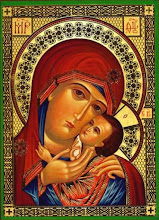
Mary is given a special place in the Orthodox Church, where she is hailed as being "more honorable than the Cherubim and more glorious, beyond compare, than the Seraphim." But she is not seen as a goddess, nor as the fourth person of the Trinity; She is not given honor that is due to God alone: "Just as with the Holy Icons, the veneration due Mary is expressed in quite different words in the Greek writings of the Fathers than that due God." In the Orthodox Church, Mary is very seldom depicted without Christ (the image above is from a Roman Catholic website), and is attributed only with the power to intercede for us to her Son. She is lauded for her obedience to God and for her example of humility and piety.

According to the Orthodox Christian Information Center, Orthodox Christians "do not 'worship' the Virgin Mary. We 'venerate' her and show her great honor. Nor have we ever, like the Latins, developed the idea that the Theotokos was born without sin (the Roman Catholic dogma of the Immaculate Conception) or that she is a co-redemptor with Christ (the cult of the Redemtrix in the Latin Church). The consensus of the Church Fathers rejects such ideas, and the Orthodox Church adheres to that consensus."

Orthodox Christians recognize that, "where the God-Man is, so also, in Him, His Mother, His saints, His angels and His righteous ones are present. In Him—and only in Him—we have fellowship with them and ask their help. His Mother is truly Mother of us all in the Church, where she holds the most exalted position, closest to Christ, but she does not act independently from Him. She is not the Mother of the Church, nor the Mediatrix of all graces, nor the Co-Redemptrix" (Orthodox Info)

For more information:
The Veneration of the Virgin Mary in the Orthodox Church
The Orthodox Veneration of Mary the Birthgiver of God
Veneration of the Virgin Mary

20081207

The Filioque

The filioque (pronounced: filly-oh-quay) is one of those things that you've probably never heard of, but that was--and in many ways still is--a major issue in Christianity. I certainly had no idea what it was until about a year ago, and having learned a bit about it, I don't think it's an exaggeration to say that it is probably one of the top five most controversial subjects in all of Christian history.

The word "filioque" is Latin for "and the son." (filius means "son" and -que is a suffix meaning "and" that is attached to the end of the second of the two words it conjoins. It is considered a word of its own, which is why, for example, the motto of the Roman Republic, Senatus Populusque Romanus, is abbreviated "SPQR.") It was first inserted into the Nicene-Constantinopolitan Creed by sixth-century Spanish bishops, and eventually came to be accepted by the entire western Church, to the extreme consternation of the East. It amended the third article of the Creed to read "and in the Holy Spirit, the Lord, the Giver of life, Who proceedes from the Father and the Son..."

I first became aware of the filioque during my investigation of Roman Catholicism, and determined quickly that, as with any aspect of Trinitarian theology, its legitimacy is way beyond my ability to discern from a theological perspective, and is best left to the experts. However, I was able to look at Scripture and at history to get a sense of whether the filioque is an acceptable addition to the Creed, as the Roman Catholics and most Protestants believe, or a blunder and a travesty, as the Orthodox believe.

First a bit of background information: The first and second Ecumenical Councils composed a statement of faith outlining the very most basic and essential elements of the Christian Faith. It came to be called the Nicene-Constantinopolitan Creed, or Nicene Creed for short, and has been used as the baptismal confession ever since.

In 589, a local church council in Toledo, Spain, which was trying to suppress the Arian heresy, inserted the phrase "filioque" into the Creed in an attempt to bolster the doctrine of Christ's equality with the Father. The use of the filioque spread throughout Europe, but met sharp resistance in Rome, where Pope Leo III had the original text of the Creed engraved in Latin and Greek onto two silver tablets, which he displayed next to the tomb of St Peter along with the inscription:
HAEC LEO POSUI AMORE ET CAUTELA ORTHODOXAE FIDE (I, Leo, place here for the love and protection of the orthodox Faith)
For centuries, European churches continued to use the filioque even though Rome did not. Then, in 1014, at the coronation of Henry II as Holy Roman Emperor, Pope Benedict VIII included the filioque for the first time in a Roman Mass. This action scandalized the Eastern Churches, who removed the name of the Roman Pope from their roster of Orthodox Bishops. The West excommunicated the East. The East excommunicated the West, and the rest is history.

Now, according to Scripture, Christ promised to send the Holy Spirit, Who "proceeds from the Father" (Jn 15.26). Nowhere in Scripture is the Holy Spirit said to proceed also from the Son; however, I'm not aware that the Spirit is anywhere said not to proceed also from the Son. When I was attending RCIA last year, I asked one of the Catholic deacons about this and he told me that, because Christ said that He would send the Spirit, the correct understanding would be that the Spirit proceeds from the Father through the Son. Okay, so why not word it that way, I asked. He didn't have an answer.

I'm not too proud to admit that any doctrine involving the Trinity is far too sophisticated for me to discern intellectually. When someone who knows what they're talking about tells me that the Spirit proceeds from the Father and the Son, I nod my head and say "Okay." When they tell me that the Spirit proceeds only from the Father, I nod my head and say "Okay." That's about the best I can do when it comes to the theology of single versus double procession.

However, history tells me that the Creed was written and approved by two Ecumenical Councils--that is, it was approved by the whole Church...twice!!! It was then altered to include the filioque by a local council--that is, by a single diocese acting on its own. Whether their intentions were upright (and it appears that they were), there's no question that they overstepped their authority and unilaterally articulated an understanding of God that differed from that of the Church as a whole; and that was immediately rejected by the Church as a whole (including the popes of Rome themselves), only much later to gain acceptance gradually in the west.

I have read Orthodox theologians who say that the doctrine of double procession (the Spirit proceeds from two sources rather than from one) distorted the western church's understanding of the roles of the three Persons of the Trinity and led it eventually down the path to the doctrines of papal infallibility and universal jurisdiction, and then finally to the many-headed beast that is Protestant Christianity (not my words).

They make a strong case. But then so do the Roman Catholic theologians who oppose "the error that the Holy Ghost proceeds from the Father, not from the Son."

What is one to believe??

In the end, I have to cast my lot with the Church that has proven itself right with so many other doctrines, and that has clearly shown to have maintained the Faith of the Apostles more consistently than any other.

For more information:
The Filioque
The Filioque (Pelikan)
On the Question of the Filioque
One Single Source

20081125

The Holy Orthodox Popes of Rome

Orthodox churches on the new calendar, today celebrate the life and martyrdom of St Clement, who was one of the Seventy Apostles chosen by Christ in Luke 10, and who served as bishop of Rome (i.e. Pope) until his exile and execution around A.D. 100. So, today is a good day to say something about Orthodox popes.

Contrary to what I thought before I became acquainted with Orthodoxy, the Orthodox Church does not reject the papacy, only what the papacy has become. For the first thousand years after Pentecost, the Pope of Rome was in communion with the other Orthodox bishops of the world. In fact, he was one of the five Patriarchs, which were bishops of the five most important cities in the empire: Rome, Constantinople, Alexandria, Antioch, and Jerusalem. Because Rome was the biggest and most important city, the bishop of Rome was regarded as the honorary leader of the episcopate, much like St Peter was the honorary leader of the Apostles.

In 1054, the Church of Rome officially broke with the other Patriarchates and became known as the Roman Catholic Church, taking all of western Christianity with her.

The following (including the comments at the bottom) is provided by the Orthodox England website. It is a list of the Popes of Rome who are venerated as saints by the Orthodox Church. According to the website, "popes who already appear in all Eastern Orthodox calendars are marked with an asterisk."

St. Linus (+ c. 78), first pope, Martyr. A disciple of the Apostle Paul, he was consecrated by him. One of the Seventy Apostles, he is mentioned in 2 Timothy 4,21. He was pope for about twelve years and may have been martyred. Feast: 23 September (In the East 4 January and 5 November). *

St. Anacletus (Cletus) (+ c. 91), by origin a Greek from Athens and possibly a martyr. His name, correctly Anencletus, means 'blameless' (see Titus 1,7) and he may originally have been a slave. Feast: 26 April.

St. Clement of Rome (+ c. 101), martyr. One of the Seventy Apostles and a Church Father, he was consecrated by the Apostle Peter. He is mentioned in Philippians 4,3 and his letter to the Church of Corinth still exists. He was much venerated in the West in the early centuries and still today in the East. The church of San Clemente in Rome probably stands on the site of his house. According to tradition, he was banished to the Crimea and there martyred. Feast: 23 November (in the East 4 January, 22 April, 10 September and 25 November). *

St. Evaristus (+ c. 109), perhaps a martyr and almost certainly of Hellenic/Jewish origin. Feast: 26 October.

St. Alexander I (+ c. 116), the fifth pope and possible a martyr and by tradition a Roman. Feast: 3 March (in the East 16 March).*

St. Sixtus (Xystus) I (+ c. 125), possibly a martyr. A Roman of Greek origin. Feast: 3 April. *

St Telesphorus (+ c. 136), a martyr, Greek by origin. Feast: 5 January (in the East 22 February). *

St. Hyginus (+ c. 142), by origin a Greek philosopher from Athens. Also perhaps a martyr. Feast: 11 January.

St. Pius I (+ c. 155), from Aquilea, probably born a slave and perhaps the brother of Hermas who wrote 'The Shepherd'. He defended the Church against Gnosticism. Possibly a martyr. Feast: 11 July.

St. Anicetus (+ 166) the tenth pope and of Syrian origin, he fixed the date of Easter, opposed the Gnostics, perhaps martyred. Feast: 17 April.

St. Soter (+ 174), of Greek descent, he may have been martyred. Feast: 22 April.

St. Eleutherius (+ 189), Greek, possibly martyred. Feast: 26 May.

St. Victor (+ 198), an African and the first Latin pope. A forceful character, he fought for Orthodoxy and against Gnosticism. He may have been martyred. Feast: 28 July. *

St. Zephyrinus (+ 217), of Greek descent. Although not a strong character, he still fought for Orthodoxy against Adoptionism and Modalism and may have been martyred for it. Feast: 26 August.

St. Callistus I (+ 222), the fifteenth pope and originally a slave. Pope Callistus, with his Greek name, was known for his mercifulness and defended married clergy against fanatics. He condemned modalism. Probably martyred. Feast: 14 October.

St. Urban I (+ 230), Roman, possibly martyred. Feast: 25 May.

St. Pontian (+ 235), Roman, he was persecuted for the faith and deported to Sardinia, where he died as a confessor. Feast: 19 November.

St. Antherus (+ 236), Greek and perhaps martyred. Feast: 3 January (5 August in East). *

St. Fabian (+ 250), Roman martyr. Described as an incomparable man, 'his death matched the purity and goodness of his life', he did much to help the poor. Feast: 20 January (5 August in the East). *

St. Cornelius (+ 253), the twentieth pope and a Roman, he was greatly helped by St Cyprian of Carthage in the struggle against novatian fanaticism. He was renowned for his mercifulness and died as a result of persecution. Feast: 16 September.

St. Lucius (+ 254), a Roman he was exiled as soon as he was elected in a persecution. Supported by St Cyprian, he was certainly a confessor and perhaps was martyred. Feast: 4 March.

St. Stephen I (+ 257), a Roman and a strong character, perhaps a martyr, he is well known for his argument with St Cyprian of Carthage about the baptism of heretics. St Stephen defended the view of economy, that invalid baptism outside the Church was made valid by entry into the Church, and there was no need to repeat the actual rite. Feast: 2 August. *

St. Sixtus II (+ 258), an Athenian. He was 'a good and peace-loving man' who was much helped by Dionysius, Bishop of Alexandria. He was martyred by beheading, together with his seven deacons, one of whom was St Lawrence. He was and is greatly venerated in the Orthodox Church, West and also East. Feast: 7 August (10 August in the East). *

St. Dionysius (Denis) (+ 268), one of the most important Roman popes of the third century. He was a learned Greek, who opposed several heresies, helped the persecuted and also reorganized the Church in Rome. Feast: 26 December.

St. Felix I (+ 274), the twenty-fifth pope. A Roman, he opposed the adoptianist heresy. Feast: 30 May.

St. Eutychian (+ 283), a native of Tuscany. Feast: 7 December.

St. Gaius (+ 296), possibly from Dalmatia. It seems that he was martyred together with his brother, a priest, and his children. Feast: 22 April (11 August in the East). *

St. Marcellinus (+ 304), possibly a martyr, and certainly a penitent for previous errors and apostasy. Feast: 2 June (7 June in the East). *

St. Marcellus I (+ 309), a confessor who died as a result of persecution. Feast: 16 January (7 June in the East). *

St. Eusebius (+ 310), the thirtieth pope and a Greek by origin. He was deported to Sicily by the Emperor and died there as a confessor. Feast: 17 August.

St. Miltiades (+ 314), probably from Rome, although he had a Greek name. The Emperor Constantine gave him a palace on the Lateran as his residence. He condemned Donatism. Feast: 10 December.

St. Sylvester I (+ 335), Roman. Feast: 31 December (2 January in the East). *

St. Mark (+ 336), Roman. Feast: 7 October.

St. Julius I (+ 352), Roman. A defender of St. Athanasius, this most Orthodox Pope condemned arianism. Feast: 12 April.

St. Liberius (+ 366). The thirty-fifth pope, he was not of strong character and even compromised the Faith at one point in his life, confessing arianism. However, like St Marcellinus, he then repented, atoned and is recognised as a saint of God. Feast: 27 August. *

St. Damasus (+ 384). Of Spanish origin, he was born in Rome in c. 305, the son of a priest. He fought for Orthodoxy and opposed several heresies. He did much to establish the Latin text of the Bible, developed the liturgy and the veneration of the Roman martyrs. Although as a new pope, he made several arrogant errors, he repented for these and was recognized as a saint at the end. Feast: 11 December.

St. Siricius (+ 399), Roman. An imperious man like St Damasus, he nevertheless forbade the harsh treatment of heretics and supported ascetics. He received the support of St Ambrose of Milan and opposed those who slandered the Mother of God. Feast: 26 November.

St. Anastasius I (+ 401). A man of poverty and apostolic mind, he did much to stop the spread of origenism. Feast: 19 December.

St Innocent I (+ 417). The son of St Anastasius I, he had an imperious character and thirty-six letters of his survive. He supported St John Chrysostom and condemned pelagianism. Feast: 28 July.

St Zosimus (+ 418), the fortieth Pope, by origin a Greek. Although initially he made many errors of tact and judgement, he was anti-pelagian. Feast: 26 December.

St Boniface I (+ 422), a Roman and son of a priest. He was kind, humble and fought for Orthodoxy. Feast: 4 September.

St Celestine I (+ 432). A strong character, he was active against pelagianism, he sent St. Germanus of Auxerre to Britain and St. Palladius to Ireland. He also strongly opposed nestorianism and supported St Cyril of Alexandria. Feast: 6 April (8 April in the East). *

St Sixtus III (+ 440), Roman. He vigorously opposed the heresies of both Pelagius and Nestorius. Feast: 28 March.

St. Leo I, 'the Great' (+ 461). He was born in Rome at the end of the fourth century. He was very energetic, opposed many heresies and protected Rome from the barbarian Huns and Vandals. His teaching on Christ was acclaimed by all the Orthodox at the Council of Chalcedon in 451. Feast: 11 April (In the East 18 February) *.

St. Hilary (+ 468), the forty-fifth pope and by origin Sardinian, he actively opposed many heresies. Feast: 28 February.

St. Simplicius (+ 483), he supported the Orthodox in the East against monophysitism. Feast: 10 March.

St. Felix II (+ 492), the son of a priest, he was also the grandfather of St. Gregory the Great. He sternly opposed monophysitism. Feast: 1 March.

St. Gelasius I (+ 496), African, but born in Rome. He helped the poor and was sternly opposed monophysitism. Of imperious character, he put the authority of the Pope on the same level as that of the Emperor. We have from him over a hundred letters or fragments and six theological works. He was the greatest Pope of the fifth century after St Leo. Feast: 21 November.

St. Anastasius II (+ 498), Roman and the son of a priest, he had a conciliatory character. Feast: 8 September/19 November.

St. Symmachus (+ 514), the fiftieth pope and by origin Sardinian, he was very active and a builder of churches. Feast: 19 July.

St. Hormisdas (+ 523), from Italy and father of St. Silverius (see below), he helped end the monophysite schism. Feast: 6 August.

St. John I (+ 526), Tuscan. A confessor, he suffered much from the Arian Goth Theodoric, King of Italy. He was immediately revered as a saint on his repose. Feast: 18 May.

St. Felix III (+ 530), the fifty-third pope and saint in succession, he was greatly loved for his simplicity and almsgiving. He was succeeded by Boniface II, who was the first pope of Germanic origin, and John II, neither of whom is considered a saint. John II was the first pope to change names on assuming that office. Feast: 22 September.

St. Agapitus I (+ 536), the son of a priest, he opposed monophysitism and reposed in Constantinople. Feast: 22 April and 20 September (In the East 17 April). *

St. Silverius (+ 537), he was exiled to Asia Minor as a result of political intrigues. He later died in exile from starvation and various hardships and injustices. He was venerated as a martyr for Orthodoxy. He was succeeded by five popes who are not saints. Feast: 20 June.

St. Gregory I, 'the Great' [left] (in the East 'the Dialogist') (+ 604). One of only two popes to be called 'the Great' (with St. Leo), this able and energetic saint was possibly the greatest of all Roman popes. Known as 'the Apostle of the English', he also did much to convert the Lombards and the Goths. A true monk and ascetic, he wrote much about the monastic life, and was greatly concerned for liturgical life and the poor. Some 850 of his letters survive as well as other extremely important patristic and pastoral works, especially his Dialogues. Notably, he condemned as 'antichrist' any bishop who claimed universal jurisdiction and supremacy. Feast: 12 March. *

Boniface IV (+ 615). A follower of St Gregory the Great, he was also a true monk. Preceded by two popes who are not saints. Feast: 25 May.

Deusdedit I (+ 618), Roman. 'Simple, devout, wise and shrewd', he loved ordinary priests and did much for those then suffering from the plague. He was succeeded by five popes who are not saints. Feast: 8 November.

St. Martin I (+ 655), from Umbria. Condemning the monothelite heresy, he was arrested in Constantinople and starved to death. He was the last Pope of Rome to be martyred. He is widely venerated in the East. Feast: 12 November (In the East 14 April). *

St. Eugene I (+ 657), Roman. Famed for his mildness and kindness to the poor, this saintly man resisted threats to his life from the Emperor in Constantinople. Feast: 2 June.

St. Vitalian (+ 672), opposed monothelitism and appointed the first Greek Archbishop of Canterbury, St Theodore. Feast: 27 January (In the East 23 July). *

St. Agatho (+ 681), Sicilian of Greek origin. Preceded by two popes who are not saints, he was a kindly and generous man, who also helped call the Sixth Oecumenical Council and helped end monotheletism. Feast: 10 January (20 February in the East). *

St. Leo II (+ 683), Sicilian, possibly of Greek descent. He confirmed the condemnation of a predecessor, the heretical Pope Honorius I (+ 638), who had fallen into the monothelite heresy. He loved the poor and was also much concerned with church music. Feast: 3 July.

St. Benedict II (+ 685), Roman. He loved the poor and was humble-minded and gentle. Feast: 7 May.

St. Sergius I (+ 701), born in Palermo, he was a Syrian. Able and energetic, he did much for missionary work in England and northern Europe. He loved the liturgy and church singing and introduced the feast of the Exaltation of the Cross into the West. He was preceded by two popes who are not saints and succeeded by four other non-saints, two Greeks and two Syrians. Feast: 8 September.

St. Gregory II (+ 731), the most outstanding Roman pope of the eighth century An able leader, he condemned iconoclasm as a heresy and did much to encourage missionary work, like that of

St Boniface among the German tribes. He restored churches and fostered the monastic life. Feast: 11 February.

St. Gregory III (+ 741), Syrian. He was acclaimed Pope by the crowds at his predecessor's funeral. He vigorously opposed iconoclasm, built churches and had them adorned with frescos, and also encouraged the monastic life and fostered missionary work in northern Europe. Feast: 28 November.

St Zacharias (+ 752), a Greek and the last Orthodox saint in this see, he opposed iconoclasm, adorned churches with frescos, and did much for missionary work and peace all over western Europe. Feast: 15 March.

Readers will notice that information on many of the early popes is lacking. Many of these are also traditionally held to be martyrs, but there is some uncertainty about this. It should be added that many of the popes were opposed by antipopes, often heretics. This became more and more the case in the Middle Ages when the Orthodox period of the papacy is over and the institution becomes more political and worldly than religious and spiritual.

The reader will no doubt be struck by the fact so many of the early popes are revered as saints, indeed, the first fifty-three in continuous succession. If we take the period up till St Zacharias inclusive, of 90 popes, 68 are revered as saints. Perhaps even more striking is the fact that since St Zacharias, the last Orthodox Roman pope to be a saint, there have been no fewer than 173 popes. Of these only seven are today considered to be saints by the Vatican: one of these was Nicholas I, the notorious filioquist who condemned St Photius of Constantinople, another was Leo IX, the pope ultimately responsible for excommunicating Patriarch Michael of Constantinople in 1054.

Thus with our thoughts on the holy Orthodox popes of Rome, let us pray with one mind and one soul for the salvation of the once Orthodox lands of the West and their salvation in this new millennium.

Holy Orthodox Popes of Rome, pray to God for us!

20081120

Sola Scriptura, Part 4

Continued form last week [Part 1, Part 2, Part 3]

FALSE ASSUMPTION # 2: The Scriptures were the basis of the early Church, whereas Tradition is simply a "human corruption" that came much later.

Especially among Evangelicals and so-called Charismatics you will find that the word "tradition" is a derogatory term, and to label something as a "tradition" is roughly equivalent to saying that it is "fleshly," "spiritually dead," "destructive," and/or "legalistic."

As Protestants read the New Testament, it seems clear to them that the Bible roundly condemns tradition as being opposed to Scripture. The image of early Christians that they generally have is essentially that the early Christians were pretty much like 20th Century Evangelicals or Charismatics! That the First Century Christians would have had liturgical worship, or would have adhered to any tradition is inconceivable — only later, "when the Church became corrupted," is it imagined that such things entered the Church. It comes as quite a blow to such Protestants (as it did to me) when they actually study the early Church and the writings of the early Fathers and begin to see a distinctly different picture than that which they were always led to envision. One finds that, for example, the early Christians did not tote their Bibles with them to Church each Sunday for a Bible study — in fact it was so difficult to acquire a copy of even portions of Scripture, due to the time and resources involved in making a copy, that very few individuals owned their own copies. Instead, the copies of the Scriptures were kept by designated persons in the Church, or kept at the place where the Church gathered for worship. Furthermore, most Churches did not have complete copies of all the books of the Old Testament, much less the New Testament (which was not finished until almost the end of the First Century, and not in its final canonical form until the Fourth Century). This is not to say that the early Christians did not study the Scriptures — they did in earnest, but as a group, not as individuals. And for most of the First Century, Christians were limited in study to the Old Testament.

So how did they know the Gospel, the life and teachings of Christ, how to worship, what to believe about the nature of Christ, etc? They had only the Oral Tradition handed down from the Apostles. Sure, many in the early Church heard these things directly from the Apostles themselves, but many more did not, especially with the passing of the First Century and the Apostles with it. Later generations had access to the writings of the Apostles through the New Testament, but the early Church depended on Oral Tradition almost entirely for its knowledge of the Christian faith.

This dependence upon tradition is evident in the New Testament writings themselves. For example, Saint Paul exhorts the Thessalonians:
Therefore, brethren, stand fast and hold the traditions which ye have been taught, whether by word [i.e. oral tradition] or our epistle (II Thessalonians 2:15).

The word here translated "traditions" is the Greek word paradosis — which, though translated differently in some Protestant versions, is the same word that the Greek Orthodox use when speaking of Tradition, and few competent Bible scholars would dispute this meaning. The word itself literally means "what is transmitted." It is the same word used when referring negatively to the false teachings of the Pharisees (Mark 7:3, 5, 8), and also when referring to authoritative Christian teaching (1 Corinthians 11:2, 2 Thessalonians 2:15). So what makes the tradition of the Pharisees false and that of the Church true? The source! Christ made clear what was the source of the traditions of the Pharisees when He called them "the traditions of men" (Mark 7:8). Saint Paul on the other hand, in reference to Christian Tradition states, "I praise you brethren, that you remember me in all things and hold fast to the traditions [paradoseis] just as I delivered [paredoka, a verbal form of paradosis] them to you" (1 Corinthians 11:2), but where did he get these traditions in the first place? "I received from the Lord that which I delivered [paredoka] to you" (1 Corinthians 11:23). This is what the Orthodox Church refers to when it speaks of the Apostolic Tradition — "the Faith once delivered [paradotheise] unto the saints" (Jude 3). Its source is Christ, it was delivered personally by Him to the Apostles through all that He said and did, which if it all were all written down, "the world itself could not contain the books that should be written" (John 21:25). The Apostles delivered this knowldge to the entire Church, and the Church, being the repository of this treasure thus became "the pillar and ground of the Truth" (1 Timothy 3:15).

The testimony of the New Testament is clear on this point: the early Christians had both oral and written traditions which they received from Christ through the Apostles. For written tradition they at first had only fragments — one local church had an Epistle, another perhaps a Gospel. Gradually these writings were gathered together into collections and ultimately they became the New Testament. And how did these early Christians know which books were authentic and which were not — for (as already noted) there were numerous spurious epistles and gospels claimed by heretics to have been written by Apostles? It was the oral Apostolic Tradition that aided the Church in making this determination.

Protestants react violently to the idea of Holy Tradition simply because the only form of it that they have generally encountered is the concept of Tradition found in Roman Catholicism. Contrary to the Roman view of Tradition, which is personified by the Papacy, and develops new dogmas previously unknown to the Church (such as Papal Infallibility, to cite just one of the more odious examples) —the Orthodox do not believe that Tradition grows or changes. Certainly when the Church is faced with a heresy, it is forced to define more precisely the difference between truth and error, but the Truth does not change. It may be said that Tradition expands in the sense that as the Church moves through history it does not forget its experiences along the way, it remembers the saints that arise in it, and it preserves the writings of those who have accurately stated its faith; but the Faith itself was "once delivered unto the saints" (Jude 3).

But how can we know that the Church has preserved the Apostolic Tradition in its purity? The short answer is that God has preserved it in the Church because He has promised to do so. Christ said that He would build His Church and that the gates of Hell would not prevail against it (Matthew 16:18). Christ Himself is the head of the Church (Ephesians 4:16), and the Church is His Body (Ephesians 1:22-23). If the Church lost the pure Apostolic Tradition, then the Truth would have to cease being the Truth — for the Church is the pillar and foundation of the Truth (I Timothy 3:15). The common Protestant conception of Church history, that the Church fell into apostasy from the time of Constantine until the Reformation certainly makes these and many other Scriptures meaningless. If the Church ceased to be, for even one day, then the gates of Hell prevailed against it on that day. If this were the case, when Christ described the growth of the Church in His parable of the mustard seed (Matthew 13:31-32), He should have spoken of a plant that started to grow but was squashed, and in its place a new seed sprouted later on — but instead He used the imagery of a mustard seed that begins small but steadily grows into the largest of garden plants.

As to those who would posit that there was some group of true-believing Protestants living in caves somewhere for a thousand years, where is the evidence? The Waldensians 7 that are claimed as forebearers by every sect from the Pentecostals to the Jehovahs Witnesses, did not exist prior to the 12th Century. It is, to say the least, a bit of a stretch to believe that these true-believers suffered courageously under the fierce persecutions of the Romans, and yet would have headed for the hills as soon as Christianity became a legal religion. And yet even this seems possible when compared with the notion that such a group could have survived for a thousand years without leaving a trace of historical evidence to substantiate that it had ever existed.

At this point one might object that there were in fact examples of people in Church history who taught things contrary to what others taught, so who is to say what the Apostolic Tradition is? And further more, what if a corrupt practice arose, how could it later be distinguished from Apostolic Tradition? Protestants ask these questions because, in the Roman Catholic Church there did arise new and corrupt "traditions," but this is because the Latin West first corrupted its understanding of the nature of Tradition. The Orthodox understanding which earlier prevailed in the West and was preserved in the Orthodox Church, is basically that Tradition is in essence unchanging and is known by its universality or catholicity. True Apostolic Tradition is found in the historic consensus of Church teaching. Find that which the Church has believed always, throughout history, and everywhere in the Church, and then you will have found the Truth. If any belief can be shown to have not been received by the Church in its history, then this is heresy. Mind you, however, we are speaking of the Church, not schismatic groups. There were schismatics and heretics who broke away from the Church during the New Testament period, and there has been a continual supply of them since, for as the Apostle says, "there must be also heresies among you, that they which are approved may be made manifest" (ICorinthians 11:19)

Continued in Part 5 - FALSE ASSUMPTION # 3

7. The Waldensians were a sect that was founded in the 12th century founded by Peter Waldo which in some ways anticipated the Protestant Reformation. Due to persecution by the Roman Catholic Church this sect survived primarily in the mountainous regions of northwestern Italy. With the advent of the Protestant Reformation, the Waldensians came under the influence of the Reformed movement and essentially joined forces with it. Many early Protestant historians claimed that the Waldensians represented a remnant of "true" Christians that had existed prior to Constantine. Though today no credible historian would make such an unsubstantiated claim, many fundamentalists and cults like the Jehovahs Witnesses continue to claim descent from the early church through the Waldensians — despite the fact that the Waldensians still exist to this day, and they certainly do not claim the Jehovahs Witnesses.

20081030

Sola Scriptura, Part 1


Sola Scriptura, which is Latin for "Scripture alone," is the belief that the Bible is "the only source of revealed truth concerning Jesus, faith and salvation."

This is a doctrine that, along with Sola Fide (by faith alone), Sola Gratia (by grace alone), Solus Christus (Christ alone), and Soli Deo Gloria (glory to God alone), make up the "Five Solas," which were the driving principles of the Protestant Reformation.

While four of the five Solas have never been troublesome to me, Sola Scriptura is something that I have had difficulty with for as long as I can remember; even before I knew it had a name. How could it be, I wondered, that the God of the universe would choose to restrict the entirety of His revelation to the pages of the Bible? Even while I was a professed Baptist, I began to develop an uncomfortable sense of the confining nature of this doctrine, and started asking questions to which I have never heard any satisfying answers: Where is the divinely inspired Table of Contents? (in other words, someone had to determine the canon of Scripture, because Christ didn't hand over the Bible in its present form); The Pauline Epistles seem to have been written to churches that already knew the Faith. Without the Bible, how did they know?; If the Bible were truly the sole source of revealed Truth, wouldn't it have to say so? It does not.

As my questions about Sola Scriptura grew in number and went years without proper answers, they evolved into misgivings, suspicions, and finally objections to the doctrine. It is partly because of my extreme discomfort with Sola Scriptura, and with what I eventually learned was a deep Lutheran commitment to it, that I ultimately decided to abandon my ambitions of pursuing ordination.

If there is anything on which the Roman Catholic and Orthodox Churches agree (and there really does not seem to be much), it is that the Bible is not the sole source of revealed Truth. The former places Scripture alongside Sacred Tradition, the latter includes Scripture as a part of Sacred Tradition. The Orthodox Church defines "Tradition" as "That which is handed down, transmitted," which, of course, includes the Bible. The Orthodox Church has immeasurable respect and regard for the Bible, and uses Scripture more than any other church I've ever known; they understand the Bible to be inspired by God, but they recognize that the Bible is a product of the Church, not vice versa. I am not aware of a Protestant tradition that would agree with this last point. That is part of what has gotten me where I am in the Faith.

Through the remainder of the year, I will be posting weekly excerpts from an great article entitled Sola Scriptura: In the Vanity of Their Minds. It was written by Father John Whiteford, who is a former Church of the Nazarene pastor, and it expresses as well as anything I've read what is at the heart of my intense mistrust of Sola Scriptura. It is a long article, so I will be posting it in several parts, but it has a lot of very good information, so I recommend that my readers take the time each week to read it through thoroughly. Here is the first section (all emphases in this and subsequent installments are my own):


AN ORTHODOX EXAMINATION OF THE PROTESTANT TEACHING
Introduction: Are Protestants Beyond Hope?
Despite all that stands in their way, there definitely is hope for Protestants. Protestants in search of theological sanity, of true worship, and of the ancient Christian Faith are practically beating on our Church doors. They are no longer satisfied with the contradictions and the faddishness of contemporary Protestant America.

Perhaps the most daunting feature of Protestantism — the feature which has given it a reputation of stubborn resiliency is its numerous differences and contradictions. Yet for all their differences there is one basic underlying assumption that unites the amorphous blob of these thousands of disparate groups into the general category of "Protestant." All Protestant groups (with some minor qualifications) believe that their group has rightly understood the Bible, and though they all disagree as to what the Bible says, they generally do agree on how one is to interpret the Bible — on your own! — apart from Church Tradition. If one can come to understand this belief, why it is wrong, and how one is rightly to approach the Scriptures, then any Protestant of any stripe may be engaged with understanding. Even groups as differing as the Baptists and the Jehovahs Witnesses are really not as different as they outwardly appear once you have understood this essential point — indeed if you ever have an opportunity to see a Baptist and a Jehovahs Witness argue over the Bible, you will notice that in the final analysis they simply quote different Scriptures back and forth at each other. If they are equally matched intellectually, neither will get anywhere in the discussion because they both essentially agree on their approach to the Bible, and because neither questions this underlying common assumption neither can see that their mutually flawed approach to the Scriptures is the problem. Herein lies the heart of this Hydra of heresies — pierce its heart and its many heads at once fall lifelessly to the ground.

Why Scripture Alone?
If we are to understand what Protestants think, we will have to first know why they believe what they believe. In fact if we try to put ourselves in the place of those early reformers, such as Martin Luther, we must certainly have some appreciation for their reasons for championing the Doctrine of Sola Scriptura (or "Scripture alone"). When one considers the corruption in the Roman Church at that time, the degenerate teachings that it promoted, and the distorted understanding of tradition that it used to defend itself -along with the fact that the West was several centuries removed from any significant contact with their former Orthodox heritage — it is difficult to imagine within those limitations how one such as Luther might have responded with significantly better results. How could Luther have appealed to tradition to fight these abuses, when tradition (as all in the Roman West were lead to believe) was personified by the very papacy that was responsible for those abuses. To Luther, it was tradition that had erred, and if he were to reform the Church he would have to do so with the sure undergirding of the Scriptures. However, Luther never really sought to eliminate tradition altogether, and he never used the Scriptures truly "alone," what he really attempted to do was to use Scripture to get rid of those parts of the Roman tradition that were corrupt. Unfortunately his rhetoric far outstripped his own practice, and more radical reformers took the idea of Sola Scriptura to its logical conclusions.

Continued next week in Part 2 - Problems with the Doctrine of Sola Scriptura

20081017

Q&A

Q: I thought there are just two kinds of Christians, Protestant and Catholic. How can you claim you are neither?

A: From the Orthodox point of view, Roman Catholicism is a medieval modification of the original Orthodoxy of the Church in Western Europe, and Protestantism is a later attempt to return to the original Faith. To our way of thinking, the Reformation did not go far enough.

We respectfully differ with Roman Catholicism on the questions of papal authority, the nature of the church, and a number of other consequent issues. Historically, the Orthodox Church is both "pre-Protestant" and "pre-Roman Catholic" in the sense that many modern Roman Catholic teachings were developed much later in Christian history.

The word catholic is a Greek word [καθολικός] meaning "having to do with wholeness." We do consider ourselves "Catholic" in that sense of the word, that is, as proclaiming and practicing "the Whole Faith." In fact, the full title of our Church is "The Orthodox Catholic Church."

We find that Protestants readily relate to Orthodoxy's emphasis on personal faith and the Scriptures. Roman Catholics easily identify with Orthodoxy's rich liturgical worship and sacramental life. Roman Catholic visitors often comment, "in lots of ways your Liturgy reminds me of our old High Mass."

Many of the "polarities" between Protestants and the Roman Communion (i.e., "Word versus Sacrament" or "Faith versus Works") have never arisen in the Orthodox Church. We believe Orthodox theology offers the "western" denominations a way in which apparently opposite differences can be reconciled.

Courtesy of St Paul's Greek Orthodox Church

20080924

St Peter the Aleut

Little is known about Saint Peter the Aleut, who is remembered today in the Orthodox Church, other than the fact that he was brought to the Faith by Orthodox missionaries in Alaska and put to death by Roman Catholic missionaries in California.

St Peter was one of fourteen Aleut fishermen who, in 1815, were intercepted by Spanish sailors and brought to San Francisco for questioning. The Franciscans there insisted that the fishermen convert to Roman Catholicism or suffer torture. The captives refused, informing their captors that they were, in fact, already Christians. So the priests locked up the Aleuts in prison cells. They took Peter and severed a toe from each of his feet, while his companions watched. Still he refused to accept the Catholic faith, insisting that he was already a baptized Christian.

The Franciscans then set a group of local Indians to work, cutting off all of Peter's fingers one joint at a time, and then removing his hands and feet. All the while Peter refused to convert, even while they disembowled him.

After Peter died, the priests threatened to continue torturing the remaining fishermen one at a time until they converted. However, during the night, the priests received orders from their superiors to free the prisoners.

The fishermen finally returned to the monastery in Alaska and told the abbot, Father Herman, what had happened. When he heard about Peter he exclaimed, "Holy new-martyr Peter, pray to God for us!"

I wondered as I first read about St Peter whether there was a single one of the more than thirty-thousand Christian denominations in the world of whose truth I was so convinced that I would rather suffer torture than renounce. I think I can honestly say that if any Christian clergyman—even a Calvinist!—started chopping off my fingers I'd join their flock. That's sad to say, but it's true. And I'd justify it by saying, "What's the difference? They're still Christians."

St Peter is one of several thousand martyrs that Orthodox Christians look to as an example of devotion to Truth.

For more information:
OCA biography
Peter the Aleut
Article at OrthodoxWiki
From All Saints of North America

20080919

Q&A

I will begin posting a weekly question and answer extracted from credible online sources (yes, it turn out there is such a thing!).
Anyone wishing to submit a question may do so, and I will see what I can do about getting you a competent answer.

Q: I would like to know what is the orthodox canon regarding the "original sin." The following confuse me:

Father Michael Azkoul states that God punished man only once for the original sin by introducing death, and the original sin wasn't transferred to the next generations. He says (on the OCF website): "The Church does not accept the idea that the Mother of God was born with the (inherited) guilt of Adam; no one is ..."

On the Greek Orthodox Metropolis of Toronto's page there is a totally different statement:"Worst of all, original sin is hereditary. It did not remain only Adam andEve's."


A: Concerning the original -- or "first" -- sin, that commited by Adam and Eve, Orthodoxy believes that, while everyone bears the consequences of the first sin, the foremost of which is death, only Adam and Eve are guilty of that sin. Roman Catholicism teaches that everyone bears not only the consequence, but also the guilt, of that sin. In the article by Fr. Azkoul, he deals with this quite clearly in the sections above the quote which you sent in your email. There is nothing wrong with his statement.

Concerning the second passage -- from the Toronto Metropolis' web site -- it would probably have been clearer to the reader had the sentence read as follows: "Worst of all, the consequences of the original sin are hereditary. It did not remain only Adam and Eve's." I am not sure that there is any conflict whatsoever; rather, the second passage needs to be clarified.

Finally, the "Orthodox canons" are not statements of doctrine; rather, they are the "canon laws" drafted by the early Church councils. Canons deal with Church discipline and order, not with doctrine. They are found in the proceedings of the seven ecumenical councils and the local councils of the early Church. If by asking "if the Orthodox canons are published and available for purchase" you refer to Canon Law, please let me know, and I will direct you to places where you can purchase them. If you are interested in doctrinal material, however, collections of canons would not contain the fundamental teachings of the faith.

Courtesy of oca.org

For more information:
What is the difference between the Orthodox and the Roman Catholic understandings of original sin?
St. Augustine & Original Sin
What are the differences between Orthodoxy and Roman Catholicism?
Original Sin According to St Paul
Banishment and Repentance of Adam and Every Christian
Original Sin in the Eastern Orthodox Confessions and Catechisms
Ancestral vs. Original Sin: A False Dichotomy

20080817

The Scriptures, Part 2

It is interesting and ironic that the Christian faith traditions that hold to the doctrine of Sola Scriptura are the very same ones that use a truncated version of the Bible.

The Bible that Protestants use—and the one I used growing up—excludes seven books from the Old Testament, and parts of two others.

Those books are:

Tobit
Judith
Wisdom of Solomon
Sirach
Baruch
1 & 2 Maccabees

and portions of:

Esther (Vulgate Esther 10:4-16:24), and
Daniel (Vulgate Daniel 3:24-90; Vulgate Daniel 13; Vulgate Daniel 14).

Protestants call these books "Apocrypha" (from the Greek word ἀπόκρυφα, meaning "those having been hidden away"). Orthodox and Roman Catholics call them "Deuterocanon" (from δεύτερος, meaning "second" and κανών, meaning "rule" or "standard," because they were written after the "Protocanon."). When Orthodox and Roman Catholics refer to the apocrypha, what they have in mind are the Gospel of Thomas, the Gospel of Peter, the Revelation of Paul, and other books that were never accepted by the Church.

There was certainly controversy in the past surrounding the books of the Old Testament deuterocanon, because they were written after the Hellenization of the Middle East by Alexander the Great, and were therefore never written in Hebrew, but in Greek. Thus, the Jews rejected these books at the Council of Jamnia in A.D. 90 in an attempt to rid their culture of everything they felt was not entirely Jewish.

For this reason and others, certain members of the early Church (including St. Jerome, who first translated the Bible into Latin) felt that these books should not be included in the Biblical Canon. The Church, however, ultimately decided in favor of these books (as well as certain other controversial books, like Hebrews, James, 2 Peter, 2 & 3 John, Jude, and Revelation).

The deuterocanonical Old Testament books were included in the Septuagint,* which is the version of Scripture that Jesus and the Apostles used and quoted, and have been part of the liturgical life of the Church since the very beginning. They were part of the canon approved by the Council of Rome in 382, the Synod of Hippo in 393, and the Council of Carthage in 397. They were in the fifth-century Latin Vulgate (St Jerome's translation), in the Middle English translation by John Wycliffe in 1382, and in the Bibles that Gutenberg printed in the mid 1400’s.

However, LCMS.org says that "neither Luther nor the Lutheran church has ever regarded these writings as canonical--i.e., as part of the inspired and inerrant Word of God--since they do not meet the criteria discernible from the Scriptures themselves regarding what constitutes those books belonging to the canon of Scripture." I have not yet been able to find where they detail what these criteria are.

If it's true that Christ and the Apostles accepted the Septuagint as Scripture, and that Christians for over a thousand years accepted a canon that was ratified by multiple church councils (and which included the 7 books in question), what “criteria” could possibly exclude these books from the Biblical canon; and why is it that Protestants (specifically Lutherans in this case) "hold to the 66 [rather than 73] books of the Bible that historically authenticated themselves to the church as God's inspired Word" if indeed "all Scripture is God-breathed"? (2 Ti 3:16) Did the Holy Spirit forget to guide the Church in “all truth” (Jn 16.13) for the first fifteen hundred years until the Reformers came along?

Objections to the use of the Deuterocanon:
From the Christian Research Institute (CRI): "They contain teachings that are clearly unbiblical."

Well the thing is, any teaching is unbiblical… if you remove it from the Bible!
Excising chunks of the long-accepted Canon because it doesn't conform with what you think is proper doctrine is no different from
removing a few sentences from the Gospels of Matthew and Luke and claiming that the virgin birth of Christ is unbiblical! This argument is silly at best, blasphemous at worst. And besides, since when is it the practice of Protestants to tailor the content of the Scriptures to match their beliefs?

Also from CRI: "There have been a number of authoritative testimonies against the acceptance of these books, including those from the Jewish scholars of Jamnia, as well as many of the church fathers and scholars, like Athanasius and Jerome."

1. The scholars of Jamnia also rejected the Gospels. And Christ. And when have Christians ever been subject to the decisions of a post-Christian Jewish council anyway? And why are Protestants using the Old Testament given to them by the Masoretes—medieval Hebrew translators—rather than the one used and handed down by Christ, His Apostles, and His Church?

2. There was also much scholarly objection to the inclusion of Hebrews, James, 2 Peter, 2 & 3 John, Jude, and Revelation, but the Church ultimately accepted them as it accepted the books of the deuterocanon. Why accept this New Testament deuterocanon and reject the Old Testament deuterocanon? There is much we can learn from the Church Fathers, like Sts. Athanasius and Jerome (who, by the way, ultimately did include the deuterocanon in his copy of the Scriptures), but as pious and knowledgeable as they were, they were not the "pillar and foundation of truth"—the Church is.

Also from CRI: "These books were never directly quoted by Jesus or by any of the New Testament writers."

This argument assumes that quotation or citation qualifies a book for canonicity. There are at least two problems with this assertion:

1. Several non-canonical books actually are quoted or cited in the New Testament:

Jude 1:14–15 quotes from the Book of Enoch 1:9.
Hebrews 11:37 alludes to the Ascension of Isaiah 5.1-14
Acts 17:28 quotes Cretica by Epimenides and Phaenomena by Aratus.
Titus 1:12 also quotes Cretica.
1 Corinthians 15:33 quotes Thaïs by Menander.
2 Timothy 3:8 references either the Gospel of Nicodemus, Ch. 5 or the Book of Jashar 79.27.**

If quotation equals canonicity, then why aren't these writings among the canon of Scripture?

2. There are several other Old Testament books—accepted by Protestants—that are also not quoted or cited in the New Testament:

Song of Songs
Ecclesiastes
Esther
Obadiah
Zephaniah
Judges
1 Chronicles
Ezra
Nehemiah
Lamentations and
Nahum

Not one of these Old Testament books is ever quoted or alluded to by Christ or the Apostles in the New Testament. But the fact of the matter is that we really don't know for sure Christ didn't quote from all of the books of the proto- and deuterocanon, because the Gospels don't record everything Jesus said and did (Jn 21.25). He may have quoted from the deuterocanon daily; we just don’t know.

From CRI: "The Catholic church itself didn’t canonize them until the Council of Trent, after the Reformation began."

Let me make something perfectly clear: at no point did either the Roman Catholic or Orthodox Churches add these books to a preexisting canon. The Church had used the deuterocanonical books for many centuries prior to the Council of Trent. It was only in response to the Reformers' rejection of these books and adoption of the Hebrew canon that the Roman Catholic Church reaffirmed their use.

"These books don't claim to be inspired."

Neither do most of the other books of the Bible. However, the Qur’an, the Book of Mormon, the Mahābhārata, and the Watchtower all claim divine inspiration. Does this claim prove anything?

"They contain historical inaccuracies and contradictions. For example, Antiochus Epiphanes is made to die three different deaths in three different places."

In fact, the same is true of the death of King Saul in the Protestant-accepted Old Testament:
Saul killed himself by falling on his sword (1 Sam 31.4-6)
The Philistines killed Saul on Gilboa (2 Sam 21.12)
The Lord put Saul to death (1 Ch 10.13-14)

I have found a list of more than two hundred apparent contradictions and inaccuracies in the same Bible that is accepted by every single Protestant. It is not my intention to demonstrate biblical fallacy, so I won’t post the list here. My point is simply that a case against the inclusion of the books of the Deuterocanon on the grounds of alleged inaccuracy or inconsistency is not to be made by anyone who accepts the rest of the Bible.

"These books teach immoral and ungodly things like lying, suicide, etc."

The deuterocanonical books of the Old Testament do not so much teach these actions as record them. Likewise, the Old Testament accepted by Protestants records—and in some cases actually seems to condone—acts of:
incest (Gn 19.30-36; 2 Sam 13.1-14),
rape (Gn 34.1-2; ),
infanticide (Ex 12.29-30; Nm 31.1-18),
human sacrifice (Jdg 11.29-40),
murder (2 Sam 11.14-17),
adultery (2 Sam 11.2-4), and
slavery (Ex 21.2-6; Lv 25.44-46)

How we are supposed to regard such passages is a subject for someone with much more theological knowledge than I have, but the point is that the recording of immoral acts is not a disqualification for canonicity.

"These books don’t rise to the same level of literary and rhetorical excellence evident in the rest of the Old Testament."

If “inspirational” equaled “inspired,” then the book of Numbers would have been stricken from the Canon millennia ago. However, the Church that determined that the book of Numbers—much of which is as electrifying as its title suggests—was to be included in the Biblical canon is the same Church that has for two thousand years also accepted the books of the deuterocanon.

The suggestion that the books of the deuterocanon lack something of the beauty and eloquence of the rest of the Old Testament is of course highly subjective and one that is likely to be made by someone who has not actually read them. My personal experience has found in the deuterocanon no deficiency whatsoever of the qualities that make the protocanon great.
Here’s a challenge for my readers: Identify which of the following passages is from the deuterocanon? (the answers are below)

1) I will sing a new song to my God;
Great are You, O Lord, and glorious,
Marvelous in power and unsurpassable.
Let all Your creation serve You.
For You spoke, and they were created;
You sent Your Spirit, and He formed them.
There is nothing that can resist Your voice.
For the mountains with the waters shall be shaken at their foundations.
And at Your presence, the rocks shall be melted as beeswax.
And yet You are merciful to those who fear You.

2) My son, accomplish your works with gentleness,
And you will be loved by people the LORD accepts.
The greater you are, the more humble you must be,
And you will find grace before the LORD.

3) So when they had collected their arms and stripped the spoils from their enemy, they kept the Sabbath, greatly blessing and giving thanks to the LORD, who had brought them safely through the day and appointed it for them as a beginning of mercy.

4) Take courage, O Jerusalem, for He who named you will comfort you. Wretched are those who mistreated you and rejoiced at your fall. Wretched are the cities in which your children served as slaves. Wretched is she who took your sons. For just as she took pleasure in your ruin and rejoiced over your fall, so shall she be grieved at her own desolation.

5) Your all-powerful Word leaped from heaven, from the royal throne,
Into the midst of a doomed land,
A relentless warrior carrying the sharp sword
Of Your irrevocable command,
And He stood and filled all things with death
And touched the heaven while standing on the earth.

Bottom Line:
Look, the Church never added the books of the Old Testament Deuterocanon to the Bible as some claim, but has recognized them as part of Sacred Scripture since the beginning; even since before it recognized the New Testament! The Church that compiled the rest of the Bible is the very same Church that has always included these seven books in question. Why accept that the Church was right on the one hand and wrong on the other? If you accept the books of the Protestant Bible as Scripture, then you have no reason not to accept the Deuterocanon; but if you reject the Deuterocanon, then what reason could you possibly have not to reject the rest of the Bible?
Is the Church the “Pillar and Foundation of Truth” or isn’t it?

*You will often see the Septuagint abbreviated as "LXX," which is the Latin numeration for "70." This refers to the number of scholars who transcribed these Scriptures into Greek.

You will also notice that in the early versions of the Bible, some books have different names than you're used to. For example, 1 Samuel is called 1 Kingdoms, and 2 Samuel is called 2 Kingdoms. Also, 1 & 2 Kings are called 3 & 4 Kingdoms respectively. Some modern Roman Catholic and Orthodox Bibles reflect this early naming system. The order of the books in the Septuagint is also different from that of most modern Bibles.

**Several books of the protocanonical Old Testament also cite or quote non-canonical sources:
Joshua 10.13 and 2 Samuel 1.18 both refer to the Book of Jashar.
Numbers 21.14 quotes from Book of the Wars of the Lord.
2 Chronicles 12.14-15 refers to the Book of Shemaiah the Prophet, and of Iddo the Seer.
Exodus 24:7 refers to the Book of the Covenant.
1Kings 11:41 mentions the Acts of Solomon.
1Chronicles 27:24 refers to the Chronicles of King David.
Esther 10:2 mentions the Book of the Annals of the Kings of Media and Persia.


ANSWERS: You knew right away that my quiz was a trick, didn’t you? All five passages are from books that the Protestant world has deleted from their Old Testament canon.
1) Judith 16.13-15
2) Wisdom of Sirach 3.17-18
3) 2 Maccabees 8.27
4) Baruch 4.30-33
5) Wisdom of Solomon 18.15-16
(These passages are taken from the Orthodox Study Bible)