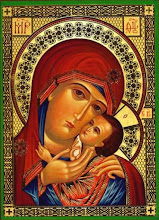
20100213
O Ye Ice and Cold, Bless Ye the Lord!

Forgiveness Sunday
I participated in this last year for the first time, and if I had a hint of any remaining suspicion that Orthodox Christianity wasn't for real, it evaporated that night. Aside from my baptism/chrismation, it was the most powerful and humbling thing I had experienced in my Christian life. There were many tears and embraces, and it set the tone for the long and challenging period of repentance that was to follow.
I'm sorry I won't be there to participate again this year in Forgiveness Sunday Vespers. Even so, I plan to begin Lent on Monday with everyone else to the extent that I am able. With that in mind, I would like to offer to those of my readers to whom it applies, my sincerest, most heartfelt apologies for any wrong to have done them, intentionally or unintentionally, whether in knowledge or in ignorance.
Forgive me, a sinner.
Forgiveness Sunday (OrthodoxWiki)
The Fourth Sunday of the Triodion Period: Sunday of Forgiveness (Cheesefare Sunday)
Questions on Forgiveness Sunday
Sanctus Valentinus
Before Valentine's Day became a celebration of the insipid and the raunchy, it was an occasion to remember the martyrdom of a bishop of the Orthodox Church. The following is from a website called the Struggler:20100212
One Nation, Under God
"[T]he nation’s Christian conservative activists...hold that the United States was founded by devout Christians and according to biblical precepts...When they proclaim that the United States is a “Christian nation,” they are not referring to the percentage of the population that ticks a certain box in a survey or census but to the country’s roots and the intent of the founders."
+++
"'...Christianity has had a deep impact on our system. The men who wrote the Constitution were Christians who knew the Bible. Our idea of individual rights comes from the Bible. The Western development of the free-market system owes a lot to biblical principles."
+++
"For [Texas state board of education member Imet Don] McLeroy, separation of church and state is a myth perpetrated by secular liberals."
+++
"'Many of us recognize that Judeo-Christian principles were the basis of our country and that many of our founding documents had a basis in Scripture. As we try to promote a better understanding of the Constitution, federalism, the separation of the branches of government, the basic rights guaranteed in the Bill of Rights, I think it will become evident to students that the founders had a religious motivation.'"
+++
"One recurring theme during the process of revising the social-studies guidelines was the desire of the board to stress the concept of American exceptionalism, and the Christian bloc has repeatedly emphasized that Christianity should be portrayed as the driving force behind what makes America great."
Read the rest here.
20100211
Андре́й Рублёв

St Andrei was a monk from Holy Trinity Monastery near Moscow who is famous for having painted many beautiful icons including his most famous work, his ubiquitous iconographic representation of the Holy Trinity, picture above (click on it for a high-resolution image). In 1966, Russian filmakers filmed a biographical account of his life, which was banned by Soviet authorities unitl the 1970s. Read more about the film and view the trailer here: Tarkovsky's "Andrei Rublev"
St Andrei's Trinity icon has been called the "most perfect of all Russian icons and perhaps the most perfect of all the icons ever painted." John Sanidopoulos, author of the article cited above writes that
Click here for an explanation of the icon's symbolism."The icon of the Holy Trinity is highly praised for its pure representation of Orthodox trinitarian theology. Rublev's genius comes in his presentation of the one Christian God in three hypostases, or persons. The three hypostases of the Holy Trinity - Father, Son, and Holy Spirit - are depicted as equal, yet unique. Rublev's perfect placement of the three persons allows for a feeling of union between the three, all acknowledging each other, while a symbol of the eucharist, the life they have given the world, rests on a table between them. Between them also exists space in which the viewer of the icon almost seems called to enter by the position of the three persons."
20100209
Fasting
The following is from the blog Gladsome Light Dialogues:
The idea that any Westerner has about fasting is strongly linked with renunciation, with giving-up, with sacrificing something for God. In the Eastern Orthodox Church however, fasting achieves a much richer meaning. Fasting is not only about giving-up, but it is actually more about gaining, about being able to reach things that are possible only through this spiritual exercise.
In a legalistic understanding of salvation some believe that Christ has come on earth to fulfill a duty, to repair an offense that man has brought unto God. His sacrifice on the Cross satisfies this need and mankind enters again in God’s favors. From this perspective fasting is a similar symbol: a personal sacrifice that one makes to step back into God’s grace. This can be anything ranging from giving up chocolate to abstaining from Facebook for the Lenten period. But such frivolous renunciations really don’t cut it into the genuine meaning of fasting. God doesn’t need any of these sacrifices as He does not need the whole burnt offering of the Old Testament anymore. It is us, not God, who need the fasting rule.
Reducing the fasting to a symbol, to a mere idea of fasting, the entire exercise of Great Lent is perverted. Fasting becomes a theoretical notion that can be achieved through an act that involves little or no effort because, at the end, is not the fasting that is important, but only the idea of fasting. This intellectual reduction is yet another symptom of our brokedness, of the ontological separation between mind and heart. The mind creates an entire new reality that we confuse many times with the true authenticity of existence that only a heart open to God can see.
In this world, made-up by our minds saturated with secular values, the importance of the complete involvement of the body in fasting is forgotten, because for the mind a symbol is enough. But man does not exist in a fantasy of the mind, but lives in the real world, as a true person, body and souls, both physical and spiritual.
Christ came to save the world not by spreading only the idea of salvation, but coming down Himself, taking body from the Virgin Mary and physically becoming one of us; not a ghost, not a spirit, but flesh and bones. His death on the cross was not a symbol, but a painful reality. His resurrection was not a simple story full of morality, but the defining moment of a new stage in human existence. By reducing everything to symbols we end up living in our minds and missing genuine life.
In the Orthodox understanding man is utterly aware that living in a physical world, with a corrupted and fallen nature, the body is subject to passions that affect the state of his entire being. Controlling the body through fasting directs the entire human being towards God, because “a body subdued by fasting brings the human spirit freedom, strength, sobriety, purity, and keen discernment.” (St. Ignatiy Brianchaninov). In a paradoxical way by starving the body the entire human being is nourished spiritually and is able to “ascend on high, to contemplate lofty things and to put the heavenly higher than the pleasant and pleasurable things of life.” (St. John Chrysostom).
We don’t want however to reduce the experience of fasting to a mere vegetarian diet. The Great Lent is a period of total transformation, of metanoia, as the Greek fathers call it. The faster should strive to change his or hers entire way of life, redirecting priorities, seeking new avenues to God, striving for perfection in Christ. As St. Basil the Great says “True fasting lies in rejecting evil, holding one’s tongue, suppressing one’s hatred, and banishing one’s lust, evil words, lying, and betrayal of vows.”
From this perspective we can truly say, paraphrasing St. John Chrysostom, that fasting of the body is a feast for the soul. A soul liberated from the weight of an overfed body and nourished with the manna of virtues can reach into the spiritual heights, free of the passions that drag it to the ground. Such a soul can pray more, can forgive more, can love more. Fasting is not a simple renunciation but an exercise of love, as salvation is not an honor satisfying sacrifice but the greatest act of love ever seen.
20100205
Martyr Agatha of Palermo in Sicily
The Holy Virgin Martyr Agatha was the fifteen-year-old daughter of rich and respected Christian parents from the city of Palermo (formerly Panormos) in Sicily. During the persecution under the emperor Decius (249-251), the city prefect of Catania, Quintianus, having heard about Agatha's wealth and beauty, sent his soldiers after her to bring her to trial as a Christian.At Catania they housed the saint with a certain rich woman, who had five daughters. They all attempted to tempt St Agatha with fine clothes, amusements and entertainment, urging her to offer sacrifice to the pagan gods, but the saint disdained all these things. The more they tried to move her, the more resolute she became. She prayed that she might soon face martyrdom.
During her interrogation under Quintianus, the holy martyr was swayed neither by the flattery, nor by the threats, and she was subjected to cruel torments. They also tried to remove her breasts with metal tongs, and when this failed, they used knives.
The holy Apostle Peter appeared to her in prison and healed her wounds. St Agatha was led to torture again, and Quintianus was astonished to see her completely healed, with no trace of cutting. Then the torture began once more.
At this moment an earthquake took place in the city, and many buildings were destroyed. Among those killed were two of Quintianus's advisors. The terrified inhabitants rushed to Quintianus, demanding an end to Agatha's tortures. Fearing a revolt by the people, Quintianus sent St Agatha back to prison. There the martyr, offering thanks to God, peacefully surrendered her soul to the Lord.
(oca.org)
20100201
Church and (Head of) State
NYT on Fr. Moses Berry
[As I was clicking through his church's website just now I came across something remarkable. Fr Moses's parish hosted an American Heritage Music Festival last year and the year before. Until now, the only festivals I have known Orthodox parishes to host have been those for the purpose of celebrating some Eastern ethnic heritage: Serbian, Greek, Russian, etc. The ones that I have attended I have enjoyed--and i LOVE the food--but I have difficulty with the notion that it is among the Church's purposes to preserve/celebrate, etc ethnic pride or nationalism. But as long as we're celebrating heritages...why not celebrate American heritage? We are Americans after all, are we not? I didn't become Greek when I became Orthodox.]
ASH GROVE, Mo. — When he moved back home here 12 years ago, the Rev. Moses Berry wanted to settle down to small-town life with his wife and two children. He did not intend to become a one-man racial reconciliation committee.
But some residents of this nearly all-white, rural town of 1,400 people 15 miles west of Springfield say that he has done just that.
By founding a black history museum here, cleaning up his family’s cemetery and telling his family’s sometimes controversial story, beginning with its roots in slavery, Father Moses, as everyone calls him — an African-American, Orthodox Christian priest in a flowing black cassock — has tried to remind people of a part of the region’s often-forgotten past, and to open up hearts and minds along the way.
Read the rest here.
Ozarks Afro-American Heritage Museum website
Theotokos "Unexpected Joy" Orthodox Church
Why we need beautiful churches

The following is from an interview of Andrew Gould of New World Byzantine architects.
Q: Would you mind telling us a little bit of your philosophy on why we need beautiful churches?
A: The question of ‘why this sort of architecture?’ really brings me back to why I started becoming interested in Orthodoxy. I had previously been Anglican and I was interested in designing Anglican churches in gothic style; when I was in college, I studied gothic architecture quite intensively. But as I started to learn about Orthodoxy and Byzantine churches, I was really impressed by the degree to which architecture, iconography, music and liturgy are integrated in Orthodoxy, as one common vision. The way the liturgical movements connect to the different spaces of the building, and then the way the liturgical movements address the different icons, the way in which the icons are painted on the particular surfaces of the buildings in the proper order where they go, and then the way the hymnography refers to all of these saints and to liturgical actions. All of these things work together as an icon of the Kingdom of God in its entirety. Panel icons of saints are not the whole story. They represent the saints, the angels, Christ—but the Kingdom of God is a lot more than that.
If you read the end of the Book of Revelation it describes the Kingdom of God. The Kingdom of God is the City of New Jerusalem: it has foundations made of precious stones; it has columns and arches and beautiful pavements; it has domes—all of this is described. And it has ever been the practice of the Orthodox Church to understand church architecture as iconographic. That it, along with the icons and saints, makes for the full representation of the Kingdom of God, and then that must be filled with liturgy, music, incense, to represent we who make up the Kingdom of God along with the saints and angels worshipping God therein. So if you don’t have that, if you have a room like this {indicates a nave in a temporary office-space – ed.} with icons hanging on the wall, you’ve only got half of the picture. To me, honestly, seeing this situation of a mission church without a church, looks like the Kingdom of God in exile. We have worship, and we have music, we have saints, but where is New Jerusalem? Where is the City?
That’s why you need beautiful architecture. And that’s why the architecture needs to be honest, and solid and sincere. We don’t want to have a stage set, we don’t want to have a building that superficially looks like an Orthodox church, because that’s a stage set, that’s sort of what Baroque architecture is. That’s sort of trying to use plaster and ornament to give a theatrical impression of the Beatific Vision. But Orthodoxy’s not about that, Orthodoxy’s about building something absolutely solid, and permanent and honest that conveys the real ethos of the eternal Kingdom of God.
20100131
St. George Orthodox Military Association (SGOMA)
You will notice that I have just made an addition to my link list. It is for a new organization that I just became aware of through a certain blog to which I am a somewhat frequent visitor.The St. George Orthodox Military Association began last October and their mission is to "find new opportunities to support and assist our Orthodox Military Members serving in the US Armed Forces Stateside and around the World, because the spiritual wellness of our Orthodox Troops matter."
Grammatical concerns aside, it looks like a good organization and is certainly a worthy cause.
20100126
Which is more Christian...

...the "Christian Nation" of the United States, or "Godless" Russia?
I have engaged in many (many, many...too many) discussions with people who insist that the U.S. is a Christian nation.
Was our country, as some like to claim, "founded on Judeo-Christian principles"? Official documents seem to say otherwise.
It is not unpatriotic or anti-American to say that the U.S. is not a Christian nation...it's just being honest.
The following is part of an article from MinistryValues.com:
Is Russian leadership more Christian than the United States? Is the Russian Government more Christian than George Bush ever hoped the United States to be? The answer is yes, and not only is it true, but thanks to born again Christians, Dmitry Medvedev and Vladimir Putin, Christian influence in matters of State is rapidly on the rise. Let's look at the facts.
A couple of weeks ago Barack Obama skipped Church on Christmas Day while the President of Russia, Dimitry Medvedev, on January 6, 2010, attended mid-night mass services celebrating the Russian Orthodox Christmas in grand splendor in the traditional Vigil liturgy in Saint Christ the Saviour Cathedral in the presence of 4,000 people, including Patriarch Kirill. The Russian Orthodox Church celebrates Christmas following the old Julian calendar, which is 13 days "behind" the Gregorian calendar.
While Russian leaders were attending Church services, half way around the world in America, Chicago Tribune, writing about Obama's troubles finding a Church for his family, said "But as his (Obama) fellow Christians around the world attended Christmas services on Wednesday and Thursday, the president-elect and his family remained sequestered at their vacation compound on the windward coast of Oahu. His lack of attendance at formal religious services showcased a dilemma faced by Obama, who is between churches and often expresses concern about bringing the disruption of his security detail into the lives of others." According to the same report President Barack Obama has not attended a public church service since before being elected.
So what you say? Well, today Russia is investing $100 million to rebuild Christian churches throughout the country. Money to rebuild theses churches is coming from Russian tax payers. This would be impossible in the US of course. Imagine the US Media's reaction if President Obama decided to invest $100 million dollars of US tax payer dollars to rebuild Catholic Churches. In the US there would be outrage yet Russia citizens are supportive of the investment.
[...]
Russia's turn to Christianity is a virtually unknown phenomenon in the United States. Most Christian leaders are oblivious to what is happening in Russia. Pastor Robertson or Pastor Hagee still believe Russia is an atheist and communist country and these prominent End-Times Christian pastors are rasing [sic] money and rattling their sabers to go to war against the Godless state.
[...]
Vladimir Putin and Dmitry Medvedeve go to Church frequently, kiss precious icons of the Virgin Mary and seek political and moral counsel from the Russian Orthodox Clergy. Furthermore, to the surprise of many Americans, particularly Evangelical Christians, Vladimir Putin wears a Christian cross with him at all times.
[...]
Funding to restore Christian sites and the return of properties seized from the Church in Soviet times are but the latest gift of the Kremlin to the Patriarchate. This year, the Russia Justice Ministry will present plans to amend the laws on "Freedom of Conscience and Religious Organisations", which, if approved, would severely restrict the activities of certain religious communities, like Evangelical Christians. In addition, the authorities plan to add religious education in public schools as well as chaplains paid by the state to the armed forces. It also appears possible that the Orthodox Patriarchate of Moscow will be granted the right to vet parliamentary bills before they go to the Duma.
Is the Russian Government building a more Christian society? Perhaps. But try telling that to your buddies at Church this Sunday.
Read the rest here
20100125
St. Benedict Biscop, abbot of Wearmouth
He came from a noble Northumbrian family in Britain, and was tonsured a monk in 653 at Lerins in Gaul. In 669 he was made Abbot of the Monastery of Saints Peter and Paul in Canterbury. He traveled to Rome in 671 to be instructed in monastic practice according to the Rule of Saint Benedict (of Nursia). Returning to Northumbria he established two new monasteries, the first to follow St Benedict's Rule in the British Isles. He went to Rome once again in 678-679, this time bringing back the archcantor of St Peter's, who taught the monks of St Benedict's monasteries the chant and liturgical practices used in Rome. Under the holy abbot's guidance, these monasteries became flourishing centers of Christian worship, scholarship and art. The Venerable Bede (May 26) was one of his disciples. Saint Benedict reposed in peace in 689 or 690, having greatly strengthened the Church and the Christian faith in Britain.From Holy Trinity Church, Baltimore, MD
20100124
20100122
Office of Prayer and Supplication for the Victims of Abortion (excerpt)
For our deliverance from all affliction, wrath, danger, and necessity, let us pray to the Lord.
People:
Lord, have mercy.
Deacon:
That He will not remember the transgressions of His people, but will turn away all His righteous wrath which He has stirred up against us, let us pray to the Lord.
People:
Lord, have mercy.
Deacon:
That He will bless the good intentions of His servants who strive to rescue His children from violent death, and allow them to begin successfully and to finish without obstacle, through the power and grace of the most Holy Spirit, let us pray to the Lord.
People:
Lord, have mercy.
Deacon:
That He will guide the hands of His servants to complete their work successfully, let us pray to the Lord.
People:
Lord, have mercy.
Deacon:
That He will bless His servants with the grace of the most Holy Spirit, and make their efforts well pleasing in His sight, let us pray to the Lord.
People:
Lord, have mercy.
Deacon:
That He will assign a guardian angel to banish from this effort every enemy and obstacle, whether visible or invisible, let us pray to the Lord.
People:
Lord, have mercy.
Deacon:
That this work may be ordered in wisdom and may end in perfection, by the grace of the Holy Spirit, let us pray to the Lord.
People:
Lord, have mercy.
Deacon:
Help us, save us, have mercy on us, and keep us, O God, by Thy grace.
People:
Lord, have mercy.
Deacon:
Calling to remembrance our most holy, most pure, most blessed and glorious Lady, the Birth-giver of God and ever-virgin Mary, with all the saints, let us commend ourselves and one another, and all our life unto Christ, our God.
People:
To Thee, O Lord.
Priest:
For unto Thee is due all glory, honor, and worship: to the Father, and to the Son, and to the Holy Spirit. Now and ever, and unto the ages of ages.
People:
Amen.
+++
Deacon:
Again we pray for mercy, life, peace, health, salvation, and visitation for the servants of God who strive against the evil of abortion, and for the pardon and remission of their sins.
People:
Lord, have mercy. Lord, have mercy. Lord, have mercy.
Deacon:
Again we beg Thee, O Lord, to hear our prayer, and have mercy on Thy servants who strive to save the lives of Thy innocent children. In Thy grace and bounty, fulfill their petitions and forgive all their transgressions, whether voluntary or involuntary. Accept their sacrifice of praise upon Thy heavenly altar; protect them from every visible and invisible enemy; deliver them from all misery, sickness, and affliction; grant them health and length of days, we pray Thee, O Lord, hearken and have mercy.
People:
Lord, have mercy. Lord, have mercy. Lord, have mercy.
+++
Deacon:
Again we pray for the children of God condemned to death by the unjust judgement of men: that the Lord our God would soften the hearts of those who seek their violent destruction, and rescue those who are being led forth to the slaughter, we diligently pray Thee, O Lord, hearken and have mercy!
People:
Lord, have mercy. Lord, have mercy. Lord, have mercy.
+++
Deacon:
Again we pray for all who have fallen into the hands of the godless civil authority for the sake of God's children, and who languish in courts and prisons: that the Lord our God may look upon them with compassion; that He may comfort, strengthen and preserve them; and that He may deliver them speedily from bondage and oppression, let us all say: O Lord, hearken and have mercy.
People:
Lord, have mercy. Lord, have mercy. Lord, have mercy.
Deacon:
By Thine infinite power, O Lord, our God, move to compassion and mercy the hearts of those who hold Thy servants in cruel captivity; restrain them from doing harm or permitting evil to befall Thy servants, but rather cause them to relent and to release them; free the captives whole and unharmed, O Lord, and bestow Thy mercy upon them, let us all say: hearken quickly and graciously have mercy!
People:
Lord, have mercy. Lord, have mercy. Lord, have mercy.
Deacon:
Thy vile enemies, O Lord, have annihilated Thy children and defiled Thy churches, and have imprisoned Thy faithful servants. Look down from heaven, therefore, and behold, and forsake us not utterly, but quickly cleanse the land of Thy people of the wickedness of those who oppose Thee, with humble heart we entreat Thee, our God Who art mighty in strength and wondrous in wisdom: O Compassionate One, hearken and have mercy!
People:
Lord, have mercy. Lord, have mercy. Lord, have mercy.
Deacon:
Again we pray for all those here present, who await from Thee Thy great and abundant mercy.
People:
Lord, have mercy. Lord, have mercy. Lord, have mercy.
Priest:
For Thou art a merciful God, and lovest mankind, and unto Thee do we send up glory: to the Father, and to the Son, and to the Holy Spirit. Now and ever, and unto the ages of ages.
People:
Amen.
+++
Priest:
O most merciful, all gracious and compassionate Lord Jesus Christ our Savior, Son of God: we entreat Thee, most gracious Master: look with compassion upon Thy children who have been condemned to death by the unjust judgement of men. And as Thou hast promised to bestow the heavenly kingdom on them born of water and the Spirit, and who in blamelessness of life have been translated unto Thee; and Who said, "Suffer the little children to come unto me, for of such is the kingdom of heaven" - we humbly pray, according to Thy unfailing promise: grant the inheritance of Thy kingdom to the multitude of spotless infants who have been cruelly murdered in the abortuaries of this land; for Thou art the resurrection and the life and the repose of all Thy servants and of these innocents, O Christ our God.
Turn the hearts of those who seek to destroy Thy little ones. We beseech Thee to pour forth Thy healing grace upon them, that they may be convicted in their hearts and turn from their evil ways. Remember all of them that kill our children as on the altars of Moloch, and render not unto them according to their deeds, but according to Thy great mercy convert them: the unbelieving to true faith and piety, and the believing that they may turn from evil and do good.
O Holy Master, Almighty Father and pre-eternal God, Who alone made and directs all things; Who rises up quickly against the evil of the impious ones; who, by providence, teaches Thy people preservation of justice and the obliteration of evil on earth; Who condescends to raise up warriors for the protection of the people of God: we entreat Thee with compunction, that as Thou didst give David power to defeat Goliath, and as Thou didst condescend through Judas Maccabeus, to seize victory from the arrogant pagans who would not call on Thy Name; so too, grant protection to us, Thy servants against the enemies rising against us as we go forth to do spiritual battle against the evil one and those who do his will rather than Thine.
For Thou art a merciful God, and lovest mankind, and unto Thee do we send up glory: to the Father, and to the Son, and to the Holy Spirit. Now and ever, and unto the ages of ages.
People:
Amen.
From ocf.org
Archpastoral Message of his Beatitude Metropolitan Jonah for Sanctity of Life Sunday 2010
Sanctity of Life Sunday
To the Venerable Hierarchs, Clergy, Monastics and Faithful of the Orthodox Church in America
Dearly Beloved in Christ:
As Orthodox Christians, we strongly affirm the value and sanctity of all human life, from the moment of conception to the final breath one takes. This affirmation is theologically based, in that each person bears within him or her self the image of God, and has the potential to fulfill that image by likening him/herself to God. To artificially terminate life is to transgress on that which is holy; it is unthinkable, a grave sin.
Every one of our churches and our homes bear the image of the infant Christ cradled in the arms of His Mother, an image that is supremely human, and supremely divine. It is the image of divine Motherhood, that the Son of God was conceived, borne and nurtured by His Most Pure Mother. God is thus revealed in the Motherhood of the Virgin; bearing us in Her holy embrace of love. This image also reveals God's love for us, that he became like us in every way--a fetus in His Mother's womb, an infant in Her arms, a little child. God has sanctified every aspect of human life, becoming what we are that He might make us like Himself.
As Orthodox, every aspect of our lives is iconic. Every child is an image of the Christ Child, every person an image of God. Each bears infinite potential to attain to the Likeness, to sainthood, to holiness. Marriage also is an icon, as the union of man and woman in the flesh blessed by God, and bringing forth the fruit of children, is an image of our union with one another in Christ in the Kingdom.
Christian marriage and family are the sacred context not only for the rearing of children, but as the basic core of our identity and reference point of stability. The family is the place where we are nurtured and accepted, find solace and consolation, and thus the faithful family becomes the place where these very human emotions and feelings are filled with grace and sanctified. Whether we are very young or very old, the family is the context of our life, in which we work out our salvation. We experience God's Fatherhood, and divine Motherhood; we experience the nurturing love which becomes a participation in divine communion. And as we breathe our last, should we not remember the image of the crucified Christ, carried in the arms of his mother, in her grief, the grief of every mother for her child?
We affirm the sanctity of life, made holy by the incarnation of the Christ. We affirm that every stage of our life has been sanctified. We affirm marriage of one man and one woman as the foundation of the family, the image of our union with God, and the means of sanctifying the lives of all members of that family by the grace of love and divine communion.
These are desperate times. Our society is in despair. It is a despair that manifests itself in the breakdown of essential relationships, of marriage and family. Continued unemployment leads to hopelessness, and the breakdown of trust that one is able to provide; this leads to the breakdown of marriages, and the bitterness that goes with it. Returning soldiers, with posttraumatic stress just below the surface, enter into relationships that often turn brutal and abusive. Marriage, and the very family itself are in question, with the issue of homosexual unions. The majority of marriages end in divorce, and the majority of children grow up without fathers or mothers; and how many pregnancies end in abortion? Despair is the primary context which could make it even possible for a mother to destroy her unborn child.
We offer, always, the way to healing and reconciliation for those who have fallen short and fallen into sin, in an embrace of love. We offer hope to those who have lost hope through the guilt of sin. We offer consolation to those in sorrow. We offer support and guidance to build families that work out their salvation together, and become the rock and foundation of our culture. Through these things, re-incarnating Christ's love and redemption in hearts, in real faces, in institutions of concrete service and healing, we offer hope to our people, our culture, our society, and through that hope, joy as we see God reborn in our lives and in those of all around us.
Yours in Christ,
+JONAH
Archbishop of Washington
Metropolitan of All America and Canada
SANCTITY OF LIFE PETITIONS AND PRAYERS
These petitions are to be inserted into the Litany of Fervent Supplication as part of the annual commemoration of Sanctity of Life Sunday.
--Again we pray that You will grant to the people of this nation the will to do good, to flee from evil, and to practice all righteousness, making us respectful of life and sharers of Your blessings, caring for one another in mercy and truth.
--Again we pray that You will banish all evil from our hearts and wickedness from our laws, enabling us to be servants of Your holy will and performers of Your love.
--Again we pray that You will kindle in our hearts the will to care for the needy, to show kindness to the poor, to aid the homeless and help the helpless.
The following prayer is to be read after the singing of "Blessed be the Name of the Lord" for the second time.
Let us pray to the Lord.
Lord, have mercy.
O Lord Jesus Christ, the only-begotten Son, Who are in the bosom of the Father, True God, source of life and immortality, Light of Light, Who came into the world to enlighten it: You were pleased to be conceived in the womb of the Virgin Mary for the salvation of our souls by the power of Your All-Holy Spirit. O Master, Who came that we might have life more abundantly, we ask You to enlighten the minds and hearts of those blinded to the truth that life begins at conception and that the unborn in the womb are already adorned with Your image and likeness; enable us to guard, cherish, and protect the lives of all those who are unable to care for themselves. For You are the Giver of Life, bringing each person from non-being into being, sealing each person with divine and infinite love. Be merciful, O Lord, to those who, through ignorance or willfulness, affront Your divine goodness and providence through the evil act of abortion. May they, and all of us, come to the life of Your Truth and glorify You, the Giver of Life, together with Your Father, and Your All-Holy and Life-giving Spirit, now and ever and unto ages of ages. Amen.
"Blessed be the Name of the Lord" is then sung for the third time, followed by the usual dismissal.
From oca.org
20100120
20100119
Forty Christians killed in Nigeria
More than 40 people have been killed in the Nigerian city of Jos, Plateau State, after around 200 Muslim youths attacked Christians near a Catholic church in Nasarawa Jos, yesterday, sparking retaliatory violence.
According to local sources, the Muslim youths claimed to have gathered to renovate a house next to St Michael’s Catholic Church, owned by a Muslim man, who had allegedly murdered three Christians during violence in Jos North in November 2008. However, instead of renovating the house, the youths are reported to have launched an unprovoked assault on a female passer-by before attacking St Michael’s Church, killing and injuring several members. They also set fire to a score of local houses and businesses and churches...
Read the rest here.
20100112
Not that I've really been searching, but I have not heard any contemporary Christian music that I would compare to (or that is anywhere near as good as) Caedmon's Call. Until now.
I just became aware of an Orthodox Christian country band (yes, you read that right) from Lafayette, IN called the SmallTown Heroes. They claim that they are "not a band," but "friends who play music," and supposedly describe themselves as "Byzantine Bluegrass." I'm not sure what that means, but, having listened to a few snippets of their songs [here], I would definitely not classify them as "bluegrass." Nor is there really anything in their lyrics or music that is overtly Orthodox per se (except for maybe: "I want to be a picture on your Sanctuary wall..."); I mean, they're not singing in Greek or anything.
But they're good. There's something about them that makes me think of Caedmon's Call. Maybe it's the acoustic guitars, maybe it's the occasional female voice. Maybe it's that moody quality that appeals to twenty-somethings. It may not bring you to the foot of the Throne the way the monks of Valaam will, but it seems like something worth listening to. Their CD is available from Saint Romanos Records (which has a lot of non-traditional Orthodox music). And, according to their website, they will be performing live at Sacred Grounds Coffee in Lafayette on Jan 16.
Note: Since I wrote this, I went ahead and bought their CD on iTunes, and I definitely recommend it. It is reminiscent of Caedmon's Call: folksy, with some rock-n-roll, a couple of sappy love songs, country-ish in a few places, with some Christian-themed lyrics. You won't hear any of it sung in church (ever), but it is a good CD.
The Blessing of the Electronics
From TimesOnline:
Great efforts have been made to modernise the Church of England, but its liturgy dates from before the arrival of the Nokia 6310, and until yesterday, none had been brave enough to adapt its ceremonies to address the modern mysteries of 3G network coverage, iPhone apps and variable battery life.
But if anyone can, [Rev Canon David Parrott] can.
Yesterday, in the church of the City of London Corporation, he presented an updated version of Plow Monday, an observance that dates from medieval times. On this day, the first Monday after Twelfth Night, farm labourers would bring a plough to the door of the church to be blessed.
Men and women coming to his church no longer used ploughs; their tools were their laptops, their iPhones and their BlackBerries.
...the congregation held their phones in the air, and Canon Parrott addressed the Almighty. “By your blessing, may these phones and computers, symbols of all the technology and communication in our daily lives, be a reminder to us that you are a God who communicates with us and who speaks by your Word. Amen.”
Read the rest here
20100110
No one has been hurt in the attacks, which began Friday. They follow a high court's ruling that Christians can use the word "Allah" in literature printed in the country's official language, Malay.
In Malay, the word for God is "Allah," as it is in Arabic.
But many in the predominantly Muslim country, including the government, believe the word should be exclusive to Islam.
Read the rest here.
20100109
The Holy Protomartyr Stephen the Archdeacon
Stephen was a kinsman of the Apostle Paul and one of those Jews who lived in the Hellenic provinces. Stephen was the first of the seven deacons whom the holy apostles ordained and appointed to the service of assisting the poor in Jerusalem. For this, he is called the archdeacon. By the power of his faith, Stephen worked great miracles among the people. The wicked Jews disputed with him, but they were always defeated by his wisdom and the power of the Spirit, Who acted through him. Then the shameful Jews, accustomed to calumnies and slander, incited the people and the elders of the people against the innocent Stephen, slandering him as though he had blasphemed against God and against Moses. False witnesses were quickly found who confirmed this. Stephen then stood before the people, and all saw his face as it had been the face of an angel (Acts 6:15), that is, his face was illumined with the light of grace as was once the face of Moses when he spoke with God. Stephen opened his mouth and enumerated the many good works and miracles that God had performed in the past for the people of Israel, as well as the many crimes and opposition to God on the part of this people. He especially rebuked them for the killing of Christ the Lord, calling them betrayers and murderers (Acts 7:52). And while they gnashed their teeth, Stephen beheld and saw the heavens open and the glory of God. That which he saw, he declared to the Jews: Behold, I see the heavens opened and the Son of Man standing on the right hand of God! (Acts 7:56). Then the malicious men took him outside the city and stoned him to death. Among his persecutors was his kinsman Saul, later the Apostle Paul. At that time, the Most-holy Theotokos, standing on a rock at a distance with St. John the Theologian, witnessed the martyrdom of this first martyr for the truth of her Son and God, and she prayed to God for Stephen. This occurred one year after the descent of the Holy Spirit upon the apostles. Gamaliel, a prince of the Jews and a secret Christian, clandestinely took St. Stephen's body and buried it on his own estate. Thus, this first among the Christian martyrs gloriously reposed and took up his habitation in the Kingdom of Christ God.20100108
Bad Vestments
This really has nothing to do with anything, but I thought I'd throw this out.One of the blogs I visit when I need a good laugh is called Bad Vestments, which is committed to "subjecting particularly awful Christian liturgical vestments to the ridicule they so richly deserve." Most of the targets of ridicule seems to be Episcopalian (in fact, I'd guess around 90%), but, believe it or not, there is one Orthodox priest in there. See if you can find him...
20100106
LXX v. Masoretic
20100104
Chaplain article
I assemble the chalice like I used to assemble my M-16 when I was enlisted. Piece by piece clicks into place and I extract an altar’s worth of furnishings from a couple of green weatherproof cases. My vestments are lightweight, small enough to be folded into a tight package. I’ve got my censer, and I’ve tucked incense and charcoal away in medicine bottles and metal cases. My gospel book is smaller than my appointment book. You could say that I haul all the altars of ancient Christendom on my back.
That’s what it’s like being an Orthodox Christian chaplain. You carry your religion with you, all 2,000 years of it. In a religion where an element of tradition that’s only 800 or 900 years old is still considered “new,” the events that played out in history books are as vital to you as things that happened to you yesterday. There are a lot of labels that we attach to our names – Greek Orthodox, Russian Orthodox, Serbian, Bulgarian, Romanian, Coptic, Ethiopian, etc. – but they all boil down to the same traditional approach to Christianity.
Coming to GTMO, even on a short-term basis, has been a wonderful experience so far. One of the challenges for any smaller religious community is that you may only get your services a few times a year. That’s why priests like me, who are currently assigned to other installations, make a point of visiting the more isolated American service members, flung out into the world at bases and posts that cling to the edges of countries everywhere on the globe. It may be someone else’s country, but we carry our nation in our heart. For small religious communities, worship is a part of your identity that links you to God, your family and your past. It is my honor and privilege to be able to feed that hunger for God through the ministry and the military allows me to do this for the sake of religious freedom.
I get surprised, too. Somebody I’d never met before hugged me yesterday. That’s what ministry boils down to – that bit of human contact that reminds us that we love each other. We’re often tired and miss family and can begin to view the day as a list of things to “get over” or “get through” but a community of strength and love surrounds us that we often forget about. I bring that care and concern in a chalice, in sermons or in counseling sessions. Other people bring it in a hug. How do you bring it?
As an Orthodox priest, I’ve served communities of countless ethnicities. The thing that binds us all is our common faith, a thing that cuts through time and circumstance to unite us. Through it all, our common dedication to justice, freedom and, most of all, love for one another, unite us as a nation.
The author of the article, Fr Matthew Streett, is the former assistant priest at Annunciation Cathedral in Baltimore. He is now an Air Force chaplain and will be visiting our base here in Baghdad and serving the Divine Liturgy on the feast of Theophany (new calendar) on Wednesday.
20100103
St Maximos Orthodox Church, Owego, NY
20091231
The Holy Martyr Sebastian and those with him
This glorious saint was born in Italy and brought up in the city of Milan. While still young, he dedicated himself to military service. Being educated, handsome and courageous, he received the favor of Emperor Diocletian, who appointed him captain of his imperial guard. Secretly he confessed the Christian Faith and prayed to the Living God. As an honorable, just and merciful man, Sebastian was greatly beloved by his soldiers. Whenever he could, he saved Christians from torture and death, and, when he was unable to do so, he exhorted them to die for Christ the Living God without turning back. Two brothers, Marcus and Marcellinus, who had been imprisoned for Christ and were already on the verge of denouncing Him and worshiping idols, were confirmed in the Faith by Sebastian, who strengthened them for martyrdom. As he spoke with them, encouraging them not to fear death for Christ, his face was illumined. Everyone saw his shining face, like that of an angel of God. Sebastian also confirmed his words by miracles: he healed Zoe, the jailer Nicostratus's wife, who had been mute for six years; he brought her, Nicostratus and his entire household to baptism; he healed the two ailing sons of Claudius the commander and brought him and his household to baptism; he healed Tranquillinus, the father of Marcus and Marcellinus, of gout and pains in his legs which had troubled him for eleven years, and brought him to baptism together with his entire household; he healed the Roman eparch Chromatius of the same illness and brought him and his son Tiburtius to baptism. The first of them to suffer was St. Zoe, whom they seized at the tomb of the Apostle Peter, where she was praying to God. After torturing her, they threw her into the Tiber River. They then seized Tiburtius, and the judge placed live coals before him, telling him to choose between life and death, that is, either to cast incense on the coals and to cense the idols or to stand barefoot on the hot coals. St. Tiburtius made the sign of the Cross, stood barefoot on the hot coals, and remained unharmed. After this, he was beheaded. Nicostratus was killed with a stake, Tranquillinus was drowned, and Marcus and Marcellinus were tortured and pierced with spears. Then Sebastian was brought before Emperor Diocletian. The emperor rebuked him for his betrayal, but Sebastian said: ``I have always prayed to my Christ for your health and for the peace of the Roman Empire.'' The emperor ordered that he be stripped naked and shot through with arrows. The soldiers shot him through with arrows until the martyr was so completely covered with arrows that his body was not seen because of them. When all thought that he was dead, he appeared alive and completely healthy. Then the pagans killed him with staves. He suffered gloriously for Christ his Lord and took up his habitation in the Kingdom of Christ in the year 287 at the time of Diocletian the Emperor and Gaius the Bishop of Rome.20091226
Twelve Days of Christmas
Everybody in the western world is familiar with the song about the Twelve Days of Christmas; I recently learned that it was written in 16th century England when Roman Catholics were being persecuted for their faith.
Partridge in a pear tree...Christ
Two Turtle Doves...Old and New Testaments
Three French Hens...Faith, Hope and Love
Four Calling Birds...The Four Gospels
Five Golden Rings...The first Five Books of the Old Testament, the "Pentateuch"
Six Geese A-laying...The six days of creation
Seven Swans A-swimming...The seven gifts of the Holy Spirit
Eight Maids A-milking...The eight beatitudes
Nine Ladies Dancing...The nine Fruits of the Holy Spirit
Ten Lords A-leaping...The Ten Commandments
Eleven Pipers Piping...The eleven faithful Apostles
Twelve Drummers Drumming...The twelve points of doctrine in the Nicene Creed
20091225
Nativity Sermon of St John Chrysostom
My ears resound to the shepherd’s song, piping no soft melody, but loudly chanting a heavenly hymn!
The angels sing!
The archangels blend their voices in harmony!
The cherubim resound their joyful praise!
The Seraphim exalt His glory!
All join to praise this holy feast, beholding the Godhead herein… on earth and man in heaven. He who is above now, for our salvation, dwells here below; and we, who were lowly, are exalted by divine mercy!
Today Bethlehem resembles heaven, hearing from the stars the singing of angelic voices and, in place of the sun, witnessing the rising of the Sun of Justice!
Ask not how this is accomplished, for where God wills, the order of nature is overturned. For He willed He had the powers He descended. He saved. All things move in obedience to God.
Today He Who Is, is born ! And He Who Is becomes what He was not! For when He was God, He became man-while not relinquishing the Godhead that is His…
And so the kings have come, and they have seen the heavenly King that has come upon the earth, not bringing with Him angels, nor archangels, nor thrones, nor dominions, nor powers, nor principalities, but, treading a new and solitary path, He has come forth from a spotless womb.
Yet He has not forsaken His angels, nor left them deprived of His care, nor because of His incarnation has He ceased being God. And behold kings have come, that they might serve the Leader of the Hosts of Heaven; Women, that they might adore Him Who was born of a woman so that He might change the pains of childbirth into joy; Virgins, to the Son of the Virgin…
Infants, that they may adore Him who became a little child, so that out of the mouths of infants He might perfect praise;
Children, to the Child who raised up martyrs through the rage of Herod; Men, to Him who became man that He might heal the miseries of His servants;
Shepherds, to the Good Shepherd who was laid down His life for His sheep;
Priests, to Him who has become a High Priest according to the order of Melchizedek;
Servants, to Him who took upon Himself the form of a servant, that He might bless our stewardship with the reward of freedom (Philippians 2:7);
Fishermen, to the Fisher of humanity;
Publicans, to Him who from among them named a chosen evangelist;
Sinful women, to Him who exposed His feet to the tears of the repentant woman;
And that I may embrace them all together, all sinners have come, that they may look upon the Lamb of God who takes away the sins of the world!
Since, therefore, all rejoice, I too desire to rejoice! I too wish to share the choral dance, to celebrate the festival! But I take my part, not plucking the harp nor with the music of the pipes nor holding a torch, but holding in my arms the cradle of Christ!
For this is all my hope!
This is my life!
This is my salvation!
This is my pipe, my harp!
And bearing it I come, and having from its power received the gift of speech, I too, with the angels and shepherds, sing:
“Glory to God in the Highest! and on earth peace to men of good will!
Courtesy of Scholé
20091222
Xmas
Along with “happy holidays” (which I actually use with my Christian friends because, I prefer covering Advent/Christmas/Epiphany in one fell swoop), “Xmas” is often the target of culture warriors, wanting to prevent Christ from getting the “x,” of all times, during the season of his birth!
However, Wikipedia (believe it or not!) points us to the truth that those who know Greek already are aware of: X is the Greek letter chi, and was often paired with rho, and used as a very ancient symbol for Jesus. In fact the chi-rho symbol was more common, and ancient, than the symbol of the cross.
In our society, in which classical education is lacking, it probably seems like a slight to our Lord to use “X” for his name, but hey, every great person needs a rocking nickname, and what could be cooler than “X?” Personally, I wouldn’t mind being called “X,” since it is sufficiently tough and yet has an air of mystery (a kind of “he’s cool, but don’t mess with him” type of name). But, in all seriousness, using “Xmas” is not an attack on Jesus, just an abbreviation with an ancient history. So, once December 25th gets here, have a very Merry Xmas, or if you have more time, a very merry Glorious Nativity of our Lord and God and Savior Jesus Christ (let’s see the heathens abbreviate that!).
(see this website for a well-intentioned but mistaken plea not to "cross out life's best name." m)
20091221
Candy-cane Lore
The following is an article by Nichola T. Krause for Orthodox Family Life:The stockings that I found as a child next to my bedroom door on the morning of December 6th—St. Nicholas’ feast day—and tucked under the tree on Christmas morning were always overflowing with goodies: oranges and apples, walnuts and pecans still in the shell, and candy, candy, candy!
But each candy meant something: There were always gum-drop bells in the stocking to represent the songs the angels sang to the shepherds about Christ’s birth, and chocolate coins for the bundles of gold coins Bishop Nicholas left for the poor family with three daughters. Finally, the big candy cane slipped over the cuff of the stocking was a symbol of the staff that Bishop Nicholas carried: every bishop carries one just like it, too, because the bishops are responsible for watching over the Lord’s flock.
My mother taught me to say an extra prayer for “my” bishop whenever I crunched into a candy cane, or hung one on a wreath or tree branch, so he’d do his job well. I just knew him as a kind, older man with a long white beard and bright purple “cape” who visited our parish several times a year; I had no other understanding of his duties. Now, as an adult, I know how much “my” bishop travels so that he can watch over, teach, and reassure ‘the flock”—building and strengthening the Church—and I know why my mother told me what she did! (Candy-cane season doesn’t seem like enough any more, so I’ve extended this personal tradition to be applied for all types of mints. Silly, I know, but a great reminder to pray…)
Here is another bite of “modern” candy-cane lore you might enjoy sharing with your children, adapted from ACSI Ohio River Valley Regional News, November/December 2000:
Many years ago, a pious old candy maker decided to make a special candy for Christmas, to remind people how important this holiday was and what it really meant. He started with pure white mint candy, to remind those who tasted it of the sinless nature of Christ and the way He came into the world: born of a pure virgin. He made the candy hard, so those who broke off pieces would remember the “rock” on which Christ built His Church, the statement of the Apostle Peter that He was indeed the only Son of God.
The candy maker shaped the stick of candy into a crook, to remind those who saw it that Jesus Christ is the both Good Shepherd and the Lamb of God. When He hears even one stray sheep calling, He will find him and return him to the flock, and He offered Himself as a sacrifice to bring salvation to all mankind.
Thinking that his candy creation was very plain, for all it symbolized, the candy maker added a thick red stripe to it, for the Blood that He shed on the Cross, along with three thin stripes, for the scourging and humiliation He suffered on our behalf.
The candy cane tells the story of our Lord and Savior, Jesus Christ!
20091219
St Nicholas

'Thou Didst Fulfill the Word of the True Shepherd'—St Nicholas the Wonderworker
20091206
Алекса́ндр Не́вский
St Alexander Nevsky, the Grand Prince of Novgorod and Vladimir, my father's patron saint, and the man who last year was voted the greatest Russian of all time, is remembered today:The Holy Prince Alexander Nevsky was born on May 30, 1220 in the city of Pereslavl-Zalessk. His father Yaroslav II, Theodore in Baptism (+1246), "a gentle, kindly and genial prince", was the younger son of Vsevolod III Large Nest (+ 1212), brother of the Holy Prince Yuri Vsevolodovich (February 4). St Alexander's mother, Theodosia Igorevna, a Ryazan princess, was Yaroslav's third wife. Their older son was the Holy Prince Theodore (June 5), who departed to the Lord at age fifteen. St Alexander was their second son.
His childhood was spent at Pereslavl-Zalessk, where his father was prince. The princely tonsure of the lad Alexander (a ceremony of initiation to be soldier) was done in the Savior Transfiguration Cathedral of Pereslavl by St Simon, Bishop of Suzdal (May 10), one of the compilers of the Kiev Caves Paterikon (Lives of the Fathers). From this Elder-hierarch, St Alexander received his first blessing for military service in the name of God, to defend the Russian Church and the Russian Land.
In 1227 Prince Yaroslav, at the request of the people of Novgorod, was sent by his brother Yuri, the Great Prince of Vladimir, to rule as prince in Novgorod the Great. He took with him his sons, Sts Theodore and Alexander. Dissatisfied with the Vladimir princes, the people of Novgorod soon invited St Michael of Chernigov (September 20), and in February 1229 Yaroslav with his sons departed to Pereslavl. The matter ended peacefully: in 1230 Yaroslav with his sons returned to Novgorod, and St Michael's daughter Theodosia was betrothed to St Theodore, the elder brother of St Alexander. After the death of the bridegroom in 1233 the young princess went to a monastery and became famous in monastic exploits as the nun St Euphrosyne of Suzdal (September 25).
From his early years St Alexander went along on his father's campaigns. In 1235 he participated in a battle at the River Emajogi (in present-day Estonia), where the forces of Yaroslav totally routed the Germans. In the following year Yaroslav went to Kiev, "settling" his son, St Alexander, to rule independently as prince at Novgorod. In 1239 St Alexander entered into marriage, taking as wife the daughter of the Polotsian prince Briacheslav. Some histories relate that the day the princess was baptized was the Name Day of her saintly spouse, and she was named Alexandra. His father, Yaroslav, blessed them at betrothal with the holy wonderworking icon of the Theodore Mother of God (the father was named Theodore in Baptism). Afterwards, St Alexander constantly prayed before this icon. Later, it was taken from the Gorodetsk Monastery, where he died, by his brother Basil of Kostroma (+1276), and transferred to Kostroma.
A very troublesome time had begun in Russian history: from the East came the Mongol Horde destroying everything in their path; from the West came the forces of the Teutonic Knights, which blasphemously and with the blessing of the Roman Pope, called itself "Cross-bearers" by wearing the Cross of the Lord. In this terrible hour the Providence of God raised up for the salvation of Russia holy Prince Alexander, a great warrior, man of prayer, ascetic and upholder of the Land of Russia. "Without the command of God there would not have been his prince."
Abetted by the invasion of Batu, by the ruin of Russian cities, by the dismay and grief of the nation, by the destruction of its finest sons and leaders, a horde of crusaders made incursions into the borders of Russia. First were the Swedes. "A king of Roman faith from the midnight land," Sweden, in 1240 gathered a great armed force and sent them to the Neva on many ships under the command of his son-in-law, Yarl (Prince) Birger. The haughty Swede sent his messengers to Novgorod to say to St Alexander: "Fight me if you have the courage, for I am already here and I am taking your land captive."
St Alexander, then not yet twenty years old, prayed a long time in the church of St Sophia, the Wisdom of God. He recited the Psalm of David, saying: "Judge, O Lord, those who injure me, fight against those who fight against me. Take hold of shield and buckler, and rise up to help me" (Ps. 34/35). Archbishop Spyridon blessed the holy prince and his army for the battle. Leaving the church, St Alexander exhorted his troops with words of faith: "The power of God is not in numbers, but in truth." With a smaller force, trusting in the Holy Trinity, the prince hastened towards the enemy to await help from his father, not knowing whether the enemy would attack, nor when.
But there was a miraculous omen: at dawn on July 15 the warrior Pelgui, in Baptism Philip, saw a boat, and on it were the Holy Martyrs Boris and Gleb, in royal purple attire. Boris said: "Brother Gleb, let us help our kinsman Alexander." When Pelgui reported the vision to the prince, St Alexander commanded that no one should speak about the miracle. Emboldened by this, he urged the army to fight valiantly against the Swedes.
"There was a great slaughter of the Latins, and a countless multitude was killed, and their leader was left with a mark upon his face from a sharp spear." An angel of God invisibly helped the Orthodox army: when morning came, on the opposite bank of the River Izhora, where the army of St Alexander was unable to proceed, was a multitude of the slain enemy. Because of this victory at the River Neva on July 15, 1240, the nation called the saint Alexander Nevsky.
The Teutonic Knights remained a dangerous enemy. In a lightning-quick campaign in 1241 St Alexander recaptured the ancient Russian fortress of Kopore, expelling the knights. But in 1242, the Germans succeeded capturing Pskov. The enemy boasted of "subjecting all the Slavic nation." St Alexander, setting forth in a winter campaign, liberated Pskov, that ancient home of the Holy Trinity, and in spring of the year 1242 fought a decisive battle against the Teutonic Order. On the ice of Lake Chud both armies clashed on April 5, 1242. Raising his hands towards the heavens, St Alexander prayed: "Judge me, O God, and judge my strife with a boastful nation and grant help to me, O God, as to Moses of old against Amalek, and to my great-grandfather Yaroslav the Wise against accursed Svyatopolk."
By his prayer, by the help of God, and by military might the Crusaders were completely destroyed. There was a terrible slaughter, and there was such a crashing of striking spears and swords that it seemed as though the frozen lake were in motion and not solid ice, since it was covered with blood. When they turned to flee, the enemy was pursued and slashed by Alexander's army "as if they sped through the air, and there was nowhere for the enemy to flee." Later, they led a multitude of captives behind the holy prince, marching in disgrace.
Contemporaries clearly understood the universal historical significance of the Great Battle of the Ice, and the name of St Alexander was celebrated throughout Holy Russia, "through all the lands, from the Egyptian Sea to Mount Ararat, from both sides of the Varangian Sea to Great Rome."
The western boundaries of the Russian land were safely secured, and it was time to guard Russia from the East. In 1242 St Alexander Nevsky and his father Yaroslav journeyed to the Horde. Metropolitan Cyril blessed them for this new service of many hardships: it was necessary to turn the Tatars from enemies and plunderers into honorable allies, and this required "the meekness of an angel and the wisdom of a snake."
The Lord crowned the holy mission of the defenders of the Russian land with success, but this required years of hardship and sacrifice. Prince Yaroslav passed from this life. Having made an alliance with Khan Batu, he was required, however, to travel to faraway Mongolia, to the capital of all the nomadic empire. The situation of Batu himself being precarious, he sought the support of the Russian princes, wishing to break with his own Golden Horde from faraway Mongolia. And there in turn, they trusted neither Batu nor the Russians.
Prince Yaroslav was poisoned. He died in agony, surviving the Holy Martyr Michael of Chernigov, whose relative he nearly became, by only ten days. Since his father bequeathed him an alliance with the Golden Horde, it was necessary for St Alexander Nevsky to hold fast to it in order to avert a new devastation of Russia. Sartak, the son of Batu, had accepted Christianity, and was in charge of Russian affairs with the Horde. He became his friend, and like a brother to him. Vowing his support, St Alexander allowed Batu to launch a campaign against Mongolia, to become the chief power in all the Great Steppes, and to raise up the Tatar Christian leader, Khan Munke (most of his Tatar Christians were Nestorians) on the throne in Mongolia.
Not all the Russian princes possessed the wisdom of St Alexander Nevsky. Many hoped for European help in the struggle against the Mongol Yoke. St Michael of Chernigov, Prince Daniel of Galich, and Andrew, St Alexander's brother, conducted negotiations with the Roman Pope. But St Alexander well knew the fate of Constantinople, seized and devastated by Crusaders in the year 1204. His own personal experience taught him not to trust the West. The alliance of Daniel of Galich with the Pope, giving him nothing in return, was a betrayal of Orthodoxy, a unia with Rome. St Alexander did not want this to happen to his Church.
When ambassadors of the Roman Pope appeared in 1248 to seduce him also, he wrote in answer that the Russians were faithful to the Church of Christ and to the belief of the Seven Ecumenical Councils: "These we know very well, but we do not accept your teaching." Catholicism was unsuitable for the Russian Church, and a unia signified a rejection of Orthodoxy, a rejection of the source of spiritual life, a rejection of the historical future foreordained by God, and the dooming of itself to spiritual death.
In the year 1252 many Russian cities rose up against the Tatar Yoke, supporting Andrew Yaroslavich. The situation was very risky. Again there arose a threat to the very existence of Russia. St Alexander had to journey to the Horde once more, in order to prevent a punitive Tatar incursion on the Russian lands. Defeated, Andrew fled to the Swedes seeking the help of those very robbers whom his great brother had crushed with the help of God at the Neva.
St Alexander became the ruling Great Prince of All Rus: Vladimir, Kiev and Novgorod. A great responsibility before God and history lay upon his shoulders. In 1253, he repelled a new German incursion against Pskov; in 1254 he made a treaty with Norway concerning peacetime borders; in 1256 he went on a campaign to the Finnish land. The chronicler called it "the dark campaign," because the Russian army went along through the polar night, "going to impassable places, unable to see neither day nor night". Into the darkness of paganism St Alexander brought the light of Gospel preaching and Orthodox culture. All the coastal region was enlightened and opened up by the Russians.
In 1256 Khan Batu died, and soon his son Sartak was poisoned, the one who was like a brother to Alexander Nevsky. The holy prince journeyed a third time to Sarai in order to confirm peaceful relations of Rus and the Horde with the new Khan, Berke. Although the successor to Batu had accepted Islam, he needed the alliance with Orthodox Rus. In 1261, by the diligent efforts of St Alexander and Metropolitan Cyril, a diocese of the Russian Orthodox Church was established at Sarai, the capital of the Golden Horde.
There followed an epoch of great Christianization of the pagan East, and St Alexander Nevsky prophetically speculated about the historical vocation of Rus. The holy prince used every possibility to uplift his native land and the ease its allotted cross. In 1262 by his decree in many of the cities the Tatar collectors of tribute and the conscription of soldiers were stopped. They waited for a Tatar reprisal. But the great intercessor of the nation again journeyed to the Horde and he wisely directed the event into quite another channel. Having been dismissed for the uprising of the Russians, Khan Berke ceased to send tribute to Mongolia and proclaimed the Golden Horde an independent entity, making it a veritable shield for Russia from the East. In this great uniting of the Russian and Tatar lands and peoples the future multi-national Russian State was matured and strengthened. Later, within the bounds of the Russian Church, was encompassed nearly the entire legacy of Ghenghis Khan to the coasts of the Pacific Ocean.
This diplomatic journey of St Alexander Nevsky to Sarai was his fourth and last. The future of Rus was rescued, his duty before God was fulfilled. But his power was wholly devoted, and his life put to the service of the Russian Church. On the return journey from the Horde St Alexander fell deathly ill. Unable to reach Vladimir, in a monastery at Gorodets the prince-ascetic gave up his spirit to the Lord on November 14, 1263, completing his difficult earthly path by receiving the monastic schema with the name of Alexis.
Metropoltan Cyril, the spiritual Father and companion of the holy prince, said in the funeral eulogy: "Know, my child, that already the sun has set for the land of Suzdal. There will be no greater prince in the Russian land." They took his holy body to Vladimir, the journey lasted nine days, and the body remained undecayed.
On November 23, before his burial at the Nativity Monastery in Vladimir, there was manifest by God "a wondrous miracle and worthy of memory." When the body of St Alexander was placed in the crypt, the steward Sebastian and Metropolitan Cyril wanted to take his hand, in order to put in it the spiritual gramota (document of absolution). The holy prince, as though alive, reached out his hand and took the document from the hand of the Metropolitan. "Because of their terror, and they were barely able to stumble from his tomb. Who would not be astonished at this, since he was dead and the body was brought from far away in the winter time."
Thus did God glorify the saintly Soldier-Prince Alexander Nevsky. The universal Church glorification of St Alexander Nevsky took place under Metropolitan Macarius at the Moscow Cathedral in 1547. The Canon to the saint was compiled at that time by the monk Michael of Vladimir.
20091129
Be Ye Perfect
The command Be ye perfect is not idealistic gas. Nor is it a command to do the impossible. He is going to make us into creatures that can obey that command. He said (in the Bible) that we were "gods" and He is going to make good His words. If we let Him--for we can prevent Him, if we choose--He will make the feeblest and filthiest of us into a god or goddess, a dazzling, radiant, immortal creature, pulsating all through with such energy and joy and wisdom and love as we cannot now imagine, a bright stainless mirror which reflects back to God perfectly (though, of course, on a smaller scale) His own boundless power and delight and goodness. The process will be long and in parts very painful; but that is what we are in for. Nothing less. He meant what He said. (Mere Christianity, Book IV, Ch. 9. Counting The Cost)C.S. Lewis, who in the passage above describes what sounds an awful lot like the Orthodox doctrine of theosis, was born 111 years ago today.
For more information:
Shine as the Sun: C.S. Lewis and the Doctrine of Deification
20091121
Called to the Holy Mountain

"The holy peninsula of Mount Athos reaches 31 miles out into the Aegean Sea like an appendage struggling to dislocate itself from the secular corpus of northeastern Greece. For the past thousand years or so, a community of Eastern Orthodox monks has dwelled here, purposefully removed from everything except God. They live only to become one with Jesus Christ. Their enclave—crashing waves, dense chestnut forests, the specter of snowy-veined Mount Athos, 6,670 feet high—is the very essence of isolation."
20091115
The Future of Worship?