ATTENTION: Visitors looking for the Royal Eagle restaurant website, click here

20100731

Poll update

It has come to my attention that the polls I posted in the Polls page (see the link in the column on the right) were not working properly. So I have used a different polling widget. This one does seem to be working. Sorry, to those of you who already voted (or tried to vote), but please do so again when you can.
Thanks.

Things You'll Never See in an Orthodox Church, Part 23

What is the purpose of these Things You'll Never See posts? Is it to poke fun at Christians who don't do things the way we do them in the Orthodox Church? Sure, that's part of it. But there is more to it than that.
Sometimes, a thing is best described by identifying what it is not. With these posts, I am demonstrating that theOrthodox Church is not irreverent, flippant, disgraceful, unseemly, tactless, tacky, or driven by what is cool, relevant, sexy or politically correct. It is not interested in celebrating human achievement or in tailoring its understanding of God to match its wordlview. It is not casual, comfortable, or laid back. It is not interested in entertaining you or bolstering your self esteem. It is not interested simply in drawing a crowd (hell, Lady Gaga can do that!) or winning converts, but in making disciples and teaching them to observe everything Christ commanded (Mt 2819-20).
In short, the Orthodox Church is the opposite of what you find in these videos.


This clip comes from Heartland Christian Center in Valparaiso, IN. At the end of his performance, the pastor tells the audience "you never thought you'd come to church and see that."
Truth be told: you won't.

20100726

Polls

I am always very interested in the opinions and perspectives of other people. Even when I disagree with them (and I usually do). Last year I posted a poll on this blog asking viewers to identify their original religious affiliation. I received 94 responses (which is a pretty poor level of participation, considering it is less than 3% of the total number of unique visitors to the blog during the year that the poll was up) with the following results:

Evangelical: 28%
Roman Catholic: 25%
Orthodox: 23%
Other Protestant: 15%
Non-Christian: 6%

Now I have decided to dedicate an entire page to polling my readers. You will see a link to it on the right-hand column of the blog. I have started off with three poll questions and will add another one every month or so. I will announce when a new question has been added and will leave each question up for one year.

Please feel free to participate and leave questions, comments, or suggestions for future poll questions.

20100725

Church as Corporation; Pastor as CEO


Is this guy making disciples? This sort of thing is the exact opposite of what you find when you read the lives of the saints, which of course is something from which we all could benefit greatly.

20100720

Things You'll Never See in an Orthodox Church, Part 22

(Newser) – A Dutch priest is in hot water for praying—in vain—that the Netherlands would defeat Spain at a Mass celebrated the day of the World Cup final, reports the BBC. Paul Vlaar decorated his church in the team color, orange; wore orange and white vestments; and played along as a churchgoer kicked a soccer ball down the aisle. He's been suspended so he can observe "a period of reflection," says his bishop. "Everybody supports Pastor Paul and we don't see what was so bad," a parishioner tells the AP.

source

20100628

Church removes cross

This is not as outrageous as the reporter seems to think it is. (But then, Fox News does tend to sensationalize a bit..."Is it diversity or perversity?")
In fact I agree with the second interviewee and applaud this "inclusive spiritual community" for their integrity. They are clearly not a church, and they no longer believe in or profess the Gospel, so why pretend? Why claim to be something they are not by displaying a cross?

I wish more "churches" would show the integrity that this one has and not only take down their crosses, but quit calling themselves churches and drop the whole "christian" charade altogether.


Here is their website.

20100524

Agia Sophia

This is a fascinating documentary that I recommend to anyone who--like me--is at all interested in history and architecture, especially the churchy kinds.

A couple things to pay attention to as you watch this: First of all, you will see several beautiful aerial shots of the cathedral as is today; remember that the minarets surrounding it and the huge gold crescent at the peak of its dome were not there when it was built. The dome, of course was topped by a cross.

Also, you may notice the images of seraphim on the pendentives in the interior of the church, just below the dome. These are mosaics that were very recently--like last year!--discovered and exposed. They had, like all the sacred imagery in the church, been plastered over when the Turks took over in 1453. You can read more about them here.

And one last thing. The cathedral is not named in honor of St Sophia.  The word "άγία," although it can be translated as "saint" (which comes from the Latin word "sanctus," meaning "holy"), in this case refers to the Holy Wisdom--or Aγία Σοφία--of God. (see 1Co 1.20, 2.7; James 3.17)

Enjoy.

20100514

Contemporvant

I just wanted to remind you of the sorts of cool, relevant things that you will me missing out on when you decide to start attending Orthodox Liturgy.
(from Byzantine, TX)

20100506

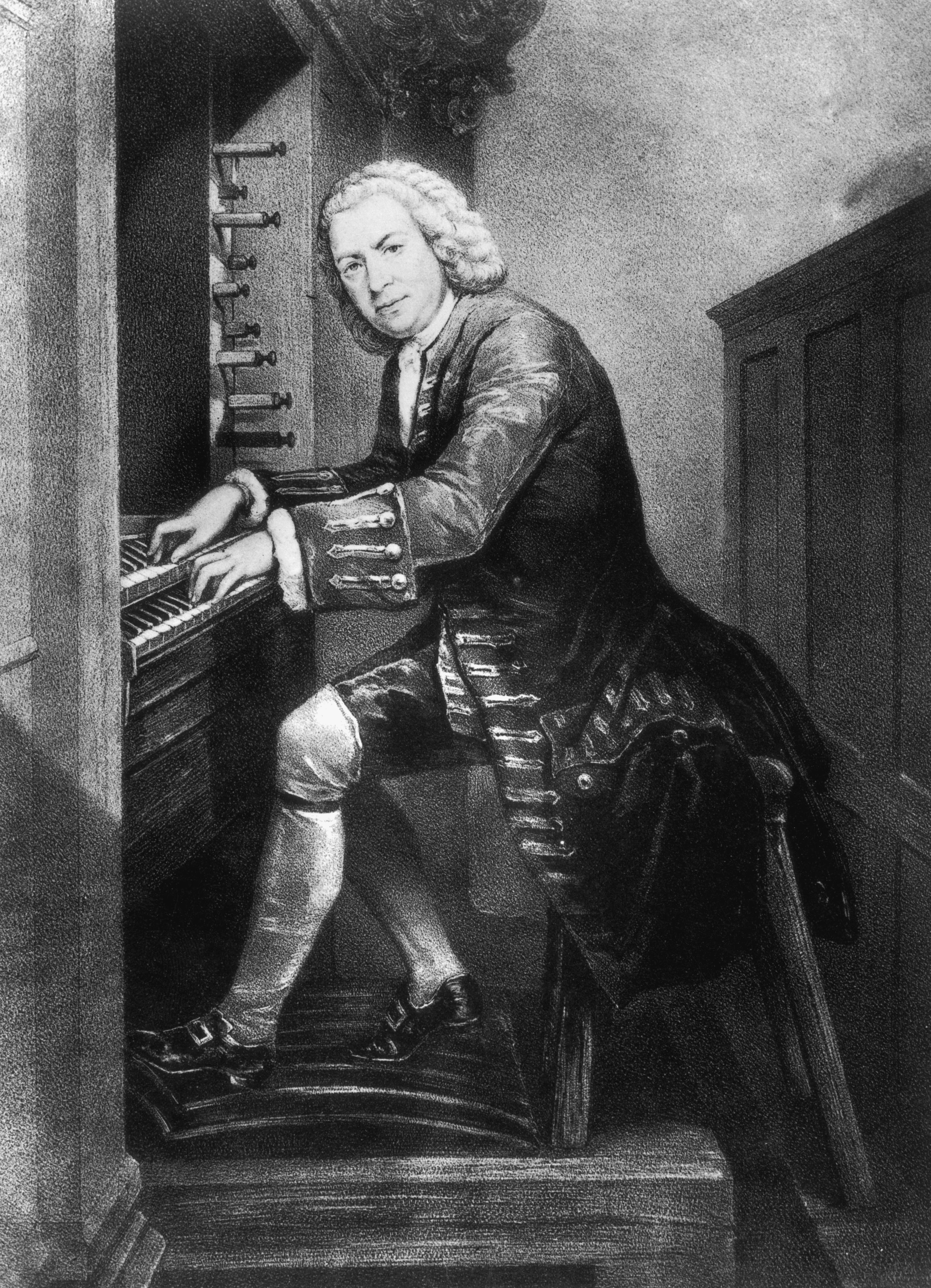
Bach: Mass in B Minor

So there we were: Two Orthodox Christians, sitting in a Presbyterian church, listening to an Episcopalian choir performing the music of a Lutheran.

Two Saturdays ago, Kathryn and I saw the Oakland Choral Society (which is not an Episcopal choir, per se, but is populated by some of our Episcopalian friends) perform Bach's Mass in B Minor at Grosse Pointe Memorial Church, which is a lovely pseudo-Gothic behemoth next to the War Memorial. (if you were at our wedding reception you now where it is.) It was a beautiful performance of one of my very favorite choral works by my hands-down favorite composer of sacred music. Bach's Mass in B Minor was cobbled together using leftover bits from other discarded works, but, even so, it is so powerful and beautiful that I'm nearly brought to tears every time I hear it.

But for all the many hundreds of times that I have listened to this piece, it never really occured to me to pay much attention to the words. This performance was the first time I had heard it since becoming Orthodox, and as I followed along with the performance I was struck by how closely the words of the Latin Mass match those of portions of the Orthodox liturgical services. In some places it's nearly verbatim.

The words of Bach's Mass are the standard words used in every choral Mass and are, with the exception of the first three lines, in Latin. A choral Mass is typically divided into six sections: Kyrie, Gloria, Credo, Sanctus, Benedictus, and Angus Dei. Sometimes those are divided further. Here are the sections:

I. Kyrie
Kyrie eleison; Christe eleison; Kyrie eleison
(Lord have mercy; Christ, have mercy; Lord, have mercy)

This is the only portion of the Latin Mass that is not in Latin. Rather, it is in Greek, and I have done some research to find out why that is and no one seems to know. But it is a very familiar phrase to anyone who has been to an Orthodox Divine Liturgy, where we say "Lord, Have Mercy" about fifty times throughout the service.

II. Gloria
Gloria in excelsis Deo et in terra pax hominibus bonæ voluntatis. Laudamus te, benedicimus te, adoramus te, glorificamus te, gratias agimus tibi propter magnam gloriam tuam, Domine Deus, Rex cœlestis, Deus Pater omnipotens.Domine Fili unigenite, Jesu Christe, Domine Deus, Agnus Dei, Filius Patris, qui tollis peccata mundi, miserere nobis; qui tollis peccata mundi, suscipe deprecationem nostram. Qui sedes ad dexteram Patris, miserere nobis. Quoniam tu solus Sanctus, tu solus Dominus, tu solus Altissimus, Iesu Christe, cum Sancto Spiritu in gloria Dei Patris. Amen.

(Glory to God in the highest, and on earth peace to men of good will. We praise You, we bless You, we adore You, we glorify You, we give thanks to You for Your great glory, Lord God, heavenly King, almighty God the Father. Lord Jesus Christ, only begotten Son, Lord God, Lamb of God, Son of the Father, who taketh away the sins of the world, Have mercy on us; You who take away the sins of the world, hear our prayers. Who sits at the right hand of the Father, have mercy upon us. For You are the only Holy One, the only Lord, the only Most High, Jesus Christ, with the Holy Spirit in the glory of God the Father, Amen.)

This section matches almost word-for-word The Great Doxology (from Matins):
Glory to God in the highest, and on earth peace, good will among men. We praise Thee, we bless Thee, we worship Thee, we glorify Thee, we give thanks to Thee for Thy great glory. O Lord, heavenly King, God the Father Almighty; O Lord, the only-begotten Son, Jesus Christ; and O Holy Spirit. O Lord God, Lamb of God, Son of the Father, that takest away the sin of the world; have mercy on us; Thou that takest away the sins of the world, receive our prayer; Thou that sittest at the right hand of the Father, have mercy on us. For Thou only art holy; Thou only art the Lord, O Jesus Christ, to the glory of God the Father. Amen.

III. Credo
Credo in unum Deum, Patrem omnipotentem... (I believe in one God, the Father Almighty...)

This is the Creed (a.k.a., the Nicene Creed, a.k.a., the Niceno-Constantinopolitan Creed) and I won't include the entire thing here. The version used in the Latin Mass is the same one used in all Western (i.e. Roman Catholic and Protestant) churches and matches that used in the East (Orthodox--both Eastern and Oriental--and Byzantine Catholic) except for two elements:

Where the original Creed says "And in one Lord Jesus Christ, the Son of God, the only-begotten, begotten of the Father before all ages, Light of Light, true God of true God...," the Latin version adds "God from God" right before "Light of Light.": "Deum de Deo, lumen de lúmine, Deum verum de Deo vero..."

The other addition is that of the Filioque, which the Latin text adds to the line "And in the Holy Ghost, the Lord and Giver of life, who proceedeth from the Father..." so that it reads "Et in Spíritum Sanctum, Dóminum et vivificántem: Qui ex Patre Filióque procédit."

IV. Sanctus
Sanctus, Sanctus, Sanctus, Dominus Deus Sabaoth; pleni sunt coeli et terra gloria tua. Hosanna in excelsis

(Holy, Holy, Holy, Lord God of Hosts; Heaven and earth are full of Your glory. Hosanna in the highest.)

This section matches the Anaphora from the Divine Liturgy, which is directly following the Creed:
Holy, Holy, Holy, Lord of Sabaoth; heaven and earth are full of Thy glory. Hosanna in the highest!

V. Benedictus
Benedictus qui venit in nomine Domini. Hosanna in excelsis

(Blessed is He who comes in the name of the Lord. Hosanna in the highest.)

This is simply a continuation of the Anaphora:
Blessed is He that cometh in the name of the Lord. Hosanna in the highest!

VI. Agnus Dei
Agnus Dei, qui tollis peccata mundi, miserere nobis.
Agnus Dei, qui tollis peccata mundi, dona nobis pacem.

(Lamb of God, who takes away the sins of the world, have mercy upon us.
Lamb of God, who takes away the sins of the world, have mercy upon us.
Lamb of God, who takes away the sins of the world, grant us peace.)

This isn't an exact match, but it's pretty close to a repeat of the Great Doxology from Matins:
Lamb of God, Son of the Father, that takest away the sin of the world; have mercy on us;
Thou that takest away the sins of the world, receive our prayer; Thou that sittest at the right hand of the Father, have mercy on us.

Much of this is simply quoting the Bible, so it shouldn't be too surprising that the services match so closely. Here is the final part of Bach's Mass, called Dona Nobis Pacem (Grant Us Peace), for your listening pleasure. Enjoy.

20100503

Making God Seen

The following is from the Protestant Daily Devotions radio ministry:

Cults of personality expand the masks of celebrities into distortions of false perfection. We create demigods from the clay of human beings, and project upon them our own desires of virtue or corruption, imagining them to be impossibly perfect saints or sinners. One can never be wholly either. When the object of a personality cult wields power - political, ideological, or theological - through words, office, or action, then dangers of distortion appear. This is evident when our need for stability crosses paths with a preacher or politician's charisma, projecting to them holiness or perfection that belongs to only God.

We could take a cue from Orthodoxy, whose priests stand with their backs to their congregation, leading a liturgy that is neither clever nor impassioned, but simply beautiful, like stone smoothed by centuries of rhythmic tides. It's an austere ritual, in the sense of - there's nothing new here; it's sublime, in the sense of - creating a clearer view into Heaven. The priest can be any priest. Who he is, what he looks like, how he speaks, and what he thinks matter little. He hasn't written the service that he officiates. It isn't about him or his prowess. He's an interchangeable functionary draped in brocaded robes, obscured by incense, and, as such, never points to himself, a flawed human, pointing ever and only to the Perfection of the Mysterious Divine. That is the role of every priest or preacher - invisibility, while making God seen.

20100428

"Pascha...is the equivalent of prayer with fireworks."

Fr. Meletios Webber

listen here

20100426

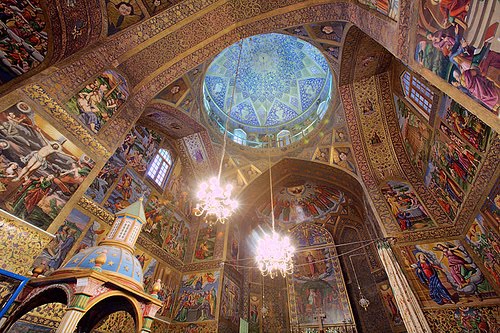
Vank Cathedral

While we're on the topic of Armenians...
I was conducting research for one of my classes this week when I came across something very interesting. In the early seventeenth century, during the reign of Shah Abbas I of the Persian Safavid dynasty, a number of Armenian Christians settled in his capital city of Isfahan. There they built a church, which they completed in 1664. When I saw pictures of it, my jaw nearly hit the floor.

Before we get to the pics, let me just say that I am all for the construction of church buildings in a style consistent with the local culture. By that I do not mean local "pop culture." I mean architecture according to the established norms. I think that can be done without sacrificing important ancient liturgical elements or forsaking whatever it is that allows a proper expression of worship. Building in a style consistent with local heritage speaks to the populace in an architecural language they can understand. It makes that church a part of the enduring cultural legacy of the place, rather than just a visitor from the outside. I think, in other words, that it makes more sense to build a church in China that looks like this, rather than like this. But that's just me.

(Wanna see how this works here at home? Compare the Roman Catholic Baltimore Basilica--built in a neoclassical style that was consistent with a popular architectural style of the period in which it was built, but is enduring and relevant [sorry!] today--with the Cathedral of Our Lady of Angels in Los Angeles, which is...just...awful).

Whoever built Vank Cathedral in Isfahan certainly had an eye for Persian architecture and design. My guess is that they hired local artisans and builders, who applied the styles with which they were familiar.
As you look at these pictures, keep in mind that this is not a mosque, it is a Christian church.
(Click on the pictures for a better view)


20100424

Եղեռնի զոհերի հիշատակի օր (Genocide Remembrance Day)

Today Armenians around the world remember the slaughter of 1.5 million of their ancestors by the Ottoman Turks during the first World War.

The Genocide (Հայոց Ցեղասպանություն in Armenian) included forced marches, starvation, serial rape and other atrocities and was an effort by Muslim Turks to remove the Christian Armenian people from existence.

President Obama had made a campaign promise to identify the massacre as a "genocide" but later reneged on this pledge. He had criticized President Bush for failing to recognize the genocide as such, but, on last year's Armenian Remembrance Day 2009, he softened his language, calling it a "calamity" ("Meds Yeghern" in Armenian). The President has received criticism and condemnation for his backtracking, and some have even called for him to give up his Nobel Peace Prize until he makes good on his campaign promise to recognize the "calamity" as a genocide.

Turkey is an ally of the U.S. and recognizing the genocide as such might put that relationship in jeopardy. Armenian-Turkish relations have also improved in recent years, and the fear is that calling the mass killings a "genocide" might strain that relationship as well.

However, 43 states have officially recognized the Armenian Genocide, and in March 2009, a bill was introduced to the House of Representatives by Congressman Adam Schiff, whose congressional district, California 29th, happens to include the city of Glendale, which has the highest concentration of Armenians in the United States. Congressman Schiff's bill, H.R. 252, states that "The Armenian Genocide was conceived and carried out by the Ottoman Empire from 1915 to 1923, resulting in the deportation of nearly 2,000,000 Armenians, of whom 1,500,000 men, women, and children were killed, 500,000 survivors were expelled from their homes, and which succeeded in the elimination of the over 2,500-year presence of Armenians in their historic homeland." It compares the Armenian genocide to the Holocaust, calls for a reduction of aid to Turkey by $3 million "until the Turkish Government acknowledged the Armenian Genocide," and demands that the President "accurately characterize the systematic and deliberate annihilation of 1,500,000 Armenians as genocide."


Learn more:
t h e f o r g o t t e n
Armenian National Institute
Fact Sheet: Armenian Genocide
Armenian Genocide 1915 Recognition Struggle
Armenian Genocide (Armeniapedia)

Take action:
Armenian National Committee of America
Follow H.R. 252 here

20100423

Liturgy at Holy Virgin Cathedral, San Francisco

Stolen Bells Recovered

From projo.com

Cumberland church bells recovered from scrap yards

CUMBERLAND — All six bells — Stephan, Sophia, Vera, Nadezhda, Lubov and Gabriel — that were stolen from the Dormition of the Virgin Mary Orthodox Church last week have been recovered. But only four of them could ring again in the small bell house in front of the church.

“Well, we miss the bells,” the Rev. Vasily Lickwar, pastor of the Orthodox parish on Manville Hill Road, said at a police news conference Thursday. “They are an integral part of our worship.”

The bell Stephan, named for Saint Stephan the first martyr, the largest at hundreds of pounds, is now in three pieces, and Father Lickwar said that bell and the second-smallest of the bells, Lubov, named for a second-century martyr, now shorn of its top, won’t join the others.

The police say James M. Haselton, 32, of Lincoln, was attempting to sell the bells at scrap yards in Woonsocket and Lincoln. The police said another arrest is possible.

Read the rest here.

20100422

Easter in Syria

I knew that Middle Easterners just love to celebrate by firing their guns into the air, but for some reason I assumed it was just the Muslims that did that. I guess I was wrong.

(You know you've been to too many military firing ranges when you watch this and think "gosh, that's going to leave a lot of shell casings for someone to pick up.")

Funeral of Archbishop Miron

Click to enlarge